• 240 Central Park South on 59th Street
    212/582.5100
    $256 for two people, with drinks, without tip
    wheelchair patron may dine on street level
    ♥ ♥ ♥

    I’m still thinking of those firm, yet pillowy, cicatelli. After Convivio and Mailiano, I think I’m convinced that when it comes to putting my money down for a great meal in New York City, handmade pasta has got to be a part of it.

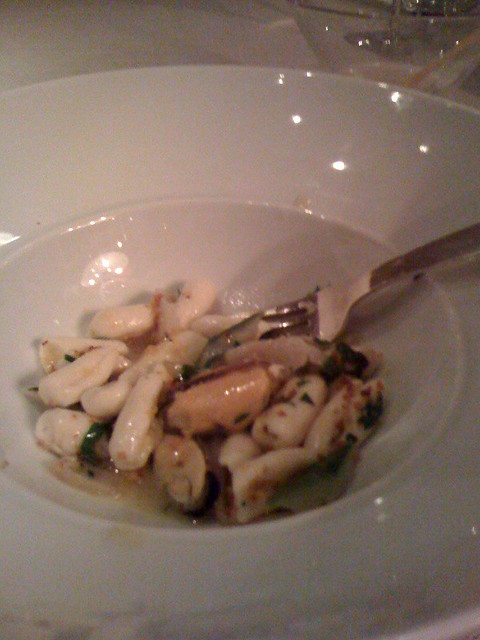
    The cocoon-shaped cicatelli sat on a very clean but rich seafood broth. Delicate mussels mimicked the pasta’s shape and provided the dish with the saltiness it needed. The summer squash pieces, also sliced so none of them were bigger than the pasta or the mussels, were tender. I’ve never been to Italy, but if this is the kind of dish locals eat along the coast, I might just pack up my shit and move there. If this is Chef Michael White’s creation alone, then I might just invite him to move in with me.

    Decadence was the theme from the minute we sat down to eat. We started with Marea’s famous uni topped with a cellophane of melted lardo. If I have to pick a dish that would give me a happy heart attack, I think I found what would easily beat roasted pork belly. This is probably one of the reasons why Marea has just been named Best New Restaurant of 2010 by the James Beard Foundation.

    We took it down a notch by breaking the richness with marinated sardines and then crudo tastings of snapper, geoduck, cuttlefish (sliced like tagliatelle), tuna, mackerel and fluke. The citrus and chili oil in all of them subtly cleaned our palates. They exhibited a different kind of decadence: controlled and unassuming.

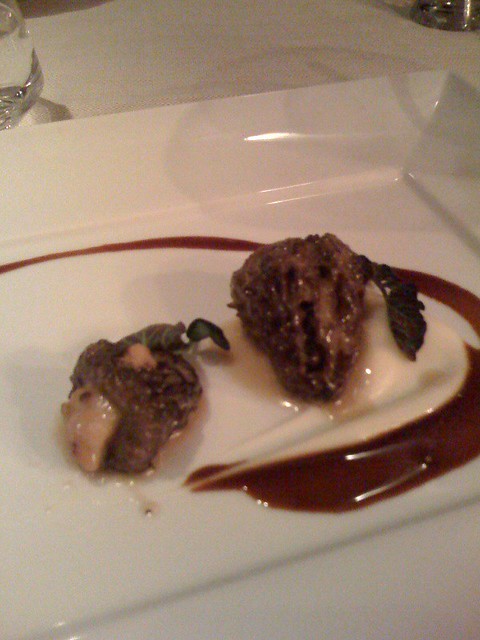
    A plate of morel mushrooms were next. Behold these mushrooms that cost an arm and a leg! I’ve never had them served to me whole, so I carefully sliced them to savor their earthy flavor in every bite.

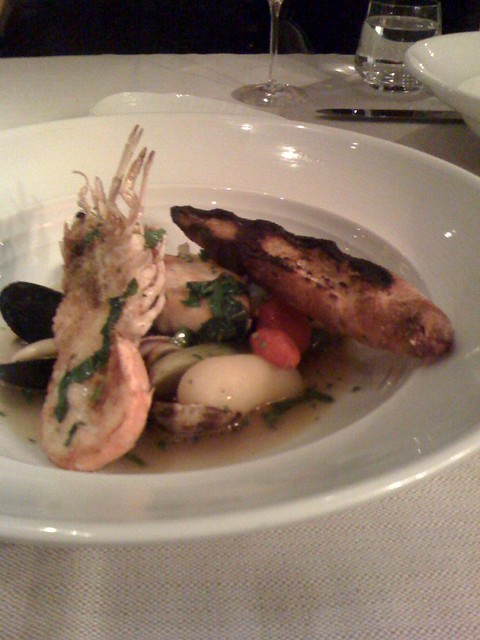
    To cap our meal, we also split the bouillabaisse. There was nothing that could have stopped me from sucking on that butterflied and seared langostine. There was also nothing that could have stopped me from slurping the seafood broth with that large soup spoon and then tilting the bowl to its side to scoop more. Even if Marea is about decadence of the sea, I think this bowl of simplicity says a lot about what seafood can become when sourced from the freshest and the best, and then handled by a pro.

    We finished our martinis and old-fashioneds plus our glasses of white wine. I informed the waiter that the panna cotta with rhubarb compote sounded like the perfect ending to our inspiring meal but that there was just no room in our tummies for it. A small plate of petit fours were served while we contently sighed, and to our surprise, our waiter brought us the panna cotta anyway. Eh, there was an extra serving in the kitchen, he said with a smile. I forgot about not having that extra room: you don’t say no when you get something complementary from Michael White’s kitchen; you don’t say no when you get the chance to eat at Marea.

    Related post/s:
    Convivio is a sister restaurant

  • Ever since I started working in Connecticut, I’ve missed Asian food. I spend my weekends back in the city eating what I can’t get at work during the day: banh mi, bulgogi, Sichuan-anything, pho, congee, rice and noodles. I’m usually tired of the commute when I get home, but I use the little energy I have left to make myself an easy meal with every bit of Asian-ness I can muster.

    You may use any long pasta for this recipe. I used spaghetti because it’s all I had the night I wanted to make this. If you have soba noodles, even better. And don’t feel like you have to use the vegetables I have here. This is a good dish to make to experiment with the spring vegetables you’re seeing out in the markets right now. If you like some crunch, toast the sesame seeds before sprinkling or shower the dish with crushed cashews.

    Ingredients:
    1 package of spaghetti
    1 packaged of extra firm tofu, sliced in manageable squares
    1 small Kirby cucumber, sliced
    a handful of baby carrots, chopped
    a handful of baby corn, halved
    a handful of sugar snap peas, destringed
    sesame oil
    3 cloves of garlic, minced
    1 spring onion, chopped
    sesame seeds
    salt

    1. Cook the spaghetti al dente in a pot of boiling water. Drain and set aside until ready to use.
    2. In a large skillet, heat some sesame oil. Sauté garlic until light brown. Add spring onion and cook until soft. Add all the vegetables and cook by tossing. The pan should be hot enough to cook the carrots and the corn.
    3. When carrots are half-cooked, add the spaghetti. Toss to combine well. Add more sesame oil so that it doesn’t dry up. Add the tofu and gently combine. It’s okay if your tofu gets crushed a little. Sprinkle with salt to taste and some sesame seeds before serving.

    Related post/s:
    There’s a close Filipino version of sesame noodles
    Sesame noodles brings me back to Montauk

  • I saw this original recipe in the New York Times last week. I was reading it and thinking, Oh, I have asparagus, and oh, I have shiitake–here’s dinner for tonight. But I didn’t have prosciutto. I did have some more Mangalitsa Pig bacon in the fridge, so I substituted a more expensive fat for an already expensive fat.

    I was very pleased with this recipe. It didn’t require much prep and the cooking was basically hands-off. Double the couscous and you’ll have enough for lunch the next day.

    Ingredients:
    1 bundle asparagus, tougher ends trimmed, chopped in 1-inch pieces
    a handful of dried shiitake mushrooms, soaked in water for 10 minutes, drained, then chopped
    4 slices of bacon, chopped
    1 cup of couscous
    1 cup of chicken broth
    oil, salt, pepper

    1. Heat oven to 200º. Line a baking sheet with parchment paper twice as long as the sheet. Lay asparagus in a pile in center. Scatter mushrooms and prosciutto on top. Drizzle with some olive oil and season with salt and pepper. Toss vegetables to coat evenly.
    2. Fold parchment to completely enclose vegetables, and fold top and sides shut. Transfer pan to oven and bake for one hour.
    3. In the meantime, put a small pot over medium-high heat, and bring the broth to a boil. Stir in couscous and remove pot from heat. Let stand for 5 minutes and then fluff couscous with a fork.
    4. To serve, divide couscous in serving bowls and top with a scoop or two of the baked asparagus with some mushrooms and bacon.

    Related post/s:
    Baked vegetables including asparagus with eggs

  • After my bike ride with Jase and Kate around Central Park, they came over my apartment to eat brunch. I had roasted some beets the night before to prepare this salad because I wanted something very spring-like without having to do any cooking the next day. There were all kinds of citrus in the supermarket the night before, too, so I also bought a few of them to add. Feta cheese may sound weird here because goat cheese is the usual beet partner, but I think the saltiness of the feta worked well with the tanginess of the orange and the subtle bitterness of the grapefruit. I threw in some frisée to add a nice green touch to the yellows and oranges.

    Ingredients:
    6 large beets, washed and trimmed
    juice from 1 orange
    2 oranges, rind removed, sliced
    1 grapefruit, rind removed, sliced
    half a head of frisée, torn to smaller pieces
    1/3 cup of crumbled feta cheese
    1 small shallot, finely chopped
    oil, salt, pepper

    1. Preheat the oven to 400º. Wrap the beets in aluminum foil and place on a roasting pan and roast for about 1 hour or until tender. When cool, peel and cut them into chunks.
    2. Make the dressing. In a small bowl, whisk the orange juice with the shallot. Marinate the shallot in the orange juice for 10 minutes, then whisk in the olive oil and season with salt and pepper. Toss the beets in the dressing and let sit until ready to use.
    3. On each of your salad plates, put a handful of frisée, and then top with a few slices of oranges and grapefruit. Remove the beets and the shallots from the marinate with a slotted spoon and divide among the plates. Drizzle with the beet dressing. Toss and sprinkle with feta.

    Related post/s:
    Try some beets with watercress
    I also love golden beets with the bite of fennel

  • While walking in the Andersonville neighborhood of Chicago, Anna and I stopped by a store that was lacking in spirit but selling every spice imaginable from Africa, Central Asia and the Mediterranean. My pantry is stocked up with spices I smuggled from our Tunisian trip, so I was in no hurry to buy curries or harissas. Everything was less expensive than Penzeys however, so I kept it in mind for the next time I would need something exotic for my kitchen. It was only on our way out when I noticed the lavash for sale–at less than $1.50 for about three sheets.

    Lavash, or flatbread, is a soft, thin bread reportedly of Armenian origin. I was intrigued by flatbreads because they showed up on every Chicago menu I perused. Having lunch by myself one day at Sepia, I ordered the flatbread of the day which was topped with sous-vide onions. If you don’t make it by hand, flatbreads are so easy to bake with almost anything you have in the fridge. Thinner than pizza and thus cook faster, flatbreads are great for quick lunches and make an awesome addition to brunch.

    For this version, I finished the two cheeses I had in the fridge by combining them after grating. I had a lot of fresh vegetables available, but was partial to the spicy arugula for the bite. One time, I made this recipe and topped it with slices of kielbasa and Mangalitsa bacon; another, just with shiitake mushrooms and spinach. Feel free to play around with Taleggio cheese and caramelized onions, too. The fun part is coming up with your own combination.

    Ingredients:
    flatbread
    arugula
    kielbasa, sliced (optional)
    1/2 cup Parmigiano-Reggiano, grated
    1/2 cup Manchego, grated
    1 small red onion, thinly sliced
    red pepper flakes
    oil, salt

    1. Preheat oven at 350º. In the meantime, lay the flatbread flat on a lined baking sheet. Brush with some olive oil. Spread the arugula on one half of the flatbread. Sprinkle with red pepper and a dash of salt. Top that half with the cheeses. Fold over flatbread.
    2. Brush the other side with olive oil. Top with kielbasa, or the toppings of your choice, and then with red onions. If you have leftover arugula, finish off with them.
    3. Bake for 3 to 5 minutes, or until you see the edges coloring a bit. Remove from oven and let stand. Transfer to a chopping block and slice to serve.

    Related post/s:
    You can make your own pizzetta at home, too
    I guess onions and flatbreads go well together

  • After a harrowing ten-hour trip from Chicago, the Dr. was craving kalbi-tang, or Korean short beef rib soup, the next day. We had stopped by Joong Boo Market on Belmont Avenue before we continued to the airport and among our purchase was a package of fresh perilla leaves. I thought of gamja-tang, pork rib soup, because it’s what I always order when I’m in Hanbat in Koreatown. I ended up buying short beef ribs and beef neck bones and then using a pork-rib recipe. I think combining the two soups in this one recipe was a pretty good compromise even though Maangchi may slap my hand if she ever reads this.

    If we knew we were to spend all afternoon and all night trying to fly back to New York City–our flight was cancelled without any notification and all 180 passengers were vying for the next three flights to La Guardia–we would have bought the soups from the market’s deli and enjoyed them at the airport.

    Finally home and caught up on sleep the next night, I searched for online recipes for both soups. All of them require boiling the bones and then rinsing them before boiling again. This step removes all the impurities and the fat from the boiled bones, but it’s sacrilege if you’re Filipino because it’s the fat that makes my people’s soups whole. Sometimes though, I do what I’m told even if the order comes from an older Korean lady. To keep my stubborn streak however, I skipped an extra rinsing step so at least some of the fat is preserved in the broth.

    Needless to say, I scared the crap out of the Dr. who was impressed with how the soup turned out: he had two full large bowls for dinner while the negative aspect of our Chicago trip dissolved in pieces.

    Ingredients:
    5 short beef ribs, rinsed
    4 beef neck bones, rinsed
    5 perilla leaves, chopped in 1-inch pieces
    1 napa cabbage, sliced into 4 pieces
    2 potatoes, peeled, sliced
    1 bunch of scallions, chopped
    4 pieces dried shiitake mushrooms
    1 large knob of ginger, peeled, chopped
    1 yellow onion, quartered
    2 tbsps soy bean paste

    Sauce:
    5 perilla leaves, chiffonade
    6 cloves of garlic, minced
    a dash of hot pepper flakes
    2 tbsps hot pepper paste
    4 tbsps cooking wine
    3 tbsps fish sauce

    1. In a large Dutch oven, boil some water. Add the beef ribs and neck bones. Lower the heat and let impurities rise to the top. Using a strainer, remove the impurities and discard. Simmer beef for a total of an hour before rinsing them out with cold water.
    2. In the same washed Dutch oven, return the beef with some more water. Add ginger, onion, soy bean paste and mushrooms. Simmer for another hour.
    3. In the meantime, in a separate pot, boil some water and blanch the cabbage for a minute. Remove from the pot, squeeze out the water and set aside.
    4. Make the sauce as well while you’re boiling the beef. Combine all sauce ingredients and mix thoroughly. Set aside until needed.
    5. When the beef is done, remove the mushrooms and let cool. Slice them and return to the pot with the rest of the vegetables. Cook for another 30 minutes in low-medium fire to make sure most of the meat is falling off the bones and the potatoes are cooked.

    Related post/s:
    What do you mean you don’t know who Maangchi is?
    I made kalbitang before, but not as involved
    I served this with my very own kimchi

  • My first real night of cooking in my apartment called for one of my favorite meats: lamb. “Real” as in I’m-home-alone-for-the-first-time-in-a-long-time and I-don’t-mind-any-minute-of-it kind of real. I stopped by the halal meat market in my neighborhood where I patiently waited for the lady to slice off the loin from the whole lamb into manageable chunks. I keep coming back to this store because the lamb is crazy cheap; I just have to deal with their Island Time and re-explain how I like the ribs with the long handle bones intact and accept the fact that when I ask for ground lamb, the response will always be: I don’t have time to ground meat right now, even though I’m the only one in the store. (I have since bought my own food grinder attachment for my KitchenAid mixer.)

    Look at that lamb though! They would easily cost more than $25 at Whole Foods but that lot cost me $12 here in Harlem. I don’t know enough about halal meat and still don’t know why it smells differently than, say, gourmet lamb meat from New Zealand, but they make a good meal every time.

    Ingredients:
    2 1/2 pounds lamb loin, cut into 1 1/2-inch pieces
    1 32-ounce container low-sodium chicken broth
    1 10-ounce box couscous
    1 medium yellow onion, sliced
    half a bag of baby carrots
    1 clove garlic, finely chopped
    1 tbsp grated fresh ginger
    zest of 1/2 lemon, grated
    a handful of cilantro leaves, roughly chopped
    a handful of parsley leaves, roughly chopped
    3/4 cup kalamata olives, pitted and halved
    2 tsps paprika
    1/4 tsp ground turmeric
    1/2 tsp ground cumin
    1/4 tsp cayenne pepper
    1 tsp ground cinnamon
    salt, oil

    1. In a large resealable plastic bag, combine the paprika, turmeric, cumin, cayenne, cinnamon, salt, and 2 tbsps of olive oil. Add the lamb, seal, and shake to coat. Refrigerate for at least 1 hour and up to 12 hours.
    2. Heat the remaining oil in a large Dutch oven over medium heat. Add the onion and carrots and cook for 15 minutes. Transfer to a plate.
    3. Add some of the lamb to the pot and brown on all sides. Transfer to a plate. Repeat with the remaining lamb. Return the lamb to the pot along with the onion and carrots. Add the garlic, ginger, and zest and stir.
    4. Add the broth and bring to a boil. Stir in the couscous. Remove from heat, cover, and set aside for 10 minutes. Stir in the cilantro, parsley, and olives.

    Related post/s:
    Try this meatball tagine dish when it’s a little cooler outside
    I’ve come a long way in cooking tagine, don’t you think?
    Still one of my favorite countries: Tunisia

  • I knew bouillabaisse had to be the first meal I make for the Dr. in my new apartment as soon as I saw Amanda Hesser’s recap in the New York Times Magazine. But because he’s been cooking the first few days of my unpacking, I wanted to make it up to him and make an impressive version.

    After work one day, I took the train from Connecticut all the way down to Grand Central Terminal where I stopped by Pescatore and splurged on fresh seafood. When I say splurged, I really mean splurged: a quarter pound of wild shrimp cost $12, two cod fillets were $13, a chunk of halibut was $16 and two more chunks of grouper were $14. I also walked by Penzeys and spent another $16 on a few strands of saffron. I have an educated guess that they were really stringed by some ladies in Spain where as the $3 jar I buy in Harlem isn’t really saffron, but safflower. A stop at Zaro’s got me my least expensive purchase of the early evening yet: $3 load of country bread.

    Back at home, I was pretty impressed at what I unpacked. The cuts of fish were absolutely beautiful. I don’t spend as much money when I cook fish at home; I usually just buy a live swimming fish from Chinatown or a whole red snapper or branzino from Fairway or Whole Foods and I just broil them without any fuss. You may think it’s a waste to cook such good fish, but I actually tried this same recipe using frozen fish from Trader Joe’s and I must tell you that it really wasn’t the same. The frozen version was bland and the fish didn’t feel supple in my mouth. In fact, I had to season more to give the Trader Joe’s bouillabaisse some kind of taste. While the seafood broth carried the frozen version, I needed only a splash to bring out the natural flavors of the fresh seafood for the Pescatore version.

    Now that I’ve had Pescatore seafood, I think I’ll be making more seafood dishes more often, even if it means an ache in my wallet once in a while.

    Ingredients:
    1 chunk of halibut fillet
    2 fillets of cod
    1 chunk of grouper fillet
    1/4-pound of shrimp, peeled, deveined
    2 medium tomatoes, halved
    1 cup of seafood broth
    1/2 cup of white wine
    1 small onion, thinly sliced
    half a bag of baby carrots
    2 pinches saffron
    1 bay leaf
    4 sprigs parsley, finely chopped
    2 cloves garlic, minced
    juice of 1/2 lemon
    olive oil, salt, pepper
    slices of country bread, toasted

    1. In a large Dutch oven, heat the oil over medium-high heat. Add the tomatoes, onion, carrot, saffron, bay leaf and half of the parsley. Sauté for a couple of minutes and then add the garlic to brown.
    2. Add the fish, shrimp and lemon juice, season with salt and pepper and toss for 10 minutes. Add the broth and wine, bring to a rapid simmer and cook until the fish is just cooked through, less than 10 minutes. Adjust the seasoning, adding more saffron, lemon juice, salt and pepper as desired. Sprinkle with remaining parsley. Set a slice of toast in the bottom of a bowl and ladle in soup.

    Related post/s:
    Bring your wallet and buy some good fish from Pescatore at the Grand Central Terminal Market
    For a little bit of summer, try Kona Kampachi with coconut and apples

  • I didn’t know that the apartment I bought came with a Korean cook. I can’t even begin to explain how it feels like to come home–your own home–from work with dinner ready at the table.

    Uh-oh, I’m nesting!

    I came home one night and the Dr. was already working in the kitchen. The beets were already roasted and out of the oven and the pasta was in the pot. When I saw him clean off the grit from the beet greens, I knew the roasted beets were for later. I’ve seen him do this before and it’s from him I learned not to waste food parts that most people throw away. I was excited for the next day’s lunch of beets, but I was even more hungry for the pasta with beet greens for dinner.

    I’m not complaining. Best apartment ever!

    Ingredients:
    beet greens with stems from 2 bunches of beets, thoroughly washed, chopped in half
    1 box of whole wheat spaghetti
    a handful of golden raisins
    1/2 cup pitted brine-cured black olives, coarsely chopped
    1/3 cup pine nuts
    1 medium red onion, thinly sliced
    3 cloves of garlic, minced
    3 tbsps balsamic vinegar
    goat cheese
    salt, oil

    1. In a pot, boil some water and cook the pasta until al dente. You’re going to need some of that pasta water in steps 3 and 4. Drain and set aside.
    2. Heat some oil in a skillet over medium heat. Add pine nuts and toast, stirring, until golden, about 2 minutes. Transfer to a plate with a slotted spoon.
    3. Add garlic to remaining oil and cook until golden. Add onions until soft. Add balsamic vinegar and stir until most of it has evaporated, about 2 minutes. Add beet stems, some pasta water, and a dash of salt. Cover and cook for about 10 minutes or until stems are tender.
    4. Add raisins, then beet greens, while stirring with tongs until leaves are wilted. Do in small handfuls if you have a small skillet. Add a splash of pasta water and cover to cook the greens, about 2 minutes. Add olives, then the cooked pasta, just until liquid has thickened slightly. Sprinkle with pine nuts and add a dollop of goat cheese before serving.

    Related post/s:
    Don’t waste your carrot tops either

  • I’ve been M.I.A. for the last seven and a half weeks so it’s great to be writing again. I’m now moved in to my new apartment–all boxes have been unpacked and the contents reorganized. I’m extra proud of my kitchen because I’ve made it my own even though I had to work with a lot of limitations (co-op rules and, not to mention, my dwindled budget). After sixteen years in New York City, I’m glad to finally call something my own.

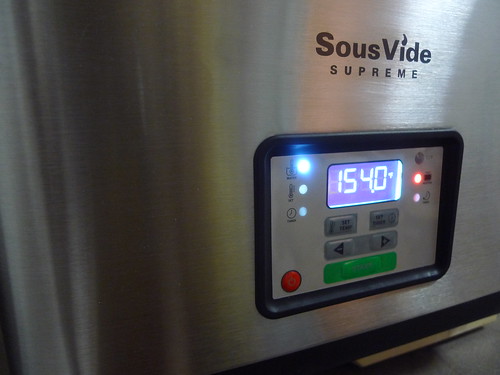
    When the SousVide Supreme was delivered to my door, I was afraid to open up yet another box of something. It sat in the kitchen with all my other stuff until I was finally comfortable enough to cook amid the chaos. It was honestly the perfect machine for someone as busy and scattered as I was. All I had to do was fill it with enough water to submerge the vacuumed-sealed meat I was about to cook, set the recommended temperature and wait for it to be ready. The whole time I was “waiting”, I was finishing tasks I had to do, cleaning up around me and living my usual routine of work and sleep. The only heavy lifting involved is vacuum-sealing and setting aside the time to submerge the meat and remember to remove and eat it.

    If you watch Top Chef, you’ve seen enough sous-vide cooking in the last year. It’s French for “under vacuum” and it’s cooking vacuum-sealed anything in a water bath set to a very low temperature. The cooking time is longer, but the temperature is consistent which may give you the impression that you really can’t mess anything up. You still can, as evidence to my duck breast story below, but with enough practice, you too can impress Thomas Keller with how evenly-cooked sous-vided meats are. (There’s your new word of the year: sous-vided!) For those who love their grill marks and roast smell–and don’t we all?–you can finish cooking by searing the meats before serving. It’s an extra step but could be worth it for presentation purposes and peace of mind.

    My main concern is how much vacuum-seal bags you need to purchase when you get into this whole sous-vide craze. You’d have to buy yet another gadget for your kitchen to seal whatever you want to sous-vide, and with every piece of meat or vegetable you have to make sure that you have a bag in stock. One just has to weigh the costs of vacuum-seal bags for sous-vide against the energy spent cooking if you do it the regular way. It may be worth it if you don’t ever want to worry about correctly roasting a whole chicken ever again.

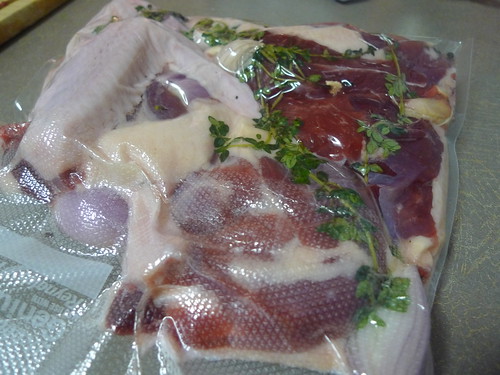
    For our first try, the Dr. picked up a whole duck (I didn’t have the free time!) and we invited two of our favorite people over for dinner. The night before, we minced and mixed all the marinade ingredients together and put them all in the bag with the duck breast and the legs. Fresh thyme, bay leaves, onions and garlic with some salt and pepper were all we need. Our mistake was putting all the duck pieces in one bag. I don’t know what came over us; we’ve cooked many ducks before and it still baffles me why we didn’t think of separating the pieces so that we could remove the duck breast from the water bath hours earlier than the legs. The legs came out nicely, like confit, but the breast was tasteless and dry because we had overcooked it. Alas, there is still such a thing as overcooking even with the SousVide Supreme.

    With the duck, we also sous-vided fennel, Brussels sprouts, parsnips and roasted beets. I don’t think we would have noticed the difference if we just roasted the vegetables like we usually do, but it certainly didn’t hurt that we added them in the mix.

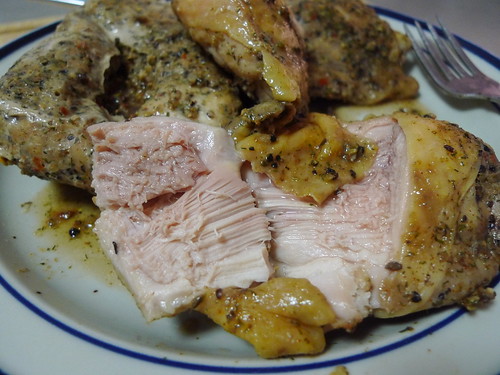
    If it ruined our duck breast, I wondered what it would do to chicken breast. I mixed some of the herbs and spices I already had in my cupboard and sous-vided four boneless chicken breasts for almost five hours. The result was very moist meat that stayed moist even after two days in the fridge. We ate the chicken as they were that night, but ate the leftovers the day after and the next and I couldn’t believe how moist they still were. Just for that, I would love to own my own SousVide Supreme so I can begin to love chicken again.

    If there is one thing I need to correct when I sous-vide chicken however, it would be to make small incisions all over the meat before I seal them in a bag. Although cooked for several hours, there was still a watery bloodbath as soon as we sliced the meat the first time. This was no big deal to me but it could turn off a lot of diners.

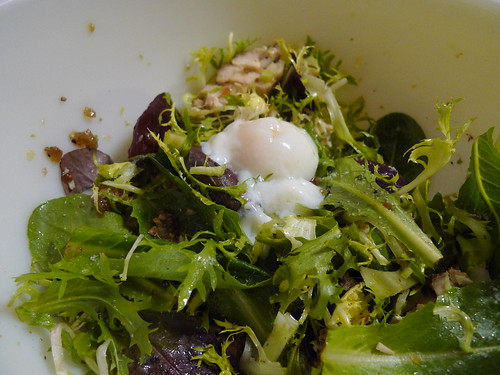
    I’ve also had sous-vide eggs before and I wanted to recreate how full and yellow the yolks were while the whites stayed delicately soft. Sure it’s easier and quicker to just soft-boil them, but with the SousVide Supreme, there is no need to worry that your soft-boiled eggs will become hard-boiled eggs. They were perfectly custardy and set beautifully against frisée and mixed greens. Is it worth spending an hour cooking eggs? Probably not, but you’d have to be a super geek about your food to appreciate how pretty soft-boiled eggs could be.

    We unfortunately didn’t have enough time to try it with beef, lamb or pork which was inexcusable because I actually already had Korean beef ribs marinating in the fridge. I had to return the SousVide Supreme back to its rightful owners. Clean-up was almost non-existent. I poured out the water and wiped the inside of the machine dry with a kitchen towel. It as fun as long as it lasted.

    Did I mention that I just moved in to a new apartment and could use a housewarming present? I have the perfect counter space for it.

    Related post/s:
    Welcome to my new home in Harlem, New York

    Recommended tool/s:
    The SousVide Supreme is available for you home cooks for under $500

  • This dish may seem like a meal for spring but if you use a hardy green like kale, then it fits any blustery winter day. I used Lacinato kale, also known as black kale, because it barely needs some cooking. Toss it with snow peas and carrots, or any other vegetable you can eat raw, and you’re good to go. I used peanut oil to cook the chicken but you can certainly substitute it with whatever oil you use to cook your meats especially if you have an allergy. The key here is to keep your sauté pan hot while you continuously toss and mix the ingredients.

    Ingredients:
    2 cups of black wild rice
    2 chicken breast fillets, cubed
    1 bunch of Lacinato kale, chiffonade
    a handful of snow peas
    a handful of baby carrots, roughly chopped
    1 small red onion, chopped
    a splash of soy sauce
    a splash of sherry vinegar
    a splash of sesame oil
    peanut oil
    salt

    1. In a large frying pan, heat some oil and cook chicken until no longer pink inside. Set aside in the pan and sauté onions until soft. Mix chicken and onions together and toss in the rest of the vegetables.
    2. In the meantime, cook black wild rice per package instructions. Boil three cups of water per cup of rice. Simmer for 45 minutes. Drain rice and fluff.
    3. Add the rice to the vegetables and keep sautéing to complete cooking the vegetables. Add a few splashes of sherry vinegar, soy sauce and sesame oil and mix well. Season with salt.

    Related post/s:
    Try this kale and bacon salad in the spring

  • I don’t know how it ended up that we both don’t have a watch. Since none of our phones were working in El Cocuy, we had to leave the TV on while we slept to help us wake up at 5:30am in order to catch the lechero at 6am.

    After a sleepless night, I woke up and checked the clock on the news channel that was on and immediately jumped off bed as soon as I saw that it was 5:45am. We hurriedly changed and packed our remaining items and tried to step out of La Posada Del Molino but the doors were all locked. We had no choice but to knock on every door to try and wake up the manager so he can let us out. He wearily stepped out of his room, checked his phone clock and grumbly told us that we were an hour early. He said we were probably watching the news from a different country. We embarrassingly and apologetically went back to our room and waited for the right time we can bother him again. One of us really needs to start wearing a watch.

    Hikers in El Cocuy hitch a ride with the lechero, or the milk truck, up to the fork on the road and decide whether to go along the Rio Lagunillas to Pulpito de Diablo or trek up north via Güicán. At exactly 6am, we were in the center of town where we informed the lechero driver that we will need to hitch a ride from him. The town was just waking up. Deliveries were being made and store owners were opening up their shops. The driver wasn’t hard to find at all. Besides the fact that his truck is the only one filled with blue vats in the back, he usually looks out for hikers to give them a ride. When the 6:30am bus pulled in from Bogotá–the same bus we were on just the previous day–he greeted the exiting passengers carrying large backpacks.

    Off we sat on the floor with the milk vats. The ride was bumpy but it was very cool to witness a slice of Colombian life like that. The driver made several stops along the way to pick up small pails of milk from local farmers. His assistant transfered them from pail to vat at each stop. At one point, a young boy joined us and took over the job. The view up the mountain was beautiful, too. We saw how green our surroundings were; the morning mist slowly moving out of the way to reveal small plots of vegetables and herbs.

    About an hour or so later, we were let off and we started our hike. I was very excited and distracted by the feeling of being in a new country again that I quickly forgot we were on high altitude. What should have taken less than two hours took us almost four because I was weakened by the shortage of oxygen. I felt like I could not lift my left leg up, and with a 30-pound pack on my back, walking was very challenging even with the help of two poles. I wasn’t dizzy per se, but my stomach definitely felt funny. The Dr. kept looking back to check up on me. He was very encouraging, but we both knew I wasn’t bringing my usual game. All those nights of swimming laps for naught. I was disappointed in myself and all I wanted was to get to camp and rest but the trail just kept going.

    We stopped at the first cabin we saw which was the other Parque Nacional Natural office. We had already registered in El Cocuy, so we didn’t need to do anything there except to catch our breaths and confirm that we were going the right way. After a few more back-breaking minutes, we passed by Cabañas Herrera. We sat and watched other hikers prepare for their next move. We realized that if we had a few more days of hiking, we would have camped here too to acclimate before continuing on to Laguna Pintada. That is really the way to do it: split a few hours worth of day hike into two to get used to the high altitude.

    I managed to look around us and take note of the river along the way. The brown trouts would swim away whenever we approached. Cows, sheep, goats and rabbits were omnipresent. The land looked healthy, but as soon as the trail turned sandy and almost volcanic, the animals and the shrubs disappeared and the frailejónes started to pepper the landscape. Resembling hooded friars, or frailes, the plants are native to Colombia and live in high altitude. Their trunks are thick and because their leaves are marcescent (when dead plant organs remain intact versus shedding), they are protected from the cold weather. It was a little eerie to be walking among so many of them, but relief was soon visible when we saw their yellow daisy-like flowers.

    Up a small hill, we asked if it was Cabaña Sisuma. After we received confirmation from the three small children running around the cabin, we climbed down the foot of the hill and began to camp. Señora Marta soon joined to welcome us. We told her about our stove problem which she solved by telling us we could come up to her kitchen and cook whenever we needed to. Camping was US$2 a day if you use the cabin’s kitchen and bathroom, but it’s otherwise free since El Cocuy is one of Colombia’s national parks. It was only 10:30am–one of Señora Marta’s kids told us–but we were already famished since we have been up since 4:30! Using our camping pots, we boiled water in the cabin’s kitchen and cooked the first cans of Korean tuna and white rice we brought with us.

    After we ate, we took a quick walk around Laguna Pintada, only to retire back to our tent and sleep for three hours. For the rest of the afternoon, we hanged out in the cabin writing in my journal or reading our books. It wasn’t any warmer in there than in our tent, but it kept us from going stir-crazy because we were at least surrounded by other people. I still don’t know how those three kids survive day to day without the distraction of a television or a phone. Other hikers came in, but most of them only stopped for a home-cooked meal and then kept going. A group of four Germans actually stayed for the night on the bunk beds upstairs.

    Unlike the cabins we stayed in in the Pyrenees, Sisuma was bare-bones. One long table was shared among the overnighters and the campers but because they paid more than we did, we basically had to wait until the kitchen was free to cook our meals. For the next two nights, we hanged out by the stairs since there were no more chairs in the dining room to sit on. Weirdly enough, Señora Marta had a washing machine but no heater. She herself slept in a small room in the other wing, while her three children slept in a tent in the living room. I liked hanging out with her in the kitchen while she prepared meals for the overnighters. We communicated just fine with my crooked Spanish, and a few times during our stay, she offered us this sweet hot drink made from a block of cane sugar.

    What sticks in my head when I think of our trip to Colombia is how the people were so hospitable and helpful. From the bus agents in El Cocuy who tried to help us book our bus ticket backs to Bogotá to Señora Marta treating us like we were paying her to keep us warm and fed, the Colombians we met were always trying to make us feel like we belonged there. So many places we’ve been where we had to explain why the likes of us were in their country, but the Colombians just spoke to us in Spanish as if we’ve been living there for as long as they have. We never felt threatened, nor was there ever a time in the mountains we felt like we were lost and without care.

    Related post/s:
    Laguna Pintada and Rio Lagunillas El Cocuy photos on Flickr
    Day 1: Getting from Bogotá to El Cocuy, Colombia