• La Tienda is my new favorite online store. When a package of cooking chorizo arrived in the mail last week, I knew I had to make a very hearty stew with it, I just didn’t know with what. At Whole Foods, I debated if I should pay $13 for two duck confit legs. The current state of the economy won out and I picked up four chicken legs instead for less than $4. I splurged on a $7 ham shank though because I didn’t want the good chorizo to be alone in the pot.

    While cooking, the entire apartment smelled really good. Sautéing the chorizo with the garlic and onions was my favorite part, right after uncovering the pot after two hours of braising time. It was delicious with rice for dinner and it will be delicious tomorrow with pasta for lunch.

    Ingredients:
    1 ham shank
    4 chicken legs
    4 pieces of cooking chorizo, chopped
    4 ribs of celery, chopped
    4 carrots, peeled, chopped
    4 small potatoes, peeled, chopped
    1 large onion, chopped
    2 cloves garlic, crushed
    4 sprigs of thyme
    oil, salt, pepper

    1. In a large Dutch oven, heat some oil and brown chicken legs on both sides. Remove them to a plate. Add a little bit more oil and brown the ham shank on all sides. Remove to the same plate.
    2. In the same pot with the rendered fat, sauté the garlic and the onions. Add the chorizo and the potatoes and cook until slightly browned. Stir in the celery and the carrots with the thyme.
    3. Add back the chicken and the shank. Add enough water to submerge the meats and let simmer. Season with salt and pepper. In the meantime, preheat the oven 350º. When the oven is ready, transfer the pot, covered, inside and braise for up to 2 hours. Carefully remove the pot from the oven and uncover. Stir and serve with rice, pasta or crusty bread.

    Related post/s:
    Buy your own chorizo and other goodies from Spain at La Tienda
    Use chorizo in a tomato paella dish
  • 243 East 14th Street between Third and Second Avenues
    212/253.7670
    $222 for four, with drinks, with tip

    Update, 2009: My Deathwatch prediction came true after only a month.

    Oy, I’m putting Mr. Jones Yakitori on a Deathwatch. I don’t know why anyone would open a yakitori restaurant a few blocks away from St. Marks Place where yakitori joints are a dime a dozen. I immediately looked around for the grill when I went in, but I only saw booths for group diners. Upon entering, you immediately realized it’s that type of place. The decor reminded me of some of the worst Thai places in the city where mod is the predominant theme and the restaurant converts into a club come the weekend. I just know that I regret paying over $200 for a mediocre dinner for four. Good thing my companions, two of whom were Japanese, had a good sense of humor.

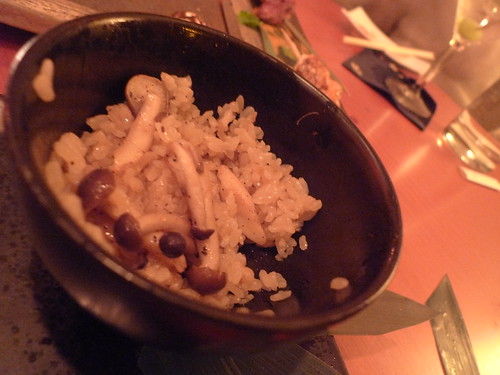
    The foie gras inside the meatballs were barely noticeable. The bowl of rice cooked in butter and truffle oil was, admittedly, an unnecessary selection but it was even more ridiculous that they charged $9 for it. The yakitori pieces that would have cost us $3 apiece elsewhere were $5, while a pair of chicken ones came in for $7. Everything added up quickly and we accumulated a pretty long list of small bites. If we brought our boys with us, they would have complained at how hungry they still were after all that expense. Heck, I wanted a slice of pizza on my way home! (If you know my relationship with pizza, you would know that that’s saying a lot.)

    The waitstaff were pretty, and though they were attentive, none of them looked like they appreciated Japanese food. I wouldn’t be asking them the difference between kobe and wagyu beef anytime soon. But then again, they might not be around even if I wanted to.

    Related post/s:
    A few blocks downtown is Village Yokocho where the wait is never as long as Yakitori Taisho
    In midtown, go to Soba Totto

  • Anna and I shared our restaurant wish list with each other a few days before I was scheduled to fly to Chicago. I had told her that I was okay with ethnic and cheap with the exception of paying a visit to the city’s West Town neighborhood to dine at Publican, which recently earned its 2009 James Beard nomination for outstanding chef and restaurant design. A chef friend, who I met at the Spotted Pig’s Fergus Henderson event last year, had texted me earlier in the week to let me know that one of the waiters he had befriended during a recent visit to Chicago had told him about Publican’s latest efforts. I knew nothing of the restaurant because their Web site still wasn’t up before I visited, but I was ready to be impressed.

    I told our waiter as much after we were seated next to the bar. It wasn’t a private table per se because the restaurant is spacious with communal tables and lofty ceilings, but being next to the kitchen kind of gave it some cachet. I requested for bar seating at the time of my reservation, but I had no idea I was actually going to be able to face my dining companions and enjoy a group conversation.

    The funny thing is that I was psyched and prepared to eat all the offal offerings as soon as I glazed over the menu, but our waiter didn’t hear half of our initial order. We knew it wasn’t neglect on his part because we practically read the entire menu out loud to him. In the end, we got the right amount of food for four and I have to say that he narrowed everything down to showcase what Publican was trying to present.

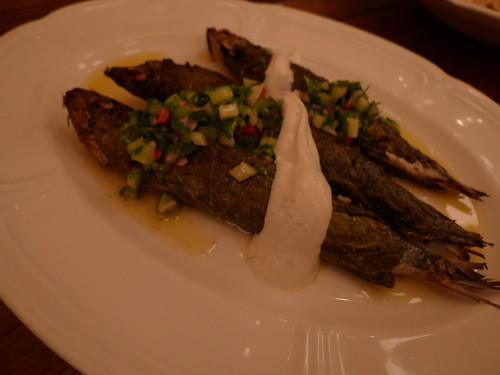
    The tied Monterey Bay sardines were bony but rewarding to pick on because of the dressing that came with it: yogurt, raisins and pine nuts. I want to be on the Mediterranean the next time I eat something like that with a plate of the same yellowtail crudo sprinkled with orange peel. We ordered the spicy pork rinds just like everyone else in the restaurant. They were airy and light with just a subtle hint of smoked paprika on them. We also shared one of the best charcuterie plates I’ve had in a while: scrapple, duck and foie gras terrine, pork pie and chorizo served with assorted pickles, capers and mustards. (Don’t get me started with wine bars calling a plate of just prosciutto “charcuterie special”.) The Basque stew of salt cod, shrimp, octopus, clams and mussels did not skimp on the broth’s flavor. I think we all felt bad that we had to share such a scrumptious bowl of goodness. A plate of sunchokes rounded out our meal with local Matilda Goose Island beers, a glass of rosé and a glass of port.

    The homeyness and hospitality of Publican and its staff coupled with the company of good eaters and sharers made up for my missing the beef’s heart. I’ll definitely make the same trip again.

    Publican is at 837 on West Fulton Market in Chicago, Illinois. You need to call for reservations at 312/733.9555 especially now that it’s on everyone’s radar. Our table for four right next to the bar was the perfect spot. You can buy the pig prints from the Tate Modern and blow them up as large as they did.

    Related post/s:
    Publican Chicago restaurant photos on Flickr
    Gastropub food and The Spotted Pig

  • Did you know that Chicago has the most Polish residents after Warsaw? Yeah, me neither. From the immigration of the 1890s called Za Chlebem, or For Bread, to the “Solidarity” wave of the 1980s, the Polish have called Chicago home for more than 150 years. So when I told Anna I was going to disturb her otherwise quiet work week by flying in to her city for three days to eat and kill time before I was scheduled to start a new job, Polish food was her first suggestion. I obviously wasn’t escaping New York’s cold weather by going to the midwest, so I thought a warm and comforting Eastern European fare was just perfect.

    I have no idea where I am when I sit on the passenger seat of a car, but I remember when Anna pointed to the gray DMV building next to the road she was driving on. The neighborhood itself looked like something from Winogrand’s photo archives as if it was frozen in time; the leafless trees didn’t make it less dreary. Smak Tak gave off the same feeling. It was empty when we walked in because the busy lunch hour just finished and it looked like a cabin that has never experienced business since it opened: it was spotless and lifeless.

    The food was the complete opposite. Even though Anna and I were the only two people eating, the kitchen still whipped up some dishes that were good and delicious enough for a big party. We started with a bowl of white borscht with a faint hint of dill. An assorted plate of pierogis came next with the savory (cheese and potato, sauerkraut and mushrooms, even tuna) and the sweet stuffings (syruped berries and cherries).

    I tried to slow down on the heavy dumplings because I wanted to save myself for the main attraction: good ol’ hunter’s stew of shredded cabbage, veal meat, potatoes and sausages. Winter food couldn’t get any better than that. It was full of depth and flavor and it went down like a very warm fuzzy blanket. If I could cuddle with that bowl of stew, I would. If I had to hunt a big animal with all my strength, it was all I needed to do the job right. We came out of Smak Tak fortified and ready for Chicago’s wind and chills and I was a little glad that lunch didn’t come with any frills.

    Smak Tak is at 5961 North Elston Avenue in Chicago, Illinois. They are open seven days a week from 11 to 9.

    Related post/s:
    Smak Tak Polish restaurant photos on Flickr
    Charlie Trotter’s knew a little something about making their diners feel comfortable

  • 94 East 7th Street between First and Avenue A
    212/982.4140
    $130 for two, with drinks, with tip
    ♥ ♥

    I’d like to think that kaiseki is Japan’s answer to Spain’s tapas if only a pincho is served in bejeweled bread held together by a hand-carved toothpick. The most basic types of food need to go a long way in a kaiseki meal, so presentation is key to make them more appealing. For the Japanese, it’s an aesthetic experience.

    I remember my first meal at Morimoto where a selection of fine sashimi was served on a large porcelain square container. The tub was so ridiculously big that it took attention away from the fish. Sometimes, you only need the most humble utensil to appreciate a skillfully-executed dish, no? At Kyo-ya, however, the attention to both food and presentation are pretty much equal: both are of very high quality. A very simple mackerel roll was beautifully presented with edible flower petals, while the uni came on top of a miniature bale of hay. The fish was served on a small mat woven together with a soft piece of thread while a twig of what looked like mistletoe stuck out of the crushed ice. Even the wasabi was on onion-skin paper I’ve only seen used for truffles. The accessories seem unnecessary, but Kyo-ya makes them so delicately that they don’t come off cheesy. Each order, even our very simple udon soup and plate of grilled sardines, came out looking like very special gifts.

    Related post/s:
    Morimoto was so long ago
    You know what was long ago? Naka Naka!

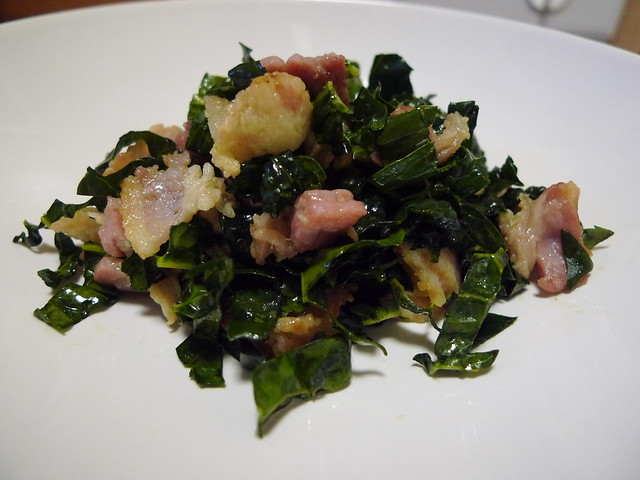
  • I saw a bunch of lacinato kale at the market and I immediately thought of the delicious salad I had at Lupa over the holiday season. At the time, I didn’t know there were other kinds of kale because I’ve only seen the curly ones in Harlem. It turns out kale is classified by leaf type and lacinato is also known as black cabbage. It’s crispier and can be eaten raw, where as the curly ones need to be cooked down or else the leaves are too tough to chew.

    The Lupa salad used guanciale, or unsmoked pig’s cheeks. I made do with a slab of bacon sliced thinly because I didn’t want to spend too much money after paying only $2.99 for the bunch of kale. The kale was also roasted but I left that out here to make the recipe even more simple. This might not be hefty to be its own course, but it sure was a good starter.

    Ingredients:
    1 small bunch lacinato kale, washed, leaves torn from hard stalks, chiffonade
    6 to 8 strips of bacon, chopped
    juice from 1 lemon

    1. In a skillet, render some fat by frying the bacon. Cook until bacon pieces are brown and slightly crispy. Remove from pan using a slotted spoon. Set the fat aside.
    2. Put the kale leaves in a big bowl and toss them with lemon juice using your hands.
    3. To serve, put a handful of kale on each person’s plate. Sprinkle with bacon and drizzle with some of the fat for extra moisture.

    Related post/s:
    Cook down kale and they’re good with sundried tomatoes
    Kale as a dessert? You bet!

  • It’s so nice to step out of the gym at 4:30pm and squint because it’s so bright outside. We New Yorkers like our different seasons, but oh, nothing is as sweet as welcoming spring. I’m actually way ahead of the weather with this recipe because I think of fennel in a cold salad as a summer produce: bright and fresh.

    If you have a mandoline, you can make a better presentation with this salad, but a sharp knife will do as long as you use extra care especially with the celeriac. A very good Parmiggiano is necessary, although Piave cheese will do okay, too. Add to the salad’s brightness by plucking a few flat parsley leaves from its stem and serving them whole.

    Ingredients:
    1 fennel bulb, sliced thinly
    1 celery root, peeled, sliced thinly
    3 sprigs of parsley, leaves plucked from stem
    Parmiggiano Reggiano cheese
    juice from one lemon
    oil, salt, pepper

    1. In a bowl, toss fennel and celery root with lemon juice and some salt. The lemon juice will keep the vegetables’ color until you’re ready to serve. Add parsley leaves and season with pepper. Drizzle a generous amount of good olive oil.
    2. Before serving, slice some cheese and add to the salad.

    Related post/s:
    I totally copied this from Frankie’s 457 in Brooklyn

  • 231 West 40th Street between Seventh and Eighth
    212/354.2195
    $65 for two, with drinks, without tip
    ♥ ♥

    Inakaya is a good place for two kinds of dates: one, an awkward first date when neither have to nervously talk but still have a good time; two, a long-term couple date when almost anything can slip by and forgiven by the end of the night. For the first couple, they can’t really have a quiet conversation while dining at Inakaya because it’s a robatayaki, also known as robata, or an open grill where every few minutes a chorus of waiters and chefs shout and repeat customers’ orders. For the long-timers, they may be amused with the very lively setting and shrug off another date night out.

    The Dr. and I belong to the latter. We were to meet midtown for dinner to eat sushi, but we didn’t want to spend too much money. I was at the new Muji store inside the New York Times building and noticed Inakaya next door. It was only a week old when we visited, but it was already packed with Japanese salarymen who perhaps wanted to support the establishment’s efforts. There were a few families as well and the younger kids seemed to enjoy all the screaming. Some of them even participated in the mochi-making presentation by the window where a giant pestle is used to mush up the soy.

    The robatayaki‘s origin leads back to the city of Sendai in the northeast region of Japan. The chefs sit on their shins wearing ninja-like socks surrounded by carefully-selected fresh ingredients. At Inakaya, it’s orchestrated how they kneel and reach out for the produce and they use the same fluid moves to serve the finished dishes. Long wooden paddles are used so that the chefs can reach you from across the grill while the rest of your order is served by kimono-wearing waiters.

    The food can’t get any better for something across the Port Authority bus terminal. The oysters came from the west coast, and even though they lightly touched the grill, they still tasted like the ocean. The day’s sashimi special came from Tsukiji Market that morning but I don’t remember it being out of our budget. We unfortunately skipped the beautiful marbled meats that were displayed in front of us–we weren’t in the mood for red meat–but we couldn’t say no to the buttery uni.

    It’s nice to know that there’s a place to go to to escape the mediocrity of Hell’s Kitchen and the awfulness of fast-food kingdom at Times Square. Now I know where to eat if I ever find myself at the bus station or the AMC movie theater next door even if it means putting up with a little bit more of noise.

    Related post/s:
    EN Brasserie’s staff used to do some screaming, too
    Degustation was originally the same way
    For less noise, try Aburiya Kinnosuke

  • The two-or-two rule I apply for squid also applies when I cook octopus. You either tenderize it for 2 minutes or two hours; anything other than those times, your octopus will be chewy and inedible.

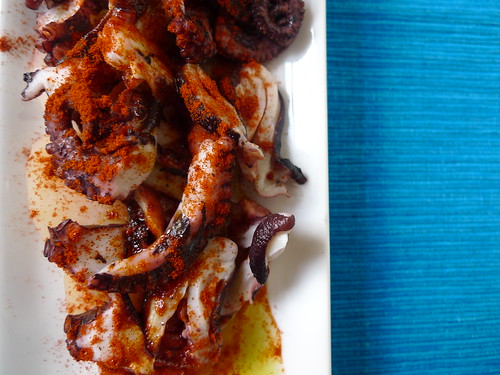
    At the Filipino grocery store in Jersey City, I found a small frozen block of octopus for under $5. I wish I bought more because this Galician salad was so easy. It might take time to cook the octopus but once tender, it’s like tossing a simple salad together.

    Ingredients:
    1 octopus, about 2 pounds, thawed, beak removed if necessary
    4 medium potatoes, peeled, sliced
    smoked paprika
    salt

    1. Bring a large pot of water to a boil and add a generous helping of salt. Put octopus in water and, when it returns to boil, cover and lower the heat to simmer. Cook for no more than 2 hours, until octopus is tender. When you have 30 minutes to go, add the potatoes and cook until tender.
    2. Remove octopus and potatoes from pot of water and drain. Slice the octopus into smaller pieces. Separate the potatoes on a platter and sprinkle with paprika. Distribute the octopus on top of the potatoes. Drizzle with olive oil and season with some salt.

    Related post/s:
    Octopus photos on Flickr
    Surprise your guests with yellow eel if octopus is too easy
    The OctoDog is a different kind of octopus

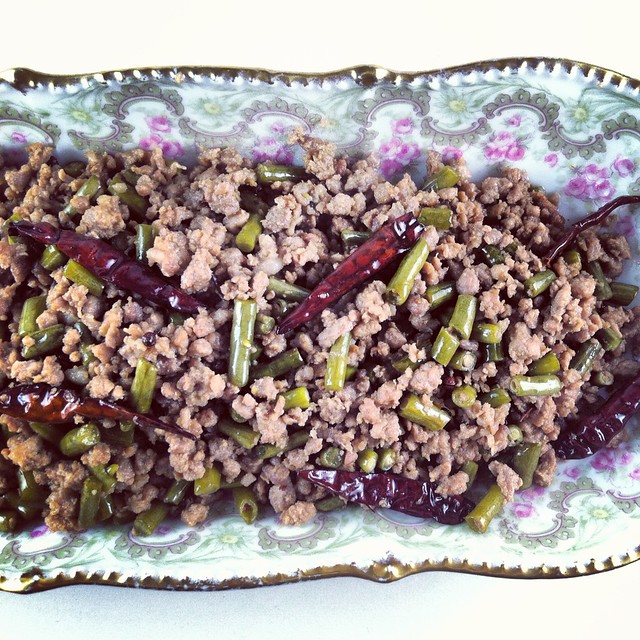
  • I picked up a copy of Fuchsia Dunlop’s Land of Plenty from the library last week. I skimmed through it before I checked it out because I wanted to see if the recipes were easy to do at home. I’m obsessed with this dry-fried string beans dish I always order when I’m eating at Grand Sichuan, so I made sure there was a similar string beans entry caled rou mo jiang dou. My mouth watered while reading the recipe and I knew I just had to do it pronto.

    Before heading out to Chicago earlier this week, I pickled the string beans. Emptying them out when I was ready to make a Friday lunch, I couldn’t believe how fragrant it had gotten. The star anise and the ginger together gave the beans a most familiar smell: I knew I was on the right track.

    Thank you to Fuschia Dunlop’s time in Chengdu! The recipes gave me an understanding of how much history came with each, but she’s deciphered them to make it easy to replicate at home.

    Ingredients:
    1 bunch of long green beans
    1/4 lb ground pork
    1/2 tsp rice wine
    1/2 tsp light soy sauce
    3 dried Thai chiles, snipped in half and some of the seeds discarded
    1/2 tsp whole Sichuan peppercorns
    salt
    peanut oil for cooking

    For the pickling solution:
    4 dried Thai chiles
    1/2 tsp whole Sichuan peppercorns
    2 tsps rice wine
    1 star anise
    1 tbsp brown sugar
    1 large finger of ginger, peeled, chopped in smaller pieces
    1 cinnamon stick
    salt

    1. Pickle the string beans up to 3 days in advance. Wash the beans thoroughly and store in a pickling jar large enough to hold all the long beans. Meanwhile, boil about 3 cups of water with some salt until it dissolves. Add the rest of the ingredients and let simmer for 5 minutes, or until water has reduced to more or less 2 cups. Set aside and let cool. When pickling solution is cool enough, separate the solid ingredients and stuff them in the jar with the beans. Pour in pickling liquid to fill the jar; there should be enough water to submerge all of the beans. Close tightly and store in the fridge until ready to cook.
    2. At time of cooking, mix ground pork with rice wine, soy sauce and salt in a large glass bowl. Set aside.
    3. Remove beans from pickling solution and chop into small pieces to complement the small grains of the ground pork. You can pick the brown tips and throw those away.
    4. Using a wok or a large frying pan, heat some peanut oil until almost smoking. Add the pork and stir-fry until dry and crispy. Transfer back to the same bowl.
    5. Add a fresh coat of peanut oil to the pan and heat. Add chiles and peppercorns and stir-fry until fragrant. Be careful not to let them burn. Add the beans and stir-fry for 1 minute. Add the pork and stir-fry for another minute. Serve with a steaming bowl of white rice.

    Related post/s:
    Buy Land of Plenty from Amazon.com
    Sichuan Dry-Fried String Beans photos on Flickr
    Eat spicy Sichuan dishes at Wu Liang Ye

  • 1 Main Street in DUMBO, Brooklyn
    718/222.0666
    $45 for two, with a drink, without tip
    ♥ ♥

    We descended on the island of Brooklyn earlier than we would want to be, but Bubby’s was already teeming with young families and baby strollers. We squeezed ourselves past the waiting crowd and told the maitre d’ we would take the two empty seats at the bar. At Bubby’s, the bar is the way to go if there’s less than four of you so you avoid the long wait, but you also sacrifice service.

    At the bar, we ordered a bloody Mary and a diet Coke. We split the grass-fed burger and opted for a salad instead of fries and shared a side of two eggs over-easy and bacon. As soon as our plates were placed in front of us, it took more than ten minutes to start eating because we had to wait for our waiter to walk by so that we can remind him about the ketchup and mustard. I walked to the other end to find one of the two guys running the bar, but couldn’t find them. When one of them came out of the kitchen, I couldn’t get his attention until he returned to our side of the bar to hear the lady next to us complain about her eggs. (She ordered fried and got scrambled instead.) But when we finally started eating, it was a very pleasant burger, and not because we were extremely hungry but because it as juicy, perfectly medium-rare and well-seasoned. The salad was boring so we mixed in some of the egg yolks with it to give it a kick. In fact, forget about well-crafted salads when you go to Bubby’s: order anything that’s heartier and heavier than a bowl of freshly tossed vegetables and expect to wait.

    Related post/s:
    Make your own burgers at home
    People can say what they want about it, but a burger and a beer at SoHo Park is still satisfying

  • From the New York Times last week, I learned what salmoriglio is: an acidic and velvety sauce of Sicilian origin that’s perfect for fish. I always use it; I just never knew it had an actual name!

    After running an errand for my friend Judy, I stopped by the Westside Market on Broadway and bought a whole red snapper to prepare for dinner. I’ve been watching the Bahamian fish competition on Discovery Channel and I’ve been craving grilled whole fish for days. But with snow on the ground and without a grill, I had to settle for baked fish safely cooked in the confines of the Dr.’s apartment.

    Ingredients:
    1 whole red snapper, scaled, cleaned, pat dry with paper towels
    2 sprigs rosemary
    1 lemon, sliced
    1 red onion, sliced
    6 bay leaves
    4 garlic cloves, peeled, minced
    oil, salt, pepper

    For the salmoriglio:
    leaves from 2 sprigs of thyme, stems reserved for fish
    2 sprigs of parsley, chopped
    1 tsp oregano powder
    1 garlic cloves, minced
    zest and juice from 1 lemon
    oil, salt, pepper

    1. In a bowl, mix the salmoriglio herbs and spices together. Drizzle some oil and add the lemon juice by whisking with a fork. Cover and refrigerate until ready to serve.
    2. Meanwhile, preheat the oven to 450º. Line a baking sheet with aluminum foil and brush with olive oil.
    3. Scatter the half of the lemon slices and half of the onion on the baking sheet and top with the thyme stems, rosemary sprigs and bay leaves. Season the fish with salt and pepper and stuff with garlic cloves and place on top of the herbs. Drizzle the fish with olive oil. Place the remaining lemon and onion slices on top of the fish. Cover with foil and bake until the fish is cooked through, about 20 minutes. Serve the fish whole, with salmoriglio sauce on the side.

    Related post/s:
    Poisson en papillote, or fish in paper, recipe
    Buttercup fish with peashoots recipe