• We were at Sona’s apartment earlier this year for a pot luck party to congratulate two friends who ran the marathon and we all contributed to making the gyoza, or dumplings. My Japanese friends make them frequently at home and they were sealing them as fast as I can say “dumpling”. I was slower and mine came out a little askew, but at least they didn’t fall apart when cooking.

    Americans call them pot stickers because, well, they stick to the bottom of the pot when you fry them. Koreans call them mandu and include them in a soup using clear broth, or mandu gook. You can substitute the pork filling with ground chicken or shrimp, but the rest of the ingredients are non-negotiable if you want to make gyoza, Japanese-style. You can go to YouTube and search for the many how-to-make-dumpling videos available. They key is frying them on one side and cooking them thoroughly by adding a little water to the pan and steaming them. Open up a bottle of Sapporo and you’re set for the rest of the afternoon.

    Ingredients:
    1 package of gyoza skins
    1/2 pound of ground pork
    a small wedge of cabbage, roughly chopped
    1 bunch of scallions, finely chopped
    3 cloves of garlic, minced
    a knob of ginger, peeled and finely chopped
    1 tbsp soy sauce
    1 tbsp sesame oil
    2 tbsps peanut oil

    1. Make the filling by combining all the ingredients except for the skins in a large bowl.
    2. To prepare the dumplings, you’ll need a small bowl of water to seal the dumplings and a wet paper towel to cover the gyoza skins to keep them from drying out. Using a teaspoon, spoon the filling in the middle of the skin. Dab one edge of the skin with water and fold the skin over in half and pinch in the middle. To seal the sides, ruche and pinch to make pleats. (There goes my fashion education.)
    3. Steam-fry the dumplings. Heat up the peanut oil in a deep frying pan. Add the dumplings one side down and fry for 3 minutes. Lower the heat and add 1/4-cup of water. Cover to steam the dumplings for about 8 minutes, or until most of the water has evaporated. Remove using a heat-resistant spatula to a plate lined with paper towel. Dip in soy sauce and vinegar mixture.

    Related post/s:
    Buy gyoza skins
    Just like making your own meatballs

  • 120 West Broadway on Duane Street
    212/964.2525
    $175 for the tasting menu with wine pairings, without tip
    ♥ ♥ ♥ ♥

    There comes a time in your life when you have an awesome meal with good company and you think back the next day without regrets because you realize you deserve everything. Unfortunately for me, I think that way 80% of the time, but I recently read that desire is never a mistake. For my birthday this year, my good friend Miriam and her fiancé, Eric, showed me that you have to allow yourself to want things, even if that means a lot of them. And boy, Bouley was the perfect place for it.

    The night started off with the scent of apples in the foyer. Ever since I stepped in Bouley a couple of years ago to check out the menu, I have known that smell. It’s of the holidays, of cider, and of something warm and cozy inside. The small bar at the receptionist’s counter was a different matter. Our table was for 8pm, but it seemed like the entire New York Japanese population was also waiting to be seated. It had been drizzling outside and the coat check lady was flustered with requests from customers who have already eaten and from customers waiting to be relieved of their coats. We started afresh as soon as we were seated in the dining room.

    The ambiance reminded me of Daniel and Le Bernardin, though it isn’t as expansive as Daniel’s and the crowd around us was less older than that of Le Bernardin’s. The jacquard chairs and the tassels on the lamps belong more in Versailles than the TriBeCa neighborhood this incarnation now stands, but you know to expect that the food will be as polished and refined as any old New York institution.

    Below is a list of what I ate with their wine pairings:

    1. Phyllo-crusted Florida shrimp, Cape Cod baby squid, scuba-dived sea scallop and sweet Maryland crab meat in ocean herbal broth with Pouilly Fumé Domaine Lebrun 2006

    Restaurants need to cook shellfish more this way: you don’t have to force the meat; they just give. The baby squid was a spoonful of tenderness that softly went “squish” in my mouth.

    2. Potato-crusted Mediterranean rouget with a mung bean saffron risotto, rose-olive sauce and Parmesan cloud with Viognier, Alban Vineyards, Edna Valley, California 2006

    The potato gave the fish texture and the olive sauce gave it a bit of tart that harmoniously fused with the delicate touch of cheese. I could have enjoyed this even without the very yellow risotto. Extra points for calling the cheese a “cloud”.

    3. Organic Pennsylvania rack of lamb baked with rocket salad, fava beans, sage and a purée of zucchini and mint with Crozes-Hermitage, Domaine des Vins de Vienne, Rhone Valley 2005

    The best of all the racks I’ve had this year mainly because I wasn’t inebriated by the time this course was served. I thoroughly enjoyed the juiciness of the meat and couldn’t have enough. The touch of zucchini-mint was just right. The greens wonderfully matched. Just like the risotto with the rouget, I could have done without the gnocchi.

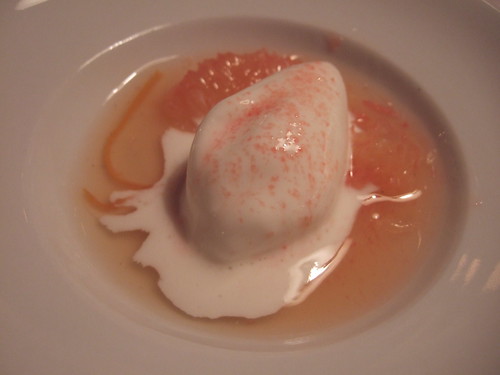
    4. Texas pink grapefruit soup infused with green cardamon, star anise and Tahitian vanilla with Campari sugar and fromage blanc sorbet with Moscato D’Asti, Francesco Coppo 2006

    The three of us all had this “soup” as a palate cleanser. I could have ended our night here with this flawless dessert. This is the kind of dessert I aim to make someday.

    5. Warm passion fruit and blueberry meringue with caramel sauce, huckleberry coulis and Provence lavender ice cream with Muscat de Rivesaltes, Domaine des Schistes 2006

    I loved the lavender ice cream, but I thought the meringue was too sweet with the caramel sauce.

    Talk about decadence, but hey, I am allowed to want things. Happy birthday, me.

    Related post/s:
    My birthday last year was with a larger group at Blau Gans
    The year before at La Esquina after its opening
    A delirious experience at Daniel
    A younger menu at Le Bernardin

  • 7 Spring Street between Elizabeth and Bowery
    212/777.0877
    about $120 for two, with wine pairings, with tip
    ♥

    The $15,000 Enomatic Enoline 8 machine was in place behind the bar when I visited with a friend, but it wasn’t functioning. Tonight’s not the night if you were in the mood for a $90 glass of wine, our friendly bartender told us. The expensive toy is an argon gas preservation system which keeps wine fresh after it’s uncorked for up to two months–I’ve only used it to decide which bottles to buy from Union Square Wines.

    Noble Food and Wine has been quiet even though it opened in mid-September. It first made news with the machine and it made a buzz again when chef Daniel Dorado, previously of Marema, reportedly walked out several weeks later. This hasn’t been confirmed yet, but the space looked like it was waiting for a party that refused to start. Maybe because it was six days before Christmas, but we felt a little weird for being the only two people there for dinner time.

    We sat and drank at the bar instead of the lower-level dining room with Philippe Starck furnitures–our bartender seemed like he needed some company. He was attentive without being too obtrusive. To make up for the Eno, he generously let us share our wine pairings. We started with a half dozen oysters with sparkling wine. The busboy wasn’t exactly sure which were the Kumamotos from the Blue Points, but our bartender came back to the rescue and clarified. The perfectly-cooked serving of seared scallops came with a nice glass of white from Oregon and the Berkshire pork chops with honey-glazed apples and sautéed spinach were served with a full-body red. We weren’t sure what wines we were drinking anymore, but we both thought that it was just a sign that we were actually having an okay time.

    When it was time for dessert, we also split the goat cheesecake. Our bartender proved that he was really paying attention to his only two customers of the night because he served it with a lit candle after he overheard that my birthday was coming up. Thankfully, two more couples walked in before we paid our bill. We didn’t feel as bad when we left to join the revelry outside.

    We appreciated our bartender, but I’m afraid Eater.com’s Deathwatch is looming over Noble Food and Wine.

    Related post/s:
    Tequila and Mexican at Cafe El Portal just around the corner

  • 141 First Avenue between St. Mark’s Place and 9th Street
    212/529.2740
    about $30 each for three, with sake, with tip
    ♥

    What shoyu, or soy sauce, ramen is to Rai Rai Ken is shio to Setagaya. Shio, or salt, ramen is the only type available at Setagaya, so you better like it more than you do your pork bone type, or tonkotsu, or fermented soybean paste, or what we all know as miso.

    I walked in with two other friends who were craving a hot bowl of soup for dinner and I suggested that we try Setagaya. It was cold outside so the line that snaked around First Avenue when the restaurant first opened is now gone, but the cold air has moved inside with the customers. The glass wall does not help. We sat tucked in the corner by the kitchen bar, but every time someone came in, we felt a chill. We ate our dinner wearing our coats and sharing two small bottles of sake.

    Setagaya follows the traditional shio broth recipe that includes boiling dried seafood, like anchovies and scallops, for hours at a time. In fact, all that saltiness comes from the ocean. The broth is not clear because it is also flavored with pork that’s been barbecued on a charcoal grill. It sounds good, but we all had the same complaint: the broth tastes too much of barbecue. The secret ingredient is reportedly Vietnamese salt, and boy, was it salty. I love shio ramen because it’s lighter than the other types, but the charred and salty flavors didn’t meld the night we visited.

    The noodles, though, were perfect in texture and stringiness. I love my ramen noodles a little chewy and meaty, and Setagaya’s reminded me of those $5 giant bowls I ate in Tokyo’s ramenyas oh so many years ago. Stick with the regular size when you visit, though, because you can only have so much barbecue and salt flavor in your ramen.

    Related post/s:
    Rai Rai Ken is a couple of blocks west
    More Zen broth at Sobaya
    Soba Koh is only open for dinner
    Try somen noodles with roasted duck from Chinatown

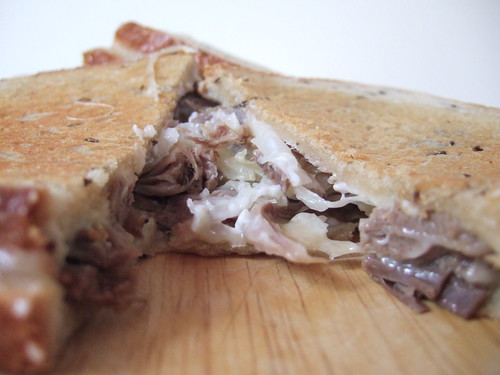
  • What to do with still the remaining homemade corned beef in the fridge? Reuben sandwiches, of course! They were actually the reason why I made my own corned beef in the first place because I’ve been curious about how they are made ever since I tasted a really good version from Gettin’ Hungry, themorning deli on Hudson Street with the giant wooden lion inside. The origin of the Reuben sandwich is still being disputed, but it is essentially a grilled sandwich made with corned beef, Swiss cheese, sauerkraut and Russian dressing on rye bread.

    I also don’t eat a lot of sandwiches besides the Vietnamese kind, but when I make them at home, I like them to be elaborate. But there are two things I don’t stock in the kitchen: ketchup and mayonnaise. It was snowing outside, but I made the trip to the grocery store anyway to pick them up. In the same aisle, I discovered horseradish cream sauce from Kraft. It looked like mayonnaise, but I guessed correctly, a touch of dried horseradish was included in the mix. Reuben sandwiches require a Russian dressing that looks like Thousand Island, but I figure, I can get away with this ready-made type especially after already spending five hours making my own corned beef the other day.

    Combine the following to make Russian dressing if you don’t want to use ready-made horseradish cream sauce:
    1/3 cup mayonnaise
    1 1/2 tbsp ketchup
    1 1/2 tsp prepared horseradish
    1/2 tsp Worcestershire sauce
    salt, pepper

    Ingredients:
    corned beef, shredded; thinly-sliced if not homemade
    Swiss cheese slices
    sauerkraut, excess water squeezed off using paper towels
    8 slices rye bread
    horseradish cream sauce
    half a stick unsalted butter, softened in microwave for 15 seconds

    1. Spread one side of each bread slice evenly with some butter. With buttered sides down, spread horseradish cream on four slices and with some corned beef, sauerkraut and equal portions of cheese. Top with remaining slices, buttered side up.
    2. Place large skillet over high heat and melt a small knob of butter. Reduce heat to low and add sandwiches. Using an iron grill press, put on top of the sandwiches and press. Cook until browned and crisp on both sides, about 2 minutes a side. Transfer to a platter lined with parchment paper. Cut in half and serve.

    Related post/s:
    Homemade corned beef is so much better
    Pressed taleggio cheese sandwich
    Turkey bacon avocado portobello sandwich

  • 136 Division Street between Ludlow and Orchard
    212/941.5060
    $50 each for five, with two bottles of wine, with tip
    ♥

    I used to know someone who lived on Madison Street in the deep recesses of Chinatown five years ago, but I haven’t been back in the area since then. Before that, Good World on Orchard was the place to be among dot-comers. For the last four years, I’ve been working in and around SoHo and have grown to love Frank DeCarlo and John LaFemina’s Peasant on Elizabeth Street. Its downstairs space is one of the places I end up in when I don’t have a reservation nor a dinner plan.

    When Bacaro started appearing in food blogs as DeCarlo’s latest project after splitting from LaFemina, I kept a note in my head to make it back to Division Street when I get the chance. That opportunity came a little earlier last week when five of us wanted to eat from small plates and share bottles of wine but had nowhere to go. I had to lend my cab driver my iPhone to show him where Division Street is located because he said he had never heard of it. I was dropped off in the corner of a very quiet and deserted street. If it weren’t for the few smoking outside, I would have thought my Google map was wrong.

    At 7pm, the four in our party were at the bar waiting for a table. We witnessed as other groups were seated as soon as they came in. It became worrisome that once another group showed up, we’d have to leave to find another restaurant, unless we wanted to wait for another hour. The bartender was nice enough to seat just the four of us–he made a smaller group move to a smaller table near the door just to accommodate us–and let us order food and wine while we waited for our fifth.

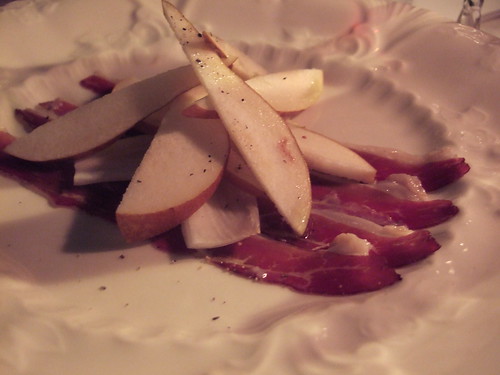
    We started with duck prosciutto and some pear slices. Salty and tougher than the prosciutto I’m used to, the pears were still a good match. The braised duck leg that was served when our party was complete fared better, although it was still on the salty side. I assumed the octopus would come in vinaigrette just like they have them in Peasant, but they were fried in batter like calamares, which I’m not a fan of. It was amusing to find lemon peels and yellow bell pepper covered in batter, too, but I just thought the dish didn’t belong with the rest of our food. I also thought the meatballs were going to be gigantic like they have them at ápizz, John LaFemina’s second venture but without DeCarlo, but they were so small I could have eaten twenty more of them. The polenta salad was the most interesting because it was topped with a small chunk of cod. At Bacaro, everything I thought was a salad did not come with any leaves. The cod whet our appetites and prepared us for the gnocchi cooked in brown butter with mushrooms and the pasta with anchovy sauce–one warm and hearty, the other difficult to split among five.

    Related post/s:
    Peasant was Frank DeCarlo and John LaFemina’s venture before they split to do ápizz (LaFemina) and Bacaro (DeCarlo)

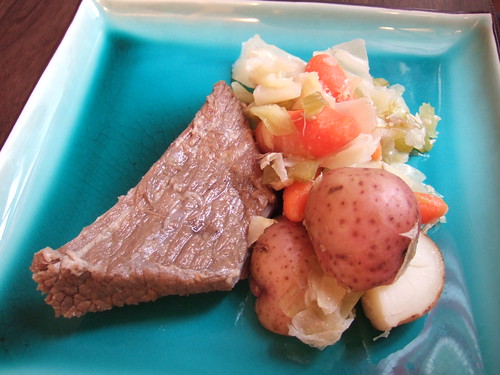
  • It’s feeling a lot like the holidays outside and all I’ve been drinking, besides wine, is Guinness draft. And what else matches with a full-bodied glass of Guinness? Corned beef, cabbage and potatoes! (Besides oysters, of course.) This recipe involves a lot of planning. In my case, I made sure I went straight home after work on the 10th day so that the brisket wasn’t going to sit in brine another day. But once you start cooking, it’s really a no-brainer. I set the timer of the stove an hour at a time once I started to slow-cook the brisket to remind me to check. After three hours, the vegetables took another half an hour.

    If you can’t find ready-made pickling spices, you can easily combine the following and make your own:
    2 cinnamon sticks, broken
    1 tbsp mustard seeds
    2 tsps black peppercorns
    1 tsp whole cloves
    1 tsp whole allspice
    1 tsp powder ginger
    4 dried bay leaves

    Ingredients:
    1 fresh beef brisket, about 4 pounds
    1 small head of cabbage, cut in small wedges
    6 medium red potatoes, halved
    3 ribs celery, cut in 2-inch pieces
    2 cups of baby carrots
    2 large onions, cut in wedges
    5 cloves garlic, minced
    2 tbsps whole grain mustard
    3 tablespoons pickling spices
    1 1/2 cups kosher salt
    1 cup granulated sugar

    1. Using a large Dutch oven, make the corned beef brine. Combine about 10 cups of water, salt, sugar, mustard, spices, and 3 cloves minced garlic. Bring to a boil over high heat. Remove from heat and set aside to cool. When cool enough, add the brisket. If necessary, add more cold water to cover the beef. Using a heavy bowl, weigh the brisket down so it will stay submerged in the water. Cover the pan and refrigerate for up to 10 days in the refrigerator.
    2. When ready to cook, discard the brine and rinse the brisket well with cold water. Return to the Dutch oven and cover with cold water. Add the celery, onions and the remaining garlic. Bring to a boil and skim off impurities. Reduce heat to medium-low, cover and simmer for 3 hours.
    3. Add the potatoes, carrots and cabbage. Continue to cook in medium-low heat until vegetables are tender, about 30 minutes more.
    4. To serve, remove corned beef from liquid and slice in small chunks. Add cabbage, potatoes and carrots on the side. Drizzle some of the liquid on top of the corned beef and all over vegetables.

    Related post/s:
    Cold weather also reminds me of oxtails and wine

  • 79 MacDougal Street off Houston
    212/260.0100
    about $45 each for two, with tip
    ♥

    I’ve been wanting to go to Smith’s since it opened, but every time I would remember to walk by, they always give me an estimated hour-long wait. One Monday night, I was able to get a table for two on short notice. The place was full, but when I asked our waitress if we can chill with our drinks first before ordering anything, she told us we can stay as long as we want because it wasn’t going to be a busy night. I was so glad to hear that, too, because I was losing faith with restaurant servers due to most recent experiences. Our waitress continued to be attentive and pleasant the entire night.

    When we finally started to feel hungry, we ordered several small plates to share. I loved the squid, charred with lemon, olives and pancetta bits, and I thought it was a good match with the heavier, more substantial artichoke pasta with black truffles. A steamed egg with Gorgonzola and polenta was a sophisticated dish even though I feel like foams have come and gone. The Portuguese sardines were butterflied and were quite tasty with tomato confit, but oh, is that more foam? I loved how crunchy the fish was but the small bones were cumbersome in my mouth. One even pricked my gums and I had to excuse myself and go to the bathroom to pull it out.

    Either we were getting more drunk as we sampled dish after dish, or that our choice of sparkling wine really matched everything we ordered. Even the roasted beets became more interesting–I love beets, don’t get me wrong–but with creamy horseradish and a nutty flavor, it was a nice complement to the corzetti pasta and earthy mushrooms.

    I loved Smith’s for its location and coziness more than the food itself, but that strip off Houston is so unexciting otherwise I’d definitely come back to make sure it gets a share of my business.

    Related post/s:
    Foam and Alinea in Chicago
    Another small space, but on the other side of the city

  • 143 Grand Street off Lafayette
    212/431.7999
    about $45 for two, with tip

    Update, 2008: Michael Bao has left Bun

    I can only imagine how hard it is to work as a waiter/waitress in a city teeming with restaurants, but for everybody’s sanity, find another job if you can’t even put up with a simple request from one of your customers. I eat out a lot and I’d like to think that I know what I want when I’m ready to eat. There are things I expect when I pay for my food and one of them is some kind of service from the restaurant’s staff. Now, I’m not talking about waiting on me hand and foot; I just want the menu as soon as I sit down, the food I’ve ordered after a reasonable wait, and my bill, preferably with the correct total, after you’ve cleared the last plate from my table. I could even understand if you don’t know an ingredient off the menu (the cute waiter at E.U. during its opening week who told us periwinkles are cured meat) or if you’ve forgotten today’s specials (the waitress who touted the lamb shoulder as chops), as long as you don’t act like an asshole afterwards and try to make me the bad person because of your mistake.

    We went to Bun, Michael Bao’s new restaurant on Grand Street, to show our support for a new Asian restaurant opening in the midst of multi-million glass condo buildings coming up in SoHo. It wasn’t a particularly busy lunch hour and we were able to score the table near the door as soon as we walked in. My friend and I were the only Asian-looking customers inside. We couldn’t but help notice the lacquered red stools at the bar and the canvas Asian prints on the wall. The prices on the menu are obviously set to pay for the restaurant’s decor: $6 for a summer roll, $9 for a bowl of pho, $12 for a hot pot.

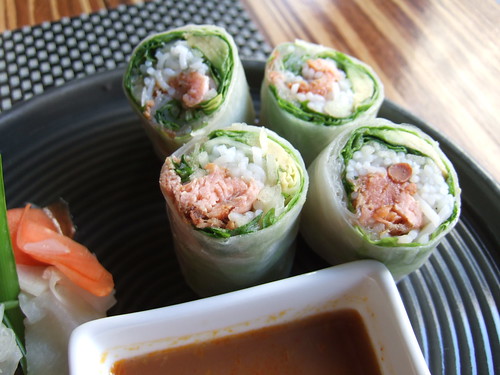
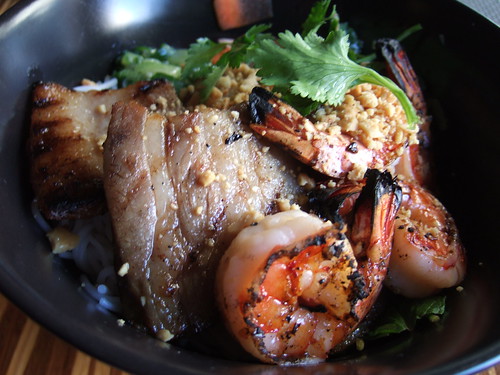
    To start, my friend ordered one salmon roll served with anchovy sauce. The sauce reminded me of the Filipino bagoong from the north. The roll is simply a Vietnamese summer roll, only with salmon was used instead of shrimps. Berkshire pork is touted several times on the menu, so I opted for the vermicelli noodles, the restaurant’s namesake, with a few slices of them tossed with shrimps. We both ordered the pho for our main course, even though we knew our lunch tab was already running up to $40 without drinks.

    The chicken pho was bland and we were surprised that it was peppered with pieces of chicken skin, complete with the small goose bumps. It’s just like eating at home, said my Chinese friend, but we wondered how the non-Asians in the restaurant felt upon seeing them in their soup. They do not taste bad, of course, but I know people who would be put off with boiled chicken skin in their dish, if not for the looks of it, the jiggly fat underneath. My bun was the day’s saving grace. I can’t make sure that the pork was indeed Berkshire pork since it’s not as distinctively sweet as a Niman Ranch pork, but the sweet and sour sauce had just the right Vietnamese flavor. At Xe Lua in Chinatown, I always order the beef bun when I’m not craving their pho.

    It was only after the bun came that I realized I’ve ordered too much food. I got our waiter’s attention to ask him to cancel my beef pho. The order was already put in, but I’ve made a mistake, and I know it wouldn’t be too hard to accommodate my request. Instead of going back to the kitchen, our waiter tried to convince me that I should take the pho to go. He only stopped insisting when I told him that I’m not going to eat reheated pho back in the office.

    When our bill came, the $9 for my canceled pho was still there. I tried to get our waiter’s attention again, but he kept looking away whenever he saw me looking. Fed up of waiting, I walked up to the bar, assumed the only guy behind it without chef’s white was the manager, and asked him to please take off the $9 off my bill because I’ve canceled that order earlier. When I returned to our table with the correct bill and we were getting ready to leave a tip, our waiter finally made an appearance and told us, I don’t have control over the computer to change your order or the bill. I nicely reminded him that I, too, don’t have that access and that was why I expected him to do his job.

    We still left a 20% tip because we didn’t want the other waiters at Bun to think their own efforts are not appreciated. But I hope the restaurant owners realize that only one ugly feather can make an entire plume look bad.

    Related post/s:
    Xe Lua is a much better deal for Vietnamese without the attitude
    I would even opt for Fr.Og if I had to spend money on Vietnamese food
    Perfected combination of noodles, Berkshire pork and poached egg at Momofuku Noodle Bar

  • I remember the day like it was yesterday. I was waiting for my coffee inside Starbucks on Crosby and I noticed this man next to me. He looked very familiar. I didn’t realize I was staring at him. I looked away and left with my coffee. I knew he was a chef, but my mind was drawing a blank. A few minutes later, while in the middle of starting my morning, his name came to me: Jean-Georges Vongerichten. I was staring at Jean-Georges! In Starbucks! That was almost five years ago.

    I was reminded of that day when the new Jean-Georges cookbook arrived in the mail last week. Like with any new cookbooks, I saved some quiet time at home to leaf through the pages and look at the beautiful photographs of food. After perusing, I started over, this time armed with small Post-Its to mark the dishes that I would like to make someday.

    Asian Flavors of Jean-Georges is a culmination of what the chef learned from the year he was sent to Bangkok to be the chef de cuisine at Louis Outhier’s restaurant in the Oriental Hotel to his own kitchen adventures in opening Vong, 66 and Spice Market in New York City. I’ve never been to Bangkok, but some of the recipes easily reminded me of summers in the Philippines with plenty of sweet and sour flavors in our food. There were green mangoes dipped in fish sauce and shrimp paste; grilled fish drizzled with ginger and chiles; pieces of deep-fried pork belly tossed in vinegar and shallots. I could go on, but my mouth is already watering with the memories of enjoying a meal while wiping the sweat off our brows. It’s the taste that David Chang and his Momofuku empire have been presenting the last year to the many New Yorkers who are now asking themselves, how come I’ve never tasted this flavor before? It’s always been around: in Chinatown and in Flushing, and at Vong back in 1997. It may have just taken a funky Japanese name for people to realize that they’ve been eating and tasting the same flavor all along.

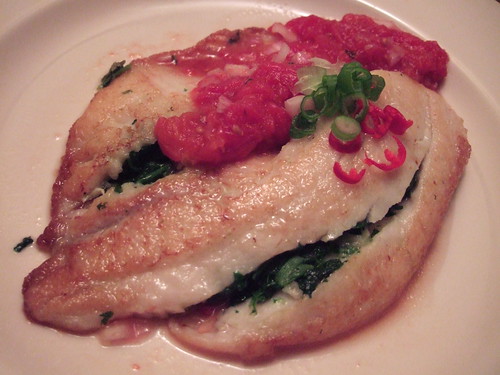
    One recipe that stood out was Jean-Georges’ “Barbecued” Red Snapper, Thai Style on page 128. I wanted to eat fish after a quick trip to Asia Food Market on Mulberry. I bought the fresh herbs I needed and my pantry is already stocked with the usual Asian condiments, so this recipe was easy to re-create. All I really needed was fish fillets from the market.

    The original recipe suggests using a food processor to make the cilantro mixture and the tomato salsa. I didn’t because I like chunks in my food–the texture actually made this dish less intimidating and look more homemade.

    Ingredients:
    3 red snapper fillets
    1 bunch of cilantro, thoroughly washed
    1 small can of crushed tomatoes
    1 tbsp brown sugar
    1 shallot, chopped
    4 garlic cloves, minced
    Thai fish sauce, or nam pla
    fresh lime juice
    1 tbsp sherry vinegar
    1 stalk of scallion, chopped
    1 fresh Thai chile, seeded, chopped
    grape seed oil

    1. Prepare a bowl with water and ice cubes. Boil some water in a pot, then add cilantro. After less than a minute, drain and transfer to the ice bath. Squeeze water off the cilantro with your hands and roughly chop. In a bowl, toss cilantro with half of the garlic and a jigger of fish sauce.
    2. Stuff fish fillets with cilantro mixture by making small slits in the fish using a sharp knife. Put on a plate, cover and keep in the fridge until ready to cook.
    3. In another large bowl, make tomato salsa. Combine tomatoes, sugar, shallots, lime juice, vinegar and a couple more jiggers of the fish sauce with the remaining garlic. Add more fish sauce to adjust taste. It should be sweet and sour with just the right amount of saltiness. Set aside.
    4. When ready to cook the fish, heat some oil in a large skillet. Fry the cilantro-stuffed fillets on one side for about 4 minutes. Using a heat-resistant spatula, gently flip and cook the other side for another 4 minutes. Remove to a serving plate. Serve with tomato salsa and sprinkle with scallions and chile.

    Related post/s:
    Get your own copy of Asian Flavors of Jean-Georges
    Marinated cucumber with orange zest is a good match

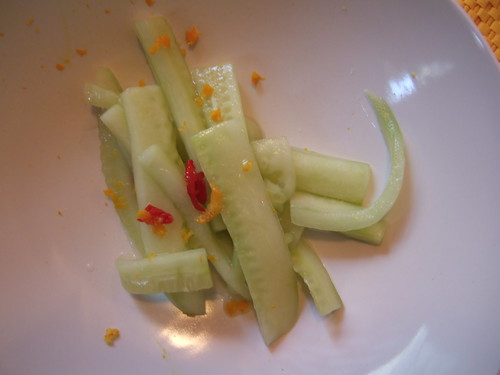
  • I’ve changed the name of this dish from Jean-Georges’ original recipe, Cucumber Marinated with Orange Peel, because I only used the orange zest to sprinkle on the dish before serving. What I kept was the marinating juice, Chinese-style. This was a great appetizer to another Jean-Georges recipe using fish.

    Ingredients:
    1 cucumber, peeled, cut into strips
    1 tbsp sugar
    3 tbsp rice vinegar
    1 tsp sesame oil
    1 fresh Thai chile
    orange zest
    2 tsps salt

    1. In a bowl, toss cucumber, salt and sugar, and let stand for 20 minutes.
    2. Toss in the vinegar, sesame oil and rice vinegar, and marinate for another 30 minutes.
    3. Sprinkle with orange zest before serving.

    Related post/s:
    Get your own copy of Asian Flavors of Jean-Georges
    This was a great match with fish, Jean-Georges style

  • Who’s in the kitchen? I asked the bartenders in La Lancha restaurant after only my second meal during my trip to Guatemala. Ezekiel, they said. He’s been the chef here at La Lancha. I wanted Ezekiel to know that I liked what he had been serving the past two days. While traveling Central America, I’ve had the same fried fish, roasted chicken, rice and plantains in every country. There’s nothing wrong with an honest meal, of course, but it was refreshing to eat something traditional that was executed so well. I was checked-in a resort, but the food did not taste like something for a corporate meeting and the menu certainly did not come with the word “fusion” in it.

    I’ve had Ezekiel’s rolled-up tortilla with ground pork and beef and smothered with tomato salsa. I’ve had his chiles rellenos, or stuffed peppers; his fish fillet with coriander sauce was equally tasty and flavorful. It was during the third night that I ordered what Guatemalans call subanik, also known as “God’s meal” in the La Lancha menu, simply because it is a bowl of everything. It was the perfect bowl of hot reddish-orange broth, made better with the rice I mixed in. I couldn’t help but order it again for my last night’s dinner.

    When I checked out of my room the next morning, the man himself, Ezekiel, stepped out of the kitchen with the recipe written on a piece of paper. I translated his notes out loud to make sure I understood and he showed me how the peppers that are crucial to the subanik broth look like. He showed me a large dried black pepper and a skinnier one that was dark red. They looked familiar to me because I have seen them in the Spanish aisle of my neighborhood supermarket. I couldn’t wait to buy them and try the recipe at home.

    Back in New York, I found and bought guaque and ancho chiles in $1.50 packets. Guaque chiles are larger than jalapeños but have the same level of spiciness. Poblano chiles are slightly spicier than bell peppers and become the more familiar ancho, or wide, when dried because of its new shape. I had some leftover dried pimento peppers in the cupboard, so I decided that adding a third variety can’t hurt. They key to subanik broth is to simmer the chiles with tomatoes and tomatillos, those green tomatoes that come with an onion-paper skin. Toasted sesame and pumpkin seeds only add to the smoky flavor of the soup.

    Feel free to add almost anything to your version. For my first, I used chicken and leftover turkey meat and skipped the vegetables. For my second, I skipped the meats entirely and just added the vegetables towards the end. I’ve tried both kaffir and mint leaves and found either worked well, as long as you have fresh lime juice to serve.

    Ingredients:
    2 dried ancho chiles
    2 dried guaque chiles
    2 dried pimento peppers
    4 tomatillos
    5 red tomatoes
    1 tbsp sesame seeds, toasted
    1 tbsp pumpkin seeds, toasted
    1 zucchini, chopped
    1 carrot, chopped
    2 stalks of celery, chopped
    2 pieces of chicken breast, sliced in small chunks
    1 cup of stewing beef chunks
    1 cup rice
    fresh lime juice
    half a bunch of cilantro leaves
    mint leaves
    salt

    1. In a large Dutch oven, boil 10 cups of water with the chiles and the tomatoes. When the water boils, turn the heat down to a medium simmer. Add the cilantro, mint leaves, sesame and pumpkin seeds and cook for about an hour, uncovered. The tomatoes will swell and eventually soften. Gently smash them with the back of a spatula. The broth will be almost black when it’s ready.
    2. Using a slotted spoon, scoop the chiles and tomatoes into a food processor and purée. Strain the remaining broth to another container to remove the chile seeds. Return the strained broth and the purée to the Dutch oven and continue to simmer.
    3. Add the rice to the tomato-chile broth. Stir occasionally to cook the rice. After about 10 minutes, add the carrots, celery and chicken. When the vegetables are halfway done, add the beef and the zucchini. Cook until zucchini is tender. Ladle into bowls and serve with a squirt of lime juice and a sprinkle of sesame seeds.

    Related post/s:
    Another travel-inspired recipe using dried pimento peppers
    Guatemala travel stories