• We arrived in Tunis-Carthage airport after a connection in Paris minus the Dr.’s backpack. We originally planned to start our drive to the north of the country without stopping in Tunis, but this setback, although minor, was still annoying. We took care of everything first: filed a claim for lost luggage, exchanged our dollars to dinars ($1 = 1.25TD), picked up our rental Fiat, bought a SIM card for our phone. We knew we had to look for a place to stay in the city for the night, but navigating the crazy streets proved difficult. The locals sweetly crossed the street without any regard for vehicular traffic. Other cars sneaked in right next to us as if in a video game docking explosions. By the time we checked out a hotel room in the city center, we were so spent. We couldn’t get our car back to the front of the hotel, so we decided to just keep driving. (Our apologies to the hotel clerk!)
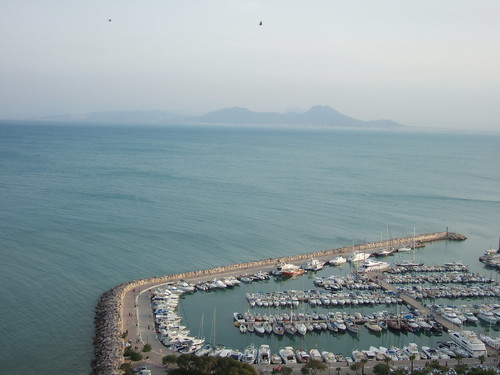
    The coast to Sidi Bou Said was a much prettier and less harried drive. It smelled less like Diesel and more of the Gulf of Tunis. Set on a cliff, all we can see were white buildings with blue window grills; bougainvillea spilling out of high walls and fences. The streets were narrow, so we parked at the bottom of the hill and checked in Hotel Sidi Boufares. For 75 dinars, we got a double room with our own bathroom. The ceiling was high and made of red bricks; the walls with tiles of different patterns. Our door was, of course, painted in that Sidi Bou Said blue, complete with metal studs and a heavy knocker. The owner talked to us in English, but I knew I will have to defer to the Dr. for the rest of our vacation when people outside the city will start speaking in French. (We think it’s a perfect travel arrangement: I plan, he speaks; I look pretty, he drives!)

    We ate at Rais Labhar for our first experience of simple Tunisian fare. The restaurant offered pizza and spaghetti, too, but we ate the salad Tunisienne, a mix of lettuce, olives, cucumber, peppers and flaked tuna. I had the under-salted grilled fish and the Dr. opted for the overcooked beef steak. A least our hunger pangs were satiated. We later found out that 22 dinars for so little food was too expensive.
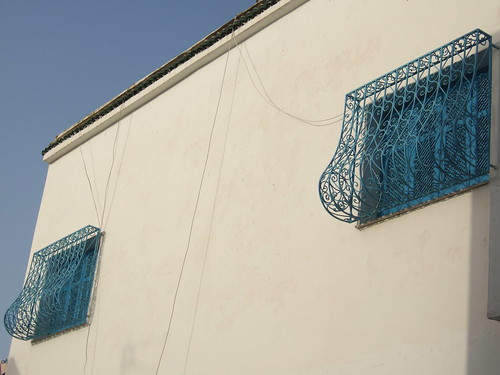
    We walked around town, past all the souvenir shops and haggling Europeans, to take photos of the Andalusian architecture. The blue tint grew on me, as well as the metal details that dot the doors and the windows. The sun started to set over the white domes, and as the other visitors boarded their giant buses, the town quieted down and emptied out.

    Later, a call to prayer we overheard coming through the town’s loud speakers reminded us that we were in a new place. The five calls to prayer each day will remain to be the most impressionable for the next two weeks. I was ready for the new tastes and different smells I will encounter.

    We were reunited with the Dr.’s pack at night time. For dinner, we walked down the hill and stopped by a hole in the wall to eat a chawarma with beef the clerk peeled off a spit. For 2.50 dinars, it was a much more satisfying fare than lunch. We were ready to start over the next day.

    Related post/s:
    Day 1 in Tunisia: Sidi Bou Said photos on Flickr

  • Got some smoked salmon? This is one of my favorite appetizers to serve while I prepare the rest of our dinner. Served with a glass of white wine, it will keep the hungry from bothering you in the kitchen.

    Ingredients:
    smoked salmon
    1 bunch of watercress, washed throughly, torn in smaller pieces
    2 garlic cloves, minced
    1 shallot, finely chopped
    a splash of red wine vinegar
    olive oil, salt, pepper

    1. In a small bowl, whisk together the red wine vinegar and olive oil. Add garlic and shallots and season with salt and pepper.
    2. To serve, arrange salmon slices on a plate. Top with watercress pieces. Drizzle with the oil-vinegar dressing.

  • What to do with potatoes before leaving for vacation? I always feel bad when there’s still a lot of produce in the kitchen before I go away. I hate wasting food and I wanted to use the herbs I also had sitting on the counter. I was too busy packing, so I wanted to cook something that would take little prep time and attention. This potato gratin is, of course, incomplete without a medium-rare steak and French onion soup, but let’s just say I did this to practice for a bistro meal come winter.

    Ingredients:
    2 large potatoes, peeled and sliced paper-thin
    1 cup heavy cream
    1 cup Parmigiano-Reggiano, grated
    2 garlic cloves, minced
    3 sprigs fresh thyme
    some fresh chives, chopped, plus more for garnish
    salt, pepper

    1. Preheat the oven to 375º. In a large bowl combine all the ingredients, tossing to coat. Season with salt and pepper.
    2. Put the potato mixture into a deep baking dish and arrange by flattening out with a spatula. Bake for 40 minutes, until the potatoes are tender and the gratin is bubbly. Set aside for 10 minutes before serving. Garnish with remaining chives.

    Related post/s:
    How about a nice steak with that?

  • After biking from Glencolumbkille to Maghera Beach, we drove to the small town of Ardara to take a break. Nancy’s is the ultimate Irish pub because it has been around for several generations. Its namesake is the great-grandmother of its current owner. There are hundreds of trinkets hanging around the pub, and each piece looked like it told a story of Ireland or one of the pub’s family members.

    The place looked small from the outside, but as soon as I ventured out to look for the women’s bathroom, I discovered other small, more private rooms around the entire lot. Upstairs, the family’s bedrooms are open in order for a visitor to finally get to the bathroom. It felt like I trespassing, but at the same time, it also felt like home because of everyone’s hospitality at the bar.

    Only in Ireland will I be asked if I fancy a pint with a plate of oysters at 1pm. Of course, I happily obliged.

    Nancy’s House is in Ardara in County Donegal, Ireland.

    Related post/s:
    Things to do in Ireland
    More Nancy’s House photos on Flickr

  • Teach Barnai, or Barney’s House, is a family-run restaurant with an impressive menu. It feels like somebody’s home, especially when you sit by the fireplace downstairs for a pint while waiting to be seated. We were seated in the more intimate space on the second floor, and it felt like we were having our own party in our own apartment.

    I was assigned to pick a bottle of wine before dinner. As soon as I selected the Gigondas, the owner and manager, Michael Carr, told me that he was going to open it right away to let it sit and air out. I knew I was going to have a good night then.

    When he heard that I hailed from New York City, he showed me a photo of Sarah Jessica Parker and Matthew Broderick. Apparently, they have a vacation home a few streets down and occasionally have dinner here when they are in town. I didn’t really care about anything New York City related when I was in Ireland, so instead, I inquired about the monkfish offered on the menu.

    They wrap the beautiful fish with bacon, sear it, and then finish it up in the oven for about 10 minutes. I politely made a request to take my order out of the oven after only 5 minutes. Everyone in our table had a taste and loved my monkfish’s perfect tenderness that I was told the chef, who is also Mr. Carr’s wife, might just start cooking all their monkfish that way. I ended up having the best meal in the entire restaurant, with the Gigondas like icing on the cake.

    Update, 2007: Teach Barnai is on the Main Street of Kilcar in County Donegal, Ireland. When I was there in 2004, I was told that Mr. Carr’s wife was really sick and they were looking to sell the place. I haven’t heard of any other updates since then.

    Related post/s:
    Things to do in Ireland
    More Teach Barnai photos on Flickr

  • At first I doubted that my body could do a second bike tour–cold and wet while fighting strong winds and pedaling downhill. When I saw the itinerary—fifteen miles from Glencolumbkille to Maghera Beach, passing through Glengesh Pass—I was prepared to accept the helpful van rides along the bike route. But it was probably our guide Johnny Daly’s infectious laugh that brought the sun out the morning of our first meeting in Glencolumbkille. For the first time during my week-long trip to Ireland, I thought that the sun would stay out, and it actually did!

    From Millstone B&B, I biked on concrete and dirt tracks, passed by flocks of sheep, and had an amazing view of open bog, dotted only by a handful of small houses and miles and miles of dry stone walls. At times, I stopped to take photographs or to stay out of the way of some of the most aggressive sheep I’ve ever encountered. (I still laugh every time I think about how they tried to scare me off track!) Only once did I have to walk my bike, and that was uphill near Maghera Beach.

    We walked the rest of the way to the dunes and the caves of Maghera. The slabs of quartzite rocks were spectacular—a testament to the power of erosion—and the water was calm enough to let us walk on rippled sand.

    Irish Cycling Safaris is unlike any other bike tour because you’re not forced to bike with a group. Much like Irish Cycle Tours, I was handed a map with directions to follow, and I was free to bike at my own pace. It was during this bike tour that I was able to experience quiet time, allowing myself to appreciate and take in Ireland the way I never expected after the first few days of mist and rain.

    Related post/s:
    Maghera Beach and W.B. Yeats photos on Flickr
    I biked with Johnny Daly of Cycling Safaris

  • I’ve always been turned off by tour guides because from what I’ve experienced, they talk like broken records and they really just do it because it’s their job. Enter Sean Mullan of Walking and Talking in Ireland. He has been walking the walk and talking the talk for about five years, and it showed. Tours turn into experiences when you’re accompanied by someone who actually has a passion for the place you’re visiting. There are new lessons learned when your guide can answer every question you have without consulting any prepared speeches. Sean Mullan opened my eyes to this country I knew nothing about. An enlightening two-day tour, Walking and Talking in Ireland made me wish all tour companies operated Sean Mullan’s way.

    We hiked Slieve League on the West Coast of Donegal, the highest sea cliffs in Europe known not only for its elevation but also its color: a range of brown to rust to orange and beautiful shades of green. Right from the beginning of our hike, we had an inspiring view of the cliffs, displaying miles of quartzites and slates that make up the mountain. We walked by unusual stacks of rocks known as the Giant’s Desk and Chair while the waves violently crashed against the cliffs thousands of feet below us.

    From where we stood, we saw other groups continuing the hike along One Man’s Path to the summit. The Atlantic Ocean stretched miles beyond what our eyes could see. At times, I had to be careful when taking photographs because of the strong winds, but the hike was as exhilirating as anyone can imagine. Sean Mullan let us take in the view—a view I thought only the top of Waimea Canyon in Hawaii could provide. Thankfully, I was proven wrong.

    We also traced the pilgrimage of one of Ireland’s three patron saints, Colm Cille, or St. Columba, believed to have driven away the demons of Donegal from the valley to the sea around 500 A.D. Gleann Cholm Cille, or Glencolumbkille, translates to the “valley of Colm Cille”, and every 9th of June, devotees stop at fifteen stations along the north side of the valley to touch the ancient inscribed stones and marked iron plaques for penance. We stopped by an old church and paid our respects at the small cemetery outside.

    Among our other stops were the Folk Village Museum and the Napoleonic Tower. The Folk Village Museum exhibits rural Donegal lifestyle and was started by a local priest named Father James MacDyer in the 1950s. He provided jobs to the locals by encouraging them to set up craft cooperatives. It sells local wares and souvenirs and also houses the Tea House, where we took a break after walking along the beach. The Napoleonic Tower was built by the British to protect their country from an invasion by France through Ireland. The hike up to the tower took only under two hours, but we stayed a few extra minutes to rest and watch the sun go down. In true Irish fashion, we witnessed a dark cloud pour rain over the valley below us while we were simultaneously enjoying the soft glow of the afternoon sun on top.

    Related post/s:
    Glencolumbille and Slieve League photos on Flickr
    I highly recommend walking and talking with Sean Mullan

  • I was craving Chinese take-out for some reason–the bad, oily and saucy kind–and so my mouth watered when I read this recipe in the Sunday Times. I bought a large eggplant on my way home because our neighborhood supermarket doesn’t carry the small and thinner Asian kind. The large ones have darker and tougher purple skin, so I took more time simmering them here. As usual, I followed Harold McGee and salted the eggplant pieces after I sliced them. This draws out the moisture and collapses their spongy texture, so they don’t absorb all the oil when sauteing.

    I realized I ran out of soy sauce when I was ready to make the sauce. I ended up using the kecap sambal in our pantry instead. It’s made of soy beans but also includes relish. I also used the last dollop of kochujang sauce I had in the fridge. Looks like I need to make a trip to Chinatown soon and restock my Asian pantry.

    Ingredients:
    1 large eggplant, cut into smaller chunks
    some ground pork
    1 tbsp kecap sambal
    1 1/2 tsps sugar
    1 tbsp cornstarch
    1 tbsp kochujang sauce
    2 stalks of scallions, finely chopped
    2 garlic cloves, minced
    peanut oil
    salt

    1. Place the eggplant chunks in a large bowl. Sprinkle with salt and toss. Set aside.
    2. In a small bowl, whisk together the kecap sambal, sugar, kochujang sauce and cornstarch until the cornstarch dissolves. Set aside.
    3. In a large wok, heat some of the peanut oil over high heat. Sauté garlic until golden brown. Add scallions and cook until soft. Add the pork and cook, stirring, until no longer pink, about 2 minutes. Using a slotted spoon, transfer the pork to a plate.
    4. Dab eggplant dry with paper towels. In the wok, heat some more oil over medium high until it just starts to smoke. Add the eggplant, and sauté until lightly browned and tender, about 10 minutes. Add the sauce mixture. Cook, stirring, for about 1 minute. Once the sauce thickens, add the pork back and 3/4 cup water. Bring to a boil, and then reduce to a simmer until the sauce thickens and the eggplant is tender, about 25 minutes, stirring occasionally. Season to taste with salt.

    Related post/s:
    Italian cianbotta also uses eggplants
    You can get the kecap sambal and kochujang sauce from Asia Food Market in Chinatown

  • We spent our first night in Ballycastle. During dinner, Ian from Irish Cycle Tours stopped by to introduce himself. The next morning, after my first Irish “brekkie” of bacon, eggs, grilled tomatoes, and black and white pudding, we biked from Ballycastle to Portballintrae and made our first stop at the Carrick-a-Rede rope bridge off Ballintoy.

    For my first bike tour ever, I was pretty surprised (and pleased) that all I had to do was ride—I was free to follow the map that was given to me and pedal at my own pace. Everything was provided for, including a helmet and a small bag for our cameras and water bottles. The map mentioned a mile of uphill biking, but it failed to say that the next four miles had more than a dozen smaller hills! I was forced to walk my bike most of the time because I was not prepared for a full workout. My big Irish breakfast just went through me. The weather did not make it any easier; rain pelted my face, my raincoat was soaking wet against my back, and I was fighting 65-mile per hour winds. We were all pedaling downhill to make it to Carrick-a-Rede, which became the trip’s joke for the next seven days. I was disappointed with myself for not being strong enough to bike the entire way. I felt better, though, when I realized that no one in their right mind would push on with that weather, but I did!

    From the parking lot, I had to walk about a mile downhill to catch a glimpse of the rope bridge, only to be stopped by one of the National Trust guards because of the strong winds. I saw how high and angry the surf was thousands of feet below, and it was probably best that they’d closed the gates. I walked back uphill to meet the rest of the group for tea instead. During tea, we all rested our butts off and read about Carrick-a-Rede. The rope bridge is eighty feet above the sea, and it provides access to the tiny island across the chasm for salmon fishermen. Carrick-a-Rede translates to “rock in the road,” the road being the sea migration route of the salmon. Across is Puffin Island, which supported a colony of puffin birds but has since been renamed Sheep Island because it was used to graze sheep after the birds moved on. We also saw from afar Rathlin Island, which is still inhabited by less than a hundred people whose ancestors have resided on Rathlin for hundreds of years.

    The weather was not getting any better, so we all decided to give up our bikes and end our bike tour. We stored them in Ian’s van and instead drove by what is left of Dunseverick Castle, a castle from the 1500s said to have been visited by St. Patrick. We could have seen other small ruins on the island, but the call of a pint of Guinness was louder than any other tourist stop around us.

    Related post/s:
    Ballycastle to Portballintrae photos on Flickr
    Book your own bike tour via DiscoverIreland.com

  • In Memories of Philippine Kitchens, Amy Besa and Romy Dorotan say that if you have to master a Filipino recipe, it has to be adobo. Adobo in Spanish-speaking countries refers to the oil, garlic and vinegar flavor. Each country has added its own touch to it, whether they be black peppercorns, marjoram or bay leaves, but if you ask a non-Filipino about a Filipino food they’ve tried and liked, adobo is most likely their answer.

    It’s hard to get my father to teach me how he cooks his own version, since he cooks by tasting the dish until it’s just right. When Dexter and Jaime gave me a copy of the new book from the Cendrillon founders, I tried their baby back ribs recipe. I’ve cooked adobo before, but I have to say that they got it right in terms of measurements–all I had to do was double everything to feed four people a couple of servings apiece. I’m going to use this recipe as my own from now on.

    Ingredients:
    3 racks of baby back ribs, about 4 pounds
    2 cups white vinegar
    2 tbsp soy sauce
    8 garlic cloves, minced
    6 bay leaves
    2 tsps black peppercorns
    1 tsp red chili flakes
    2 tsps rock salt

    1. Using a mortar and pestle, crush the garlic and the peppercorns until they are coarsely grounded. Rub the ribs with salt, and then with the garlic and peppercorns mixture.
    2. In a Dutch oven, mix vinegar, soy sauce, chili flakes and bay leaves using a wooden spoon. Add the ribs and marinate overnight, turning the ribs at least once so that the other side also gets some of the flavor.
    3. When ready to cook, put Dutch oven over medium fire, uncovered, and let boil. Then reduce heat, cover and simmer for 1 hour to cook the ribs. Remove ribs to a baking dish when done. Reduce the sauce by increasing the heat and cooking it, uncovered, for about 10 minutes or until the sauce has somewhat thickened.
    4. Broil the ribs for about 8 minutes, enough to give the top part a crust. Transfer to a plate and pour over the reduced sauce. Serve with steaming white rice.

    Related post/s:
    The baby back ribs at Bayard Meat Market cost me $16 for 4 pounds

  • After a couple of hours of sleep in a hotel in Dublin, we set off for the Mourne Mountains in Newcastle. Martin McGuigan met us for tea and sandwiches to talk to us about Walk on the Wild Side and to tell us about the day’s itinerary. He has been running his company for about three years, but he has been involved in outdoor activities all his life. Who better to take you to walk up the Mourne than an active Northerner?

    It had been drizzling on and off, so we made sure we packed our raincoats. During our drive, Martin sang the famous Mountain of Mourne song for us by Percy French. It was very appropriate because our drive along the coast consisted of dips and uphills, allowing us to catch a glimpse of the small-town lifestyle against the Irish Sea. I had a smile on my face when he was singing—it was what I expected from the people I was to meet during this trip. I hadn’t been in the country for more than twenty-four hours, and I was already pleased.

    We started our hike along the Bloody River, and Martin talked to us about the Mourne. Its highest peak is called the Slieve Donard, and it goes up to about 2,700 feet. The mountains only occupy a small part of the county of Down in Newcastle, but there are over twenty hikes to be done in the area, from short walks and strolls to longer treks. The Mourne is also known for the dry stone walls that encase the two reservoirs in the Silent Valley, which provides water for most of Northern Ireland.

    I saw my first rainbow in Ireland, but we did not make it too far up because the rain would not let up. We paused to share the cake and tea that Martin packed, and we began our descent back to our car.

    Related post/s:
    The Mourne Mountain photos on Flickr
    I walked with Marty McGuigan

  • I’m going to be away for two weeks, so I thought I’d pickle again so that it’s ready when I return. At Fairway, they had some fresh Israeli cucumbers for sale. They were small enough to fit an old pickling jar I kept, so I picked up nine pieces with some dill and mustard seeds. This is totally not the Filipino style of pickling and I had to combine two other recipes I found on the Web until it sounded just about right to me. We’ll see in a couple of weeks!

    Ingredients:
    9 pieces of Israeli cucumbers, washed
    1 bunch of fresh dill, washed and ends sliced off
    2 tbsps mustard seeds
    1 head of garlic, peeled and minced
    2 cups of white vinegar
    1 1/2 cups of water
    salt

    1. In a large bowl, submerge cucumbers in iced cold water for at least 2 hours. Set aside.
    2. In a small pot, let the vinegar and water boil with some salt.
    3. When ready to pickle, put half of the garlic and half of the dill at the bottom of the jar. Add cucumbers. Pour in the salted vinegar and water mixture. There should be enough to cover the cucumbers. Add the rest of the garlic and dill with the mustard seeds. Cover the jar with its lid and seal tightly.
    4. Boil some water in a pot, large enough for the jar. When water is boiling, put the sealed jar and let it sit in the boiling water for 15 minutes. Turn off the heat and let the jar cool. When cool enough to handle, remove the jar from the water and dry with a paper towel. Store in room temperature for a couple of weeks before opening.

    Related post/s:
    How do Filipinos pickle?
    How do island people pickle?