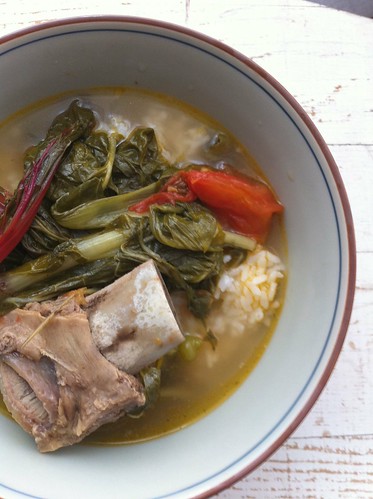
• What would be your last meal on death row? It took me a while to answer that question, but the more I eat pork sinigang, the more I stick with it as the last thing I want to eat before I go. It’s my comfort food and it’s the dish I request from my father when I return from a trip. If you ask the Dr., it’s also his favorite Filipino food.

    Back in the Philippines, I grew up eating it many ways. The only requirement is its sour taste, but the sourness always depended on where the cook was from. The most familiar to me is using tamarinds. We had a tree in the backyard and the tamarinds would be simmered in a pot to make the sinigang broth. Kamias, or bilimbi, was also used by squeezing them and straining the juice. Nowadays, though, Knorr makes the soup base with the concentrated flavor of the tamarind. They sell for 80 cents in Chinatown stores. I like this dish best when the sourness hits the back of my ears and my left eye uncontrollably closes, so I usually end up using the entire packet. I add a Serrano pepper towards the end to give it an extra kick.

    As for the vegetables in sinigang, Filipinos use kang kong–called swamp cabbage or water spinach in Chinatown–but you can certainly use other vegetables that don’t have a bitter taste. Broccoli and long string beans, or sitaw, are easy. Okra is also good, as well as daikon radish and eggplant. I’ve tried daffodil leaves but they didn’t work.

    Using a crock pot allows you to slow-cook your spareribs without paying attention to them. Leave it overnight or cook it while you’re at work. Eight hours will leave you with meat falling off the bones. My way is to slow-cook in a Dutch oven for at least an hour and a half, removing impurities that rise to the top using a ladle. Filipinos love their pressure cookers, but those things scare me. Besides, I like taking my time when I cook.
    Ingredients:
    6 spareribs
    1 packet Knorr Tamarind soup base
    1 tomato, halved
    1 red onion, quartered
    1 green Serrano pepper, cut in two
    1 bunch kang kong
    2 small eggplants
    1 small daikon radish
    salt

    1. Use a Dutch oven with enough water to cover the spareribs and simmer for at least two hours. Remove impurities that float to the top.
    2. When spareribs are ready, bring to a boil and add tomato and onion. Simmer until tomato is bruised. Add the vegetables and cook until tender. If using eggplant and okra, add them last to avoid overcooking.
    3. Add tamarind soup base and salt to taste. Saltiness and sourness should be balanced. The vegetables will tone down the taste. Throw in the pepper before turning off the heat.

    Related post/s:
    Where to buy sinigang packets in New York City

  • corner of 139th Street and Adam Clayton Powell Boulevard
    no phone number
    $25 for a whole rack of pork ribs
    ♥ ♥

    Amidst the condo buildings going up as fast as you can say gentrification, there still remains the open drums on the streets used as makeshift grills to sell home-marinated barbecue in Harlem. The Dr. and I stopped by earlier this year when we saw the smoke coming out of a corner street shrouded in scaffolding. We still haven’t figured out who runs the show, but as far as we know, a big black lady sitting down is the one who repeats everyone’s orders to the more-able “staff” around her: an older lady who spoons the sides in a container, an older man who slices the ribs apart and another who mans the grill. She is also in charge of how much to charge her customers because no one really knows how much the food really is, especially when it comes to people who look like us.

    During our first visit, four ribs with a small tub of potato salad and two slices of white bread were $10; a second visit with an order of a whole rack without any sides, even bread, was $25. A third visit cost us $70 for two racks, four sides and a giant watermelon. We’ve caught the big lady giving the older man a look when they calculate our totals.

    The ribs are really, really good. They have a tangy taste to them–a North Carolina style using cider vinegar. The meat doesn’t fall off the bones, but is tender enough to pull when you give it a bite. And in this rapidly changing neighborhood, very satisfying.

  • I saw these slimy suckers swimming in a large tub in Chinatown when the Dr. and I met up to buy groceries. Can we buy that? I asked. What are you going to do with it? The Dr. wanted to know, even though my asking does not really mean anything. I was already signaling to the lady behind the counter to get me one. It cost about $5.50 for one, cleaned, but head intact.

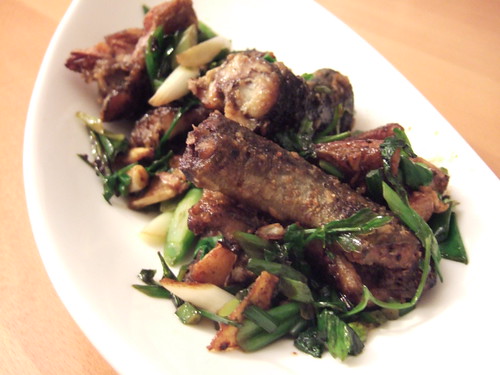
    Back at home, the eel was washed with salt and water because it was so slimy. We chopped it up in four pieces–a sharp knife was needed as the spine was pretty tough. The Dr. thought braising it in tomato paste would be ideal, but since I didn’t have it available, we just coated it in salted flour. We threw it in hot oil with some chives and scallions and the snake-like critter made some good eatin’! The meat was tender, and no kidding, tasted just like chicken.

    Ingredients:
    1 yellow eel, cleaned, chopped in 4
    3 stalks of scallions, roughly chopped
    2 stalks of chives, roughly chopped
    1/4 cup of flour
    chili flakes
    lemon juice
    oil, salt, pepper

    1. Combine flour, salt, pepper and chili in a small bowl. Coat the eel pieces evenly.
    2. In a deep sauce pot, heat some oil and sauté the leeks and chives for 1 minute. Remove immediately to a paper towel-lined plate.
    3. Then slowly drop the eel pieces. Fry until golden brown on all sides. Use tongs to make sure they are cooking evenly on both sides. Do not cover. Remove fried eel to the same plate when cooked.

    Related post/s:
    Deluxe Food Market has fresh eel
    Creeped out by eels? Try octopus!

  • corner of 145th Street and St. Nicholas
    212/491.8323
    $12 for two fish and chips, take-away
    ♥

    Harlem is teeming with fish and chips stores, and living in the neighborhood has taught me that the longer the line outside, the better the food will be. (It doesn’t work the same way downtown.) Case in point: Famous Fish Market on 145th Street and St. Nicholas. I got out of the A train and noticed the long line outside this hole in the wall even while the rain was pouring. I asked the lady what the line was for. Fish and chips, she said. I asked if it was any good, and there was no hesitation in her voice when she answered in the affirmative. I had no choice but to join the queue. When my turn came, I ordered the regular fish and chips. I tucked the brown paper bag under my arm and ran home in the rain to eat.

    I like the English fish and chips as much as the next person, but what’s different with Harlem’s version is that the fish is mostly, well, fish. There is no art involved in the making of the batter–it’s just all fried fish! I like Devin’s Fish and Chips a block away, but I think I’ve found a new place to stop by on my way home.

    Related post/s:
    Devin’s Fish and Chips

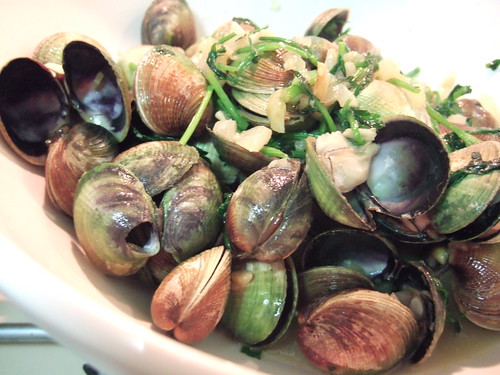
  • The Dr. requested seafood for dinner in exchange for his accompanying me to Roosevelt Island. While preparing for our meal, I entertained him with a smoked salmon appetizer. With a roasted branzino stuffed with lemon slices, I also served cockles in white wine sauce.

    Ingredients:
    1 bag of cockles, cleaned and scraped off
    1 cup dry white wine
    2 shallots, chopped
    2 cloves of garlic, minced
    a handful of flat parsley, chopped
    olive oil

    1. In a large pot, heat some oil and sauté garlic and shallots. Add the cockles and toss until a majority of them open up. Shake the pot to be sure that all the cockles are getting equal heat. Add white wine and cover for about 3 minutes to let the wine simmer.
    2. Drain the cockles into a large bowl, saving the liquid. Discard unopened cockles. Return the liquid to the pot and bring to a boil. Add chopped parsley. Pour this sauce over the cockles and serve immediately.

    Related post/s:
    How about some steamer clams?
    Perhaps the more familiar mussels?
    Momofuku serves cockles with ham and eggs

  • It took a lot to convince the Dr. to take the tram to Roosevelt Island with me–like a homemade lunch and dinner kind of a promise–but he finally relented one hazy Saturday. From 59th Street and Second Avenue, we boarded the tram using our Unlimited Metrocards. The tram runs on a much slower schedule on weekends, but the ride took less than fifteen minutes.

    We stopped by the visitors’ center to pick up a map to help us canvas the surroundings. From there, we walked south through the park and stopped in front of the Renwick Ruins, also known as the smallpox hospital constructed in 1856 when the epidemic was responsible for a lot of deaths in New York City. (James Renwick was its architect, the same architect responsible for St. Patrick’s Cathedral in Manhattan.) Because of the highly contagious nature of the disease, the island setting was considered ideal. It was turned into a nursing school residence when they transferred the patients of the hospital to another location. Today it is the city’s only landmarked ruin, covered in ivy, gated to keep trespassers off and lit at night.

    We passed the Strecker Lab next to the ruins. It served as the pathology building for the hospital. We continued our walk to the southern tip of the island where there was, surprisingly, a bed of daisies. The Manhattan skyline was hazy from there, so we turned back and walked towards the north where the view of Long Island City in Queens was more pleasant.

    A working hospital now stands behind the Roosevelt Island park where we saw a lot of patients on wheelchairs enjoying the view of the Manhattan skyline. The scene was a little eerie to me because, even though they have a nice view of the city, I felt that they were still isolated from the rest of the Big Apple. Residents who are more mobile live in some of the newly-built condos on the island. If not the tram, they take the F subway to get to Manhattan.

    An interesting tidbit: Roosevelt Island appears in F. Scott Fitzgerald’s The Great Gatsby as Blackwells Island when Nick and Jay drive into Manhattan via the Queensboro Bridge.

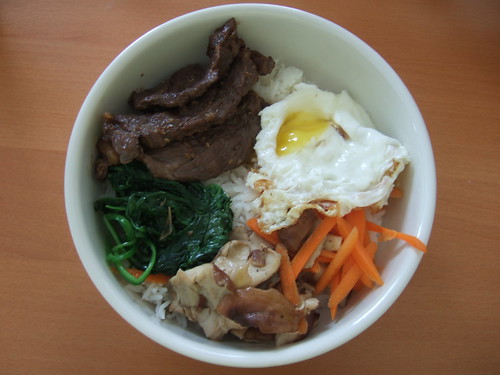
  • What possessed you? the Dr. asked as he cleaned off his bowl of bibimbap. I’ve always done Korean kalbi at home but have never done bulgogi, so I guess it was just about time. I haven’t had Korean food in a while and I was craving that sweet meat flavor.

    In Korean, bulgogi is “fire meat” because rib-eye or sirloin is traditionally grilled. Bibimbap is translated as “mixed rice.” A bibimbap bowl consists of warm white rice topped with sautéed vegetables, the bulgogi and a fried egg. Kochujang, a spicy Korean condiment made of fermented soy beans and chilis, is served with it. You mix everything together just before eating.

    The Dr. said my version tasted “just like the real thing.” I even think it looked like the real thing! I think I deserve some points.

    Ingredients:
    1 small carrot, julienned
    1 bunch spinach, thoroughly washed
    4 shiitake mushrooms, dirt rubbed off using a dry paper towel
    1 egg
    1 tbsp sesame seeds, toasted
    1 tbsp sesame oil
    Korean kochujang paste

    For the bulgogi:
    1 pound rib-eye boneless beef steak, sliced in 1/4-inch thick pieces
    1/2 cup soy sauce
    1 Asian pear, grated with juices
    2 tbsps finely chopped garlic
    1 small white onion, roughly chopped
    2 stalks scallions, roughly chopped
    1 small knob ginger, peeled, grated
    2 tbsps light brown sugar
    1 tbsp honey
    2 tbsps sesame seeds, toasted
    2 tbsps sesame oil
    a pinch of ground red pepper
    black pepper

    1. Whisk together all the bulgogi marinade ingredients in a large baking dish. Add the thinly sliced beef and turn to coat. Cover and refrigerate overnight.
    2. When ready to prepare bibimbap, heat a stove top grill to high. Grill marinated beef for 1 to 2 minutes per side without overcrowding. Remove to a plate.
    3. In the meantime, using a frying pan, heat some peanut oil and sauté spinach. Season with some salt. Remove to a plate. Using the same pan, add the mushrooms and sauté by adding in sesame oil. Remove to the same plate. Keeping the same frying pan, add a little more peanut oil and fry the egg over easy. Remove to the same plate.
    4. To serve, put a serving of cooked rice in large slightly shallow bowl. Place bulgogi on top to one side. Cover the rest of the rice by adding the vegetables and mushrooms. Put egg on top. Sprinkle with sesame seeds. Serve with kochujang paste on the side. To eat, mix well.

    Related post/s:
    Korean kalbi is also as good
    Serve with Korean pickles, or kimchi

  • 630 Bedford Road, Pocantico Hills
    914/366.9600
    $720 for three tasting menus, with wine pairing, with tip
    ♥ ♥ ♥ ♥

    Is there such a thing as too much? We arrived at Blue Hill Stone Barns just in time for our 5pm table where we were welcomed by fresh air and green grass. We sat in the lounge with our pickled ramps and cucumber martinis and black currant cosmo while they prepared the dining room. When we were seated, we met our waiter for the evening, Andrew, who happens to be from Brooklyn. He also introduced us to the sommelier, Thomas, after we decided that the farmer’s feast tasting menu with the wine pairings was the way to go. We hoped to stay for less than four hours–we thought it would be enough time to eat, chill and take the 40-minute train ride home. So how did we end up staying until 11:30pm? And how did Andrew end up snipping fresh herb leaves for our tea while we sat out in the garden? Sometimes, you just accept things as they happen and try remember every detail the next day.

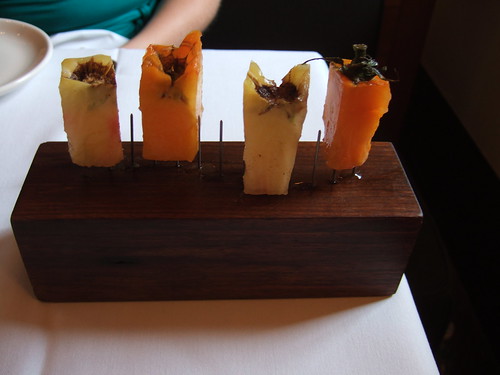
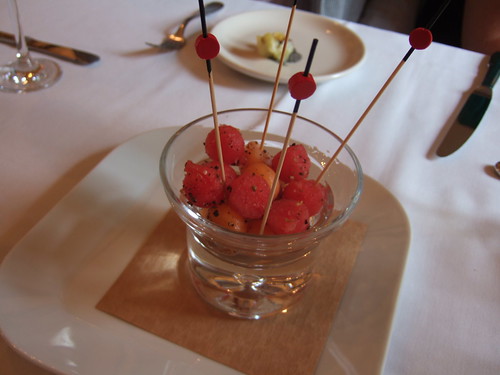
    As far as I can recall, we had a few amuse-bouche that featured the summer tomatoes and watermelon from the Blue Hill gardens. There was a tomato gazpacho we drank like a shot, with small tapioca bubbles that tickled our tongues. There were small balls of watermelon and cantaloupe sprinkled with black pepper that were so playful they reminded me of our night at Alinea in Chicago. There were the colorful tomato pulps that otherwise would have been discarded stuck vertically on pins held by a wooden block.

    There was feta cheese and watermelon granita served in small wine glasses–a sharp icicle-like texture and smoothie in our mouths. There were roasted heirloom tomatoes covered with goat cheese mixed with arugula. There was the watermelon sliced like a thick cracker, topped with crispy pancetta, currant tomatoes and goat cheese foam. It was a beautiful presentation using the simplest ingredients. Only several dips broke the watermelon-tomato parade: fresh ricotta with honey and black pepper, roasted eggplant, whipped lardo, arugula salt and carrot salt accompanied by Balthazar-baked bread.

    One of the main dishes I remember was the waxed beans with farm-fresh egg sprinkled with pistachios, a Blue Hill stand-by. The egg was encrusted in breadcrumbs which made it fun to break. I recalled the chickens running free as soon as our cab entered the Stone Barns property. I pretty much checked out after that: there was pork belly served with the chicken mushrooms they were parading earlier in the evening, and then there was apparently a lamb belly with peas–I couldn’t tell the difference between the two after several glasses of wine. But I remembered the mock-risotto made of summer corn with tomato reduction. Andrew grated an embryonic egg as if it was aged cheese before we took our first taste. The desserts were, unfortunately, erased from my memory completely. I was told that there was a granita of some sort with some whipped cream, but a third one that involved cheesecake came with a lit candle. Andrew knew it was one our birthdays, but he couldn’t let the rest of the table feel left out so we all had our own candlelit dessert.

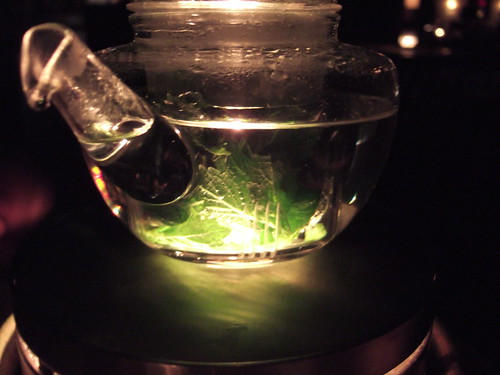
    He could have stopped there, but he made us feel more special by inviting us to check the herb garden in the back. He snipped some of the mint and thyme leaves while we sat out in the garden. He made us some tea to end our evening. It was an expensive night, but one I will remember for a long time, even if some of the details escape me.

    Related post/s:
    I’ve been at the Blue Hills in the city twice, with a new friend visiting during dinner
    Alinea in Chicago

  • I was in my neighborhood African store ordering my usual halal lamb meat when these tomato-looking things caught my eye. I asked the lady if they were tomatoes. We call them chungu, she said, but couldn’t help me with its American name. Do they taste like tomatoes? She couldn’t answer that either, so she got off her seat behind the counter, walked to one of the shelves and picked up a can of eggplants. Like this, she said, pointing to the can. I asked how I can cook them and she just told me to make my usual stew and add them. I just bought some Thai eggplants from Chinatown to add to a tagine dish, so I was curious how different the African kind would be. I picked up a few to try out.

    When making my chicken tagine–the Dr. is a big fan and it’s one of the dishes I’ve mastered in the last couple of years–I skipped the potatoes and added the two kinds of eggplants instead. I diced them only before I was ready to add them to the pot so that the flesh kept its natural white color. (If you use eggplants, whether they be the fat and bulbous American type or the long and skinny Japanese kind, you know that the spongy meat inside turns black if you have them sitting out for a few minutes.)

    The more familiar types are purple in color, aubergines as the French call them, but the African chungus I bought were green and had tight, shiny skins; the Thai type has a marbling pattern of green and white. It was an affordable vegetable to throw in a big pot of simmering meat, and turns out, tastes just like the other eggplants that come in different shapes and colors.

  • 36 West 48th Street between Fifth and Sixth Avenues
    212/398.2308
    about $50 for two, with two drinks, with tip
    ♥

    Wu Liang Ye was highly recommended to me by a Chinese friend. As we walked on 48th Street, past the OTB, the black garbage bags in front and the two crackheads on the steps, I could see why: there was nary a white person in sight and all the wait staff are older Chinese men in suits even though it was almost 90 degrees outside.

    I told one of the men in suits that I was there for a table for two. He asked me if I had a reservation. I looked around at the empty tables and said no. When I told him I will wait for the next table that opens up, he looked at me and ask, You really want to wait? He seated us in the back after five minutes.

    I was looking forward to eating Sichuan food. We had a long drive to a wedding in Rhode Island ahead of us and all I wanted was spicy Chinese food. After our Tsingtaos, we ordered our usual favorites: dan dan noodles and kung pao chicken. There was nothing extra special about them, but they are our staples whenever we get Sichuan food. I noticed, though, that Grand Sichuan makes a spicier version than Wu Liang Ye. The pork dumplings that were supposed to be spicy, too, were tolerable. We knew we were only sweating because of the restaurant’s lack of air conditioning. We also ordered the bacon with leeks. They weren’t kidding about the bacon. The leeks provided the crunch while the bacon was the king of salt in the dish. We couldn’t finish it even though we wanted to.

    Related post/s:
    I like Grand Sichuan in Chelsea
    But the Grand Sichuan on St. Mark’s is less crowded
    Spicy & Tasty in Queens is worth the trip

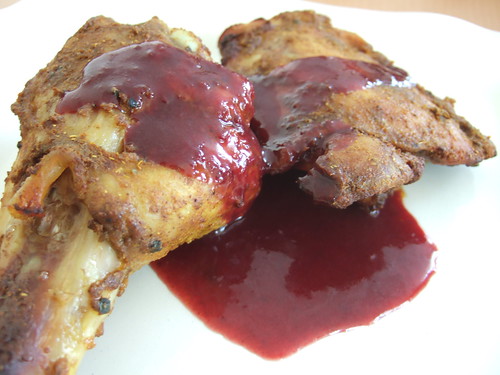
  • I’m still in shock when I find that most of the ingredients I need for a certain recipe is already in our kitchen. That’s the good thing with store-bought spices: you only have to buy them once in a while because you can store them for up to a year. For this one, all I had to do was buy the chicken, the yogurt and a couple of peaches. I used the blackberries I picked from North Fork after our trip to Montauk. They were in a Tupperware inside the fridge, but even after a few weeks, they were still good to go.

    All I really wanted was to use the blackberries before they went bad. I found this chutney recipe online and thought of matching it with pork chops because of the cherry chutney I made earlier this season. But then something Indian-spiced came to mind after I bought several lamb pieces from the Halal store around the corner.

    Ingredients:
    8 chicken breasts and legs, skinned
    1 cup of nonfat Greek yogurt
    1 onion, chopped
    2 tbsp cumin seeds, toasted, ground
    2 tbsps paprika
    2 tbsps garam masala
    2 tbsps turmeric
    2 tbsps cardamom, ground
    2 tbsps cayenne pepper
    salt, pepper, oil

    For the peach-blackberry chutney:
    1 cups of blackberries
    2 peaches, peeled, seeded, diced
    1/4 cup brown sugar
    1/4 cup cider vinegar
    1 onion, chopped
    2 coves of garlic, minced
    1 small knob of ginger, peeled, chopped
    1 small jalapeño, seeded, chopped
    salt, oil

    1. Make the marinade by mixing all the spices and yogurt together in a bowl large enough to fit all the chicken. Add the chicken pieces and make sure the marinade covers them all. Marinate for at least 2 hours in the fridge.
    2. Make the peach-blackberry chutney. In a saucepan, heat some oil and sauté the onions and the garlic. Add the jalapeño and ginger and sauté a few minutes more. Add in the cinnamon, vinegar, brown sugar and peaches. Keep sautéing until the peaches are soft. Add blackberries. Cook, stirring occasionally and crushing the fruits with the back of a wooden spoon. Turn off the heat and let cool. Strain to a container and serve with tandoori chicken.

    Related post/s:
    Make your own garam masala
    Crispy okra is great as a side dish
    How about some tandoori lamb chops?
    You can make chutney with cherries

  • I received a packet of flor de sal, or flower salt, and a packet of sea salt from Terras de Sal in Portugal last week. What good timing, too, because I ran out sea salt and have been using the grocery store type the last two nights. The Terras de Sal sea salt looks and feels like a handful of rough diamonds. It tastes like they were just filtered from the ocean. The flor de sal is more fine, and because it is traditionally applied to food before serving, its saltiness is less strong.

    Terras de Sal mines its salt in Castro Marim, or Castle by the Sea, in the surrounding natural marshland of Reserva Natural do Sapal de Castro Marim. The area is a breeding ground for many species of birds and the salt mines are known to keep its surroundings balanced with the natural environment. All the salt they produce are mined by hand with the aid of wooden instruments and techniques used from a long time ago. When the package from Portugal came, I was very intrigued since I’ve never really distinguished the different kinds of salt available in fine stores today.

    I searched for a recipe that uses a large quantity of salt. I used a fish I’ve never heard of: croaker. They were among the newly delivered fresh fish in the Harlem supermarket one Saturday morning and were going for only $2.80 for a whole one. I read later that croakers live in shallow lagoons and therefore eat a lot of shellfish, so they’re meat is considered to be pretty good even though a lot of fishermen think they are a nuisance. (Feel free to substitute with a sea bass.)

    When done, the Terras de Sal salt not only gave the fish some flavor, it also gave this dish a uniquely presentable look.

    Ingredients:
    1 white croaker, cleaned and scaled
    1 egg white, lightly beaten
    1 lemon, sliced, plus some zest
    2 sprigs of thyme
    2 sprigs of rosemary
    1 cup sea salt
    olive oil, pepper

    1. Preheat oven to 425º. Meanwhile, sprinkle the inside of the fish with pepper and stuff with lemon slices.
    2. Make the salt mixture. In a bowl, combine the thyme and rosemary with the sea salt, lemon zest and egg white. You can add a little water to get a coating consistency. It shouldn’t be too crumbly.
    3. Coat the fish. Spread some of the salt in a roasting pan and place the fish on top. Completely cover the fish with the rest of the salt mixture. Make sure the whole fish is concealed by the salt as this will seal it and keep all the aromas and flavors inside.
    4. Bake the fish for about 35 minutes. When done, remove the fish from the oven and carefully crack the salt case using a heavy knife and remove the fish. Serve the fish with a drizzle of olive oil.

    Related post/s:
    Use Terras de Sal flower salt on fennel tomato salsa

    Recommended purveyor/s:
    Buy your salt from Terras de Sal