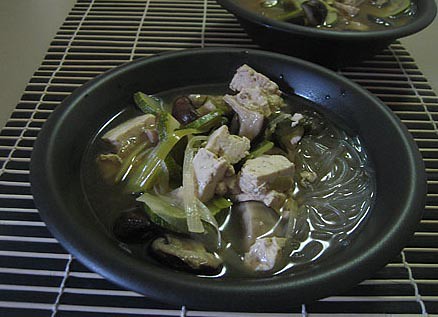
• I adjusted this from a vegetable ramen recipe using rice and potato vermicelli. This may seem to require a lot of ingredients but it’s easier than you think–just put all the vegetables in the pot and boil. Any vegetables will do, really, and I’ve tried this with baby bok choy, Napa cabbage and carrots.

    Ingredients:
    1 pack each of rice and potato vermicelli
    a quart of vegetable stock
    1 packaged firm tofu, sliced in small squares
    zucchini, chopped in half moons
    snow peas, destringed and sliced in half
    leeks, white parts only, chopped
    shiitake mushrooms, dusted off dirt, halved
    a small knob of ginger, peeled and sliced thinly
    garlic, crushed
    1 packet of white miso powder
    1 tbsp rice wine vinegar
    2 tbsps soy sauce
    sesame oil

    1. Sauté ginger and the garlic in a stock pot first then add the vegetables, stirring for 5 minutes. Add stock and let boil. Turn down the heat and simmer. Stir in miso powder, rice wine vinegar and soy sauce. Adjust to taste.
    2. In a separate pot, cook noodles in boiling water for 4 minutes. Stir with a fork to avoid sticking. Drain with cold running water. When cool enough to handle, use your hands to separate noodles and drain some more.
    3. Put a handful of noodles in a bowl and ladle in soup. Add a drop or two of sesame oil.

    Related post/s:
    Where to get white miso powder

  • The temperature outside finally went down. Now, it really feels like almost-Christmas. Before the squash and the pomegranate completely disappear from the markets, I made a very hearty soup perfect for a Netflix night. I still had leftover molasses from the last pomegranate recipe and that made this soup a little tart and gave it a nice spunk.

    Ingredients:
    1 butternut squash, cut in half lengthwise
    1 quart chicken stock
    1 tbsp pomegranate molasses
    1 pomegranate (optional)
    1 cup heavy cream
    a handful of pine nuts, toasted then some of it grounded
    1 tbsp honey
    a pinch of nutmeg powder
    half a cinnamon stick, grounded
    a pinch of whole cloves, grounded
    salt, pepper, olive oil

    1. Preheat oven to 400º. Drizzle the inside of the squash with olive oil and sprinkle with salt and pepper. On a baking sheet, bake cut side down for up to 2 hours. When done, let cool and then scoop out all the squash meat in a bowl.
    2. In a pot, simmer the chicken stock with the squash, grounded pine nuts, honey, nutmeg, cinnamon and cloves for about 40 minutes. Using a blender, puré in batches and transfer back to another pot with a strainer. Simmer and keep adding chicken stock while stirring ocassionally to thin the soup.
    3. In the meantime, make the topping. In a small glass bowl, whisk heavy cream and molasses until fluffy. Ladle the soup in serving bowls and top with a dollop of this cream. Top with remaining pine nuts and some pomegranate seeds.

    Related post/s:
    Don’t waste all that pomegranate molasses
    Where to buy pomegranate molasses

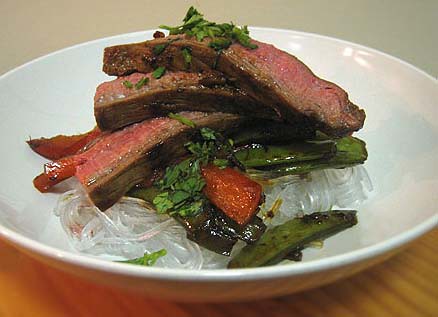
  • There have been some wonderful sugar snap peas in Chinatown for less than $2 a pound. I imagined making some sort of crunchy salad with them so I stopped by my butcher on Mott to buy a nicely-red beef flank steak to match. After searing the steak, the sauce caramelized and I ended up throwing the snap peas in the same skillet to wipe it off. The beef came out perfectly medium-rare and pink inside when I was slicing it against the grain. You can definitely eat this with rice but I opted for vermicelli noodles to make it lighter. Because it took less than an hour to make this, two people were able to drink the rest of the night after eating.

    Ingredients:
    1 pound of beef flank
    4 tbsps kecap manis
    3 tbsps sambal oelek
    a bunch of cilantro, finely chopped
    4 cloves of garlic, minced
    1 tbsp sesame oil
    2 tbsp peanut oil
    rice vermicelli
    1 red bell pepper, julienned
    a handful of sweet snap peas, trimmed
    salt

    1. Marinate the meat. In a large bowl, combine kecap manis, sambal oelek, cilantro, garlic and sesame oil and rub all over the flank steak. Cover and put in the fridge for about 20 minutes.
    2. In the meantime, trim the peas and julienne the vegetables. When ready to cook, heat peanut oil in a large skillet and sear the flank steak in high heat. Let it sit on one side first without moving it and then turn to sear the other side, about 8 minutes each depending on its thickness. Remove to a chopping board and let rest for about 5 minutes.
    3. Keep the heat on and cook the peas using the remaining oil and crusty bits in the skillet and then add the peppers. Stir-fry until peas are tender.
    4. Boil some water in a pot and then turn the heat off. Add the vermicelli in the hot water and let it cook in the remaining heat for a couple of minutes. Drain and using a fork, separate noodles and serve in a bowl. Slice the beef against the grain and serve on top of the noodles with the vegetables. Pour remaining sauce from the skillet on top.

    Related post/s:
    More recipes using flank steak

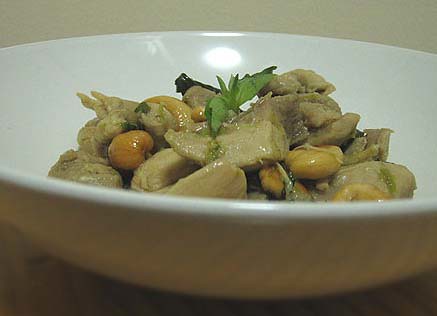
  • I’m on a Thai and Indian kick lately so I’ve also been craving spicy and hearty stews. But I didn’t want to spend too much time cooking last night–I just wanted to eat. Something quick for dinner to me means stopping by the Asia Food Market around the corner from the office and buying fragrant Thai basil leaves and lemongrass. Chicken is usually my fallback when I just want to eat from a big rice bowl in front of the TV and I ended up doing just that after putting this together, quickly and painlessly. I made a big batch so guess what I’m having for lunch?

    Ingredients:
    4 boneless chicken thighs, cut in small pieces
    1 bunch of Thai basil leaves
    a handful of cashews
    1 small knob of ginger, peeled, sliced thinly
    4 garlic cloves, minced
    1 lemongrass stalk, crushed, chopped
    1 bunch of cilantro stalks, finely chopped
    2 red chilis
    juice from 1 lime
    2 tbsps palm sugar
    2 tbsps fish sauce
    oil

    1. In a large bowl, mix the chicken with the ginger, garlic, lemongrass, cilantro and chilis.
    2. In a large skillet, heat some oil and lightly toast the cashews. Remove to a plate and drain with a paper towel.
    3. Add more oil to the skillet and cook the chicken in batches, stir-frying until they’re cooked and lightly browned.
    4. Stir in the basil leaves with the lime juice, sugar and fish sauce until the leaves wilt. Toss in the cashews and simmer until the liquid thickens a bit.

    Related post/s:
    Another Thai-inspired dish

  • I never really bake because I’m not a big fan of desserts. When I tell my friends who love to bake that I am a better cook because I can just throw ingredients in a pot and make a nice dish out of it, they tell me the same thing–that they throw eveything in a bowl and bake. I honestly think baking requires more skill and patience. I can chop vegetables until my hands are numb so I can make my own Vietnamese summer rolls and I enjoy braising and waiting for my beef bourguignon to come out of the oven, but I have no patience to wait for anything to turn golden brown. If I need more than my finger to poke and see if it’s cooked inside, then I don’t want it.

    I bought a loaf of ciabatta bread the other day to make some pizzetta for dinner and ended up only using less than half of it. I didn’t want it to go to waste so I picked up a quart of heavy cream the next day and actually baked pudding when I got home. Sure enough, it took a few TV shows before they were the color I imagined the top of pudding should be, but they actually came out perfectly. I used a 12-muffin tray and topped them with caramel sauce and packed them for sweet-toothed co-workers the next morning.

    Ingredients:
    1 big loaf of day-old bread
    3 eggs
    3 egg yolks
    1 cup maple syrup
    2 cups heavy cream
    1 cup milk
    2 tsps vanilla extract
    2 tbsps butter

    1. Prepare everything before baking. Preheat oven to 300º. Grease muffin tray with melted butter. Set aside. Slice and break bread into small pieces and fill each muffin hole.
    2. In a large glass bowl, whisk together eggs and egg yolks. Add 3/4 cup of the maple syrup, 1 cup of the heavy cream with the milk and vanilla. Pour this mixture into each muffin hole with the bread, enough to make sure they are swimming.
    3. Fill a deep baking tray with about 2 inches of water. Place the muffin tray in the baking tray and bake until golden brown, about 1 hour. If necessary, gently flip each muffin with a spatula and cook the bottom of the muffins until they are also lightly browned.
    4. During the last 30 minutes of baking, make the caramel sauce. In a small non-stick pan, heat the remaining maple syrup and whisk in the other cup of cream until thickened. Add the butter and a pinch of salt and keep whisking in low heat until caramelized.
    5. When ready to serve, place muffins on a plate and pour caramel sauce on top.

    Related post/s:
    Where I buy ciabatta bread
    Leftover ciabatta bread

  • The Dr. and I stopped by the Union Square Wines & Spirits store before we viewed the amazing Ron Mueck sculptures in the Brooklyn Museum on Saturday. They were having a free tasting of several Bordeaux and Burgundy wines from France with Marcus Lartigau, a French wine guru. We stayed for about an hour and we learned a lot of things during the tasting. I took notes and I’ll try to list them here from my indecipherable handwriting to share with you.

    If you look at a map of France, you’ll see that Bordeaux is on the lower west side of the country, closer to Spain, while Burgundy is to the east. Red wine from Bordeaux is made from Merlot and Cabernet Sauvignon with small quantities of Cabernet Franc, Malbec and Petit Verdot for blending. White Bordeaux is mostly made of Semillon but also with a blend of Sauvignon Blanc, Muscadelle and Ugni Blanc. Red Burgundy is made exclusively of the Pinot Noir grape while white Burgundy is all Chardonnay. Most of the wines from Bordeaux follow a classification that’s why a lot of people think they are more “intellectual” than Burgundy because of the rules they follow. A lot of vineyards in the Burgundy region have multiple owners so a lot of the wines come with several names on the labels. But the most obvious thing that a lot of people don’t know about the two wines is the bottle shape. Bordeaux bottles have high shoulders while Burgundy bottles slope.

    The following list consists of the wines we tasted. My personal favorite was the red Bordeaux from Chateau du Tertre at around $35 a bottle:

    1. Domain Michel Niellon 2004 Chassagne-Montrachet Blanc – Burgundy — a little anemic
    2. Chateau Carbonnieux 2004 Pessac Leognan Graves Grand Cru – Bordeaux — grapefruit, very clean
    3. Domain Ramonet 2004 Chassagne-Montrachet Rouge – Burgundy — tangy in the beginning but very good in the end
    4. Chateau Grand-Puy-Lacoste 2001 Pauillac Grand Cru – Bordeaux — some raisin, a little bit of spice
    5. Chateau du Tertre 2002 Margaux Grand Cru – Bordeaux — bolder and fuller, more spice
    6. Chateau Gruaud Larose 2003 Saint-Julien – Bordeaux — a little bit more alcohol and drier

  • 213 East 45th Street between Second and Third
    212/867.5454
    $104 for two, with two drinks, without tip
    ♥ ♥

    There are two ways you can order your grilled food at Aburiya Kinnosuke. The robata grill is right at the bar where the Japanese chefs set skewers next to burning coals (not on top of) and take about 30 to 40 minutes to prepare. If you choose the shichirin grill, your meat will be served on top of a little clay pot and you can grill your food yourself. The portion is small you won’t be grilling like you do at a Korean restaurant. It’s all done that Japanese way: simple and understated.

    When we reserved two seats at the bar, the fish of the night was yellowtail and the specials board noted that they were all flown in from Japan. The restaurant’s specialty is fish collar and because the yellowtail probably flew in style, it was priced at $30. We were interested to try it even at that price but thankfully, they were all out of stock by 9pm. We opted for the sea bass collar instead for $7. For collars, I don’t care if the fish came from another country. If it’s a cheap cut of fish, it really shouldn’t be more than $10. That said, we imagined our $7 sea bass collar was as good as how the $30 one would have tasted. It’s grilled the same way and it probably had the same amount of meat as the yellowtail.
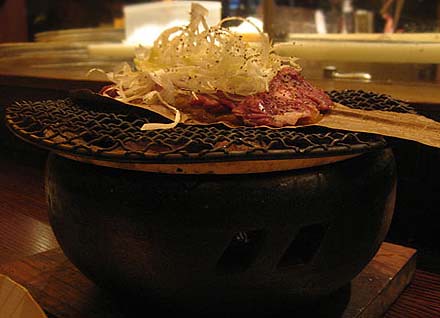
    But we started with the monkfish liver first. We never fail to order ankimo when it’s on the menu and Aburiya Kinnosuke’s is as delicate as they come. Another item we don’t skip at Japanese restaurants is the uni. The sashimi was served in a small woven basket with two kinds of kelp. I couldn’t help but order the fresh sea eel minus all the familiar kabayaki sweet sauce. They were served with the eel bone deep-fried with a dollop of wasabi. The eel meat was soft, yet very meaty, and it really had its own sweet taste without the dressing. The pork cheeks were delicious. They were chewy but tender enough to make us forget that cheeks, too, are considered cheap cuts. The offal taste was offset by the sweet seaweed and lemon juice. The fried chicken balls came with grilled peppers, something we’ve come to love after Barcelona, and powdered sea salt. They were crunchy without being too heavy. Next were the beef slices on the shichirin grill. They were atop a dried magnolia leaf and a handful of miso chiffonade garnished them. We cooked them for only a few minutes, rare and juicy enough to eat.

    The servings were small so Aburiya Kinnosuke’s pacing was key. There were short pauses in between our dishes that allowed us to enjoy our Sapporo and plum vodka. Our dessert was one of the best things I’ve had since my visit to ChikaLicious: white sesame pudding with vanilla ice cream. The sweetness was so restrained and the nuttiness so addicting that I could have eaten another serving even though we were so full.

    The crowd at Aburiya Kinnosuke is more adult and more moneyed. In fact, you can reserve a booth behind small curtains where a lot of the Japanese men probably conduct important businesses. (Since the initial reviews were published in 2005, they have employed English-speaking staff. The white girl who answers the phone is as fluent in Japanese as any of the chefs.) I understand that I have to go to midtown to have a real Japanese meal because of the proximity of the United Nations building. If I count how many times I eat Japanese food in a given month, I would group the restaurants in midtown as the best ones. Aburiya Kinnosuke is just one of them.

    Related post/s:
    Desserts at ChikaLicious
  • 792 9th Avenue between 52nd and 53rd Streets
    212/459.9057
    $52 for two, BYOB, without tip, cash only
    ♥ ♥

    I never make it to the Hell’s Kitchen neighborhood but before a My Morning Jacket concert at Roseland Ballroom, we wanted to eat dinner. Wondee Siam came recommended from an out-of-towner. Forgive me for being cynical, but I usually would not take a recommendation from a tourist, especially for Thai food. But I stand corrected. Not only did Wondee Siam offer traditional Thai food, it also offered the good kind. So what if he got the advice from Zagat’s?

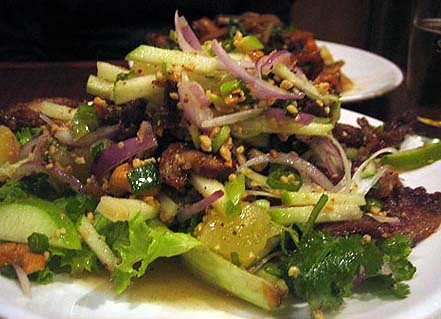
    When we were ordering our meals, I told the waiter I wanted duck so I asked for his opinion between two dishes that had roasted duck in it: Yum Ped Yang and Duck Ka Prow. He said he likes the Yum Ped Yang one (or so I thought) so I nodded to order that. When it was time to eat, he brought both dishes to us. When I told him I only picked one, he apologized but left them on the table. When we realized he was not going to take the other plate away from us and from our bill, we just asked him to pack it for us to take home. Some battles should be left untouched especially if the Yum Ped Yang with slivers of green apples and cubes of pineapples was really good.

    The duck wasn’t roasted, it was deep-fried, and it tasted more like bacon than it did duck. (It looked like bacon, too!) But I was all over the fresh combination of the chili pepper, lime juice and cashew nuts that I didn’t really care if it wasn’t the dish I ordered. The duck Ka Prow tasted familiar because I cook it at least once a month with chicken. Fresh basil is always a nice touch with sweet soy sauce even though the menu listed it as oyster sauce.

    The mixed seafood roll was like a deep-fried version of shumai and was served with that sweet orange dip Chinese restaurants call duck sauce. The menu listed it as plum sauce which I thought has a darker color. I barely tasted the crab which is featured as the main ingredient but it was still a pretty good appetizer. The chicken was good, too, drowning in all the sauce which makes your mouth numb in a good way.

    We had a good meal at Wondee Siam because their selection was also better than Pongsri’s downtown, so I’ll give them two stars even though what we ended up eating were not exactly what we initially wanted.

    Related post/s:
    Make your own Ka Prow

  • 1569 Lexington Avenue off 100th Street
    212/348.0200
    $25 for two, without drinks, without tip

    For brunch one Sunday, we took the bus to the east side of Harlem and sat at the bar of Food. We watched ice skating on one TV and that weird game of stone and broom called curling on the other. Jewel also happened to be playing from their satellite radio. Food is a restaurant that seems out of place in the El Barrio area of the upper east side but it’s also one of the sure signs that the neighborhood is really changing. Space and rent prices are two of the reasons why businesses are opening uptown. They are also trying to reach those customers who have moved up for the same reasons. No one could have imagined two Asian people being served by a French man in Harlem just a few years ago.

    Whether these changes are accepted or not, what we ordered were enough to start our day right: turkey burger with fries and huevos rancheros with bacon and beans. They were good, not exceptional, but the ritual of brunch is always better than the meal itself. I’m just glad Food makes it easier for us uptowners to partake in it.

  • The Dr. was on call so I knew I had time to make dinner before he comes back from the hospital. I stopped by the Blue Moon fish stand at the farmers’ market on my way to work and bought a couple of swordfish steaks. I’ve been buying fish from them because they also give me fish heads for free to make stock. Lately, I go up and check what’s on their blackboard and buy the kind I’ve never cooked before. We caught a swordfish when we were vacationing in Panama but we let the bugger go because he was so small. Notorious for being elusive, it’s a good fish to catch for sport. The FDA warns about high amounts of methylmercury in them so it’s been adviced not to eat them more than one serving a week. But oh, they make an excellent dinner with a bottle of white wine and they can make a very tired doctor happy.

    Ingredients:
    2 swordfish steaks, sliced about 1/2-inch thick
    2 bulbs of endive, leaves separated
    6 slices of bacon
    a handful of cherry tomatoes, cut in half
    2 garlic cloves, minced
    juice of half a lemon
    2 tbsp butter
    1 tbsp sugar
    parsley, finely chopped
    salt, pepper, olive oil

    1. Marinade swordfish in a shallow dish with the garlic, lemon juice, salt and pepper and olive oil. Make sure the fish is well-coated. Cover and chill in the refrigerator for about 20 minutes.
    2. Braise endives in the meantime. In a deep skillet, bring 1 cup of water, butter, sugar, a pinch of salt and pepper to a simmer. Add endive in one layer and braise them, covered, turning wedges over once in a 10-minute period. Remove lid and increase heat to medium-high, then cook until all of liquid is evaporated and endive is caramelized, about another 6 minutes. Transfer to a serving plate.
    3. Place swordfish on a baking sheet with the tomatoes and broil in the oven for about 20 minutes or until fish is tender and cooked through, turning over once. Place on top of the endives.
    4. Cook bacon in a skillet until golden brown and crispy while the fish is in the oven. Transfer to a plate lined with paper towel and drain. Chop roughly and sprinkle all over fish with the parsley. Serve with lemon wedges.

    Related post/s:
    What the FDA says about swordfish
    Buy fish from the Greenmarket

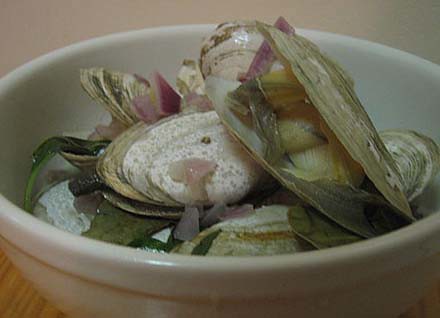
  • I cooked these steamer clams the way I cook mussels, but I added some fresh basil to give the dish a different taste. It was a nice appetizer with crusty ciabatta bread.

    Ingredients:
    half a dozen steamer clams, rinsed
    2 tbsps butter
    1 cup of dry white wine
    a small bunch of basil leaves
    1 bay leaf
    parsley, finely chopped
    1 medium onion, finely chopped
    2 garlic cloves, minced

    1. Put the shallots and white wine into a large stainless steel pot. Add the clams and cover. Steam them over high heat until the clams have opened, about 5 minutes.
    2. Drain the clams into a large bowl, saving the liquid. Discard unopened clams. Return the liquid to the pot and bring to a boil. Add the butter, basil and chopped parsley. Pour this broth over the clams and serve immediately.

    Related post/s:
    Mussels with white wine

  • 457 Court Street off 4th Place, Carroll Gardens, Brooklyn
    718/403.0033
    about $150 for four, with a bottle of wine, without tip, cash only
    ♥ ♥

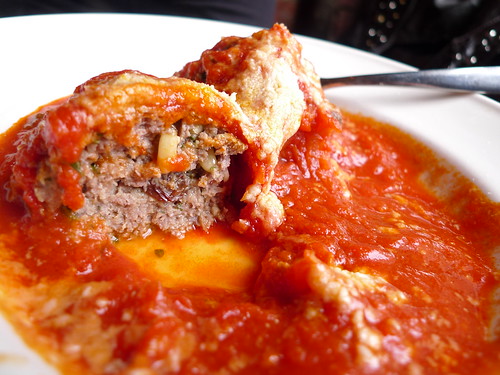
    Update, February 2009: I had a lovely weekday lunch here with gnocchi and meatballs. Both were in tomato sauce that had their own tastes. (It wold have sucked if they used the same sauce for two different dishes, no?) The salads–fennel, celery root and arugula with mozarella–were brightened by a squeeze of lemon juice and good olive oil. They were simple and just made me very happy.

    We walked in Sunday night for an early dinner and Frankie’s was already packed. We were seated in the restaurant in the back, a separate space mainly used for private parties. The main dining room seemed homey with guests eating sandwiches and crostinis, but the back felt more comfortable with only five tables. After they turned down the music volume in the back, we felt like we were having our own small dinner party at home.

    Frankie’s menu showcases the same comfort food I’ve gotten used when dining in Brooklyn. There were no seafood selections, which disappointed me a bit, because I was in the mood for fish after celebrating Thanksgiving. The home-made cavatelli with hot sausage and browned sage butter was excellent. The roast loin of pork with broccoli rabe and pine nut polenta was hearty and filling. The desserts could use a little excitement though, because sometimes tiramisu, creme brulée and cheessecake just don’t quite cut it.