Pig’s Ears Salad

The new year has just begun and I already have a favorite cookbook: Stéphane Reynaud’s Pork & Sons from Phaidon. I immediately wanted it when I saw José Reis de Matos’ pig illustrations and Carlotta’s hand-written curly titles bounded in baby pink and white gingham checks, but I held off from buying yet another cookbook. In Austin’s Bookpeople, it was sold at a discounted price; I finally walked away with it.

The front page has “for the love of sausages” written on it and there are drawings of pigs in hammocks, on bicycles, wading in mud and even pole dancing on the cover of a chapter called “A Piggy Party”. This book was made for me! If not to make your own sausages or cook this pig’s ears salad from page 186, just buy it to squeal–pun intended–at the illustrations.

As soon as I saw this recipe, I knew how it was going to taste and feel in my mouth. The pig’s ears will be gelatinous and the cartilage crunchy; the ginger and the shallots adding a kick while the spinach tames everything down. I loved the pig’s ears appetizer at El Quinto Pino and I could imagine this being served there as well. I would even try this with some flat parsley leaves or spicy arugula if I don’t have spinach handy. It’s good with a glass of white wine, but even better with cold beer.

Ingredients:
3 pig’s ears, thoroughly washed
half a bunch of baby spinach
2 shallots, thinly sliced
1 small knob of ginger, peeled, julienned
a handful of fresh chives, chopped
a few jiggers of red wine vinegar
salt, oil

1. Cook the pig’s ears in boiling water for 1 hour. Drain and let cool.
2. In the meantime, combine the shallots, ginger, chives and some canola oil in a bowl.
3. When the pig’s ears are cool enough to handle, slice thinly.
4. Heat some frying oil in a skillet and cook the ears until golden brown, while stirring occasionally using a wooden spoon to scrape off the gelatinous stuff that sticks to the bottom of the pan. Splash with the red wine vinegar and cook for 2 more minutes.
5. Remove to a plate lined with paper towel to drain the oil a little bit, and then transfer to the bowl with the spinach and shallot mixture. Toss and season with salt.

Related post/s:
You owe it to yourself to have a copy of Pork & Sons
Odd cuts and guts cooking, Filipino style
I bought 5 pig’s ears for $2 at Deluxe Food Market in Chinatown
El Quinto Pino

Baked Egg Appetizer with Vegetables

I loved this Mark Bittman recipe from The New York Times. I liked the idea of serving egg as an appetizer, but I loved that each guest was getting his own ramekin on the table even better. But for my first try, sans ramekins in our rental house in Austin, I buttered up a small baking pan to pull this off. I used some random vegetables we had in the fridge. When I served them, I just cut out each cooked egg with a spatula and served them on plates. It was a new take on eggs for our New Year’s Eve dinner.

Ingredients:
5 eggs
2 tomatoes, sliced
3 asparagus stalks, blanched, chopped
1 cup of white mushrooms, chopped
a handful of fresh basil
knob of butter
salt, pepper

1. Preheat oven to 375º. Coat the inside of five ramekins with butter. Put one tomato slice at the bottom, then top with the vegetables. Two basil leaves per ramekin will do. Break one egg into each ramekin and season with some salt and pepper.
2. Put the ramekins on a baking sheet and bake for 12 minutes or until egg is set. Because the ramekins retains heat, the eggs will continue to cook after you remove them from the oven, so it’s best to undercook them slightly.

Related post/s:
A memorable salad with egg in Washington, D.C.
Eggs, the Chinese way

Rack of Lamb with Apricot-Lime Chutney

We went crazy in Central Market when we were in Austin. Every produce aisle should look like theirs. After Cameron pushed the cart to pick up the ingredients she needed for her salads, we bought a $50 rack of lamb. I knew I wanted something savory for our New Year’s Eve dinner, so I went to the spice aisle and happily weighed some loose curry powder and bought it for 45 cents. With iPhone on hand, I Googled a chutney to match the Indian flavor. Because we were expecting a couple to join us for dinner to make us five, I wanted to do something low key as well. In fact, I was able to prepare the lamb in between courses; only the chutney was done before our guests came in. Cameron’s spinach salad peppered with blueberries, cranberries and almonds and roasted fingerling Peruvian potatoes were nice sides with this.

Ingredients:
rack of lamb
garlic cloves, minced
a small knob of ginger, peeled, thinly sliced
curry powder
salt, pepper, oil

For the apricot-lime chutney:
6 fresh apricots, pitted, chopped
juice from a lime
lime zest
honey
a small knob of ginger, peeled, thinly sliced

1. Preheat oven to 350º. Make small slits all over the lamb using a sharp knife. Insert garlic and ginger. Cover the rack of lamb with the spices and let sit for half an hour or until ready to cook.
2. Place all chutney ingredients in a saucepan, add water and bring to a boil. Lower heat to simmer and cook for 30 minutes. Stir occasionally. Add a little water if it begins to dry when simmering. Allow to cool before serving.
3. Using an oven-safe frying pan, brown one side of the rack in hot oil. Transfer in the oven and cook for 25 minutes or until medium-rare. Let rest on a wooden block to finish cooking before slicing and serving.

Related post/s:
Another Indian-inspired dish using fruit chutney
Salsa verde recipe good with either beef or lamb

Mandu Gook, Korean Soup with Dumplings

I had a dozen dumplings in the freezer and a cold, so I could only think of making myself a big bowl of hot and spicy soup to combat the sniffles. I was too lazy to go anywhere to buy ingredients. I had to make do with whatever I could rummage in the pantry. Arugula? Check. Baby carrots? Check. Cabbage? Oooh, check. I found a small jar of dashi to make the broth taste like miso, and of course, there is a jar of kochujang paste to make it spicier.

Koreans call dumplings mandu. Included in a soup using clear broth, it becomes mandu gook. Most restaurant mandu gooks come with rice cakes, or dduk, and therefore called dduk mandu gook. And that’s enough Korean lesson for today. Here’s my Filipino version of the soup that helped keep the medicine away.

Ingredients:
12 dumplings, thawed if frozen
8 dduk, thawed if frozen
a small wedge of cabbage, roughly chopped
a handful of baby carrots
a handful of arugula
1 shallot, halved
1 tbsp kochujang paste
2 tbsps dashi granules
1 tsp sesame seeds, toasted
salt

1. In a stock pot, boil 8 cups of water with the dashi and the shallot. Turn the heat to medium-low when boiling and add the vegetables until the carrots are tender.
2. During the last ten minutes of cooking, add the dduk and the dumplings to soften. Season to taste with salt and kochujang paste.

Related post/s:
Make your own dumplings
Make other soups with dashi

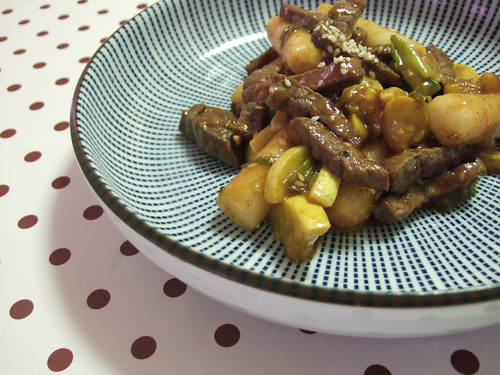
Dduk Bok-kee, Korean Beef Sauté with Rice Cake

Koreans usher in the new year eating dduk, or what we non-Koreans refer to as rice cakes. Rice flour is used to make dduk and the end product is dense and sticky, like the Japanese mochi and the Filipino kalamay. I can only assume that Koreans eat dduk during the new year for the same reason Filipinos and Chinese eat noodles: for long lives, and well, “many children”.

There are different kinds of dduk eaten as a snack or as dessert, but what I like are the cylindrical ones used in this hearty recipe. If I encounter this in a Korean restaurant, it’s usually sans meat, but having perfected my Korean bibimbap earlier this year, I thought that adding beef in it won’t hurt. Instead of a soup, though, I made a sauté with the beef lightly seared. Serve this with Korean store-bought banchan, or side dishes.

Ingredients:
a handful of Korean dduk
1 small red bell pepper, julienned
1 yellow squash, chopped
1 bunch of scallions, chopped in 1/2-inch pieces
1 tbsp soy sauce
1 tbsp brown sugar
1 tbsp sesame oil
2 tbsps kochujang, or Korean red pepper paste
1 tbsp peanut oil

For the beef marinade:
2 slices of lean beef
1 tbsp soy sauce
1 tbsp brown sugar
1 tbsp sesame oil
1 tsp mirin, or rice wine
1 clove of garlic, minced

1. In a small bowl, marinate beef while you prepare the dduk.
2. In a small pot of boiling water, cook the dduk for 5 to 7 minutes. They’re done when a fork easily pricks them. Remove from the water using a slotted spoon. Set aside.
3. Heat peanut oil in a sauté pan. Sauté scallions until soft. Add the red bell pepper and the squash and cook until tender. Move the vegetables to the side to make room for the beef. Add the beef and sear for 2 minutes per side. Remove the beef using tongs onto a chopping board.
4. Remove the pan from the heat while you slice the seared beef against the grain. Turn on the heat again and add the beef back, the dduk and the remaining ingredients. Toss until completely combined. Add more kochujang paste if you want your dduk bok-kee spicier.

Related post/s:
Korean bibimbap recipe
Kochujang sauce and sashimi
Han Ah Reum has all the Korean ingredients you need