Cucumber Pickles

I’m going to be away for two weeks, so I thought I’d pickle again so that it’s ready when I return. At Fairway, they had some fresh Israeli cucumbers for sale. They were small enough to fit an old pickling jar I kept, so I picked up nine pieces with some dill and mustard seeds. This is totally not the Filipino style of pickling and I had to combine two other recipes I found on the Web until it sounded just about right to me. We’ll see in a couple of weeks!

Ingredients:
9 pieces of Israeli cucumbers, washed
1 bunch of fresh dill, washed and ends sliced off
2 tbsps mustard seeds
1 head of garlic, peeled and minced
2 cups of white vinegar
1 1/2 cups of water
salt

1. In a large bowl, submerge cucumbers in iced cold water for at least 2 hours. Set aside.
2. In a small pot, let the vinegar and water boil with some salt.
3. When ready to pickle, put half of the garlic and half of the dill at the bottom of the jar. Add cucumbers. Pour in the salted vinegar and water mixture. There should be enough to cover the cucumbers. Add the rest of the garlic and dill with the mustard seeds. Cover the jar with its lid and seal tightly.
4. Boil some water in a pot, large enough for the jar. When water is boiling, put the sealed jar and let it sit in the boiling water for 15 minutes. Turn off the heat and let the jar cool. When cool enough to handle, remove the jar from the water and dry with a paper towel. Store in room temperature for a couple of weeks before opening.

Related post/s:
How do Filipinos pickle?
How do island people pickle?
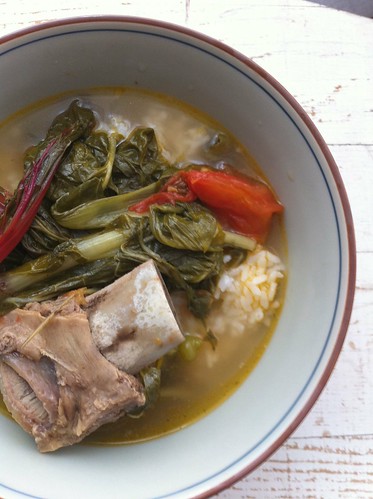
Pork Sinigang, Filipino Sour Soup

What would be your last meal on death row? It took me a while to answer that question, but the more I eat pork sinigang, the more I stick with it as the last thing I want to eat before I go. It’s my comfort food and it’s the dish I request from my father when I return from a trip. If you ask the Dr., it’s also his favorite Filipino food.

Back in the Philippines, I grew up eating it many ways. The only requirement is its sour taste, but the sourness always depended on where the cook was from. The most familiar to me is using tamarinds. We had a tree in the backyard and the tamarinds would be simmered in a pot to make the sinigang broth. Kamias, or bilimbi, was also used by squeezing them and straining the juice. Nowadays, though, Knorr makes the soup base with the concentrated flavor of the tamarind. They sell for 80 cents in Chinatown stores. I like this dish best when the sourness hits the back of my ears and my left eye uncontrollably closes, so I usually end up using the entire packet. I add a Serrano pepper towards the end to give it an extra kick.

As for the vegetables in sinigang, Filipinos use kang kong–called swamp cabbage or water spinach in Chinatown–but you can certainly use other vegetables that don’t have a bitter taste. Broccoli and long string beans, or sitaw, are easy. Okra is also good, as well as daikon radish and eggplant. I’ve tried daffodil leaves but they didn’t work.

Using a crock pot allows you to slow-cook your spareribs without paying attention to them. Leave it overnight or cook it while you’re at work. Eight hours will leave you with meat falling off the bones. My way is to slow-cook in a Dutch oven for at least an hour and a half, removing impurities that rise to the top using a ladle. Filipinos love their pressure cookers, but those things scare me. Besides, I like taking my time when I cook.

Ingredients:
6 spareribs
1 packet Knorr Tamarind soup base
1 tomato, halved
1 red onion, quartered
1 green Serrano pepper, cut in two
1 bunch kang kong
2 small eggplants
1 small daikon radish
salt

1. Use a Dutch oven with enough water to cover the spareribs and simmer for at least two hours. Remove impurities that float to the top.
2. When spareribs are ready, bring to a boil and add tomato and onion. Simmer until tomato is bruised. Add the vegetables and cook until tender. If using eggplant and okra, add them last to avoid overcooking.
3. Add tamarind soup base and salt to taste. Saltiness and sourness should be balanced. The vegetables will tone down the taste. Throw in the pepper before turning off the heat.

Related post/s:
Where to buy sinigang packets in New York City

Yellow Eel with Chives

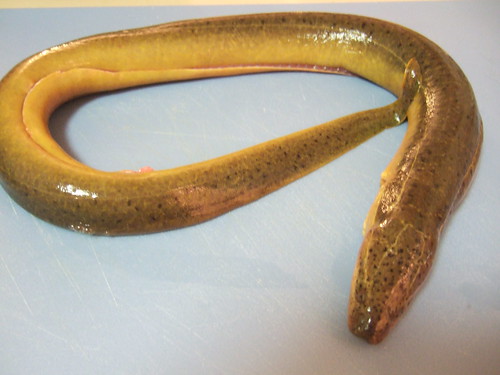
I saw these slimy suckers swimming in a large tub in Chinatown when the Dr. and I met up to buy groceries. Can we buy that? I asked. What are you going to do with it? The Dr. wanted to know, even though my asking does not really mean anything. I was already signaling to the lady behind the counter to get me one. It cost about $5.50 for one, cleaned, but head intact.

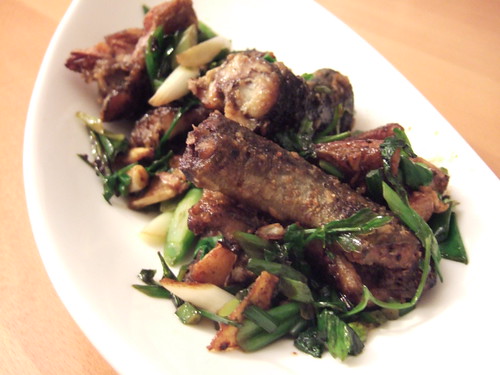
Back at home, the eel was washed with salt and water because it was so slimy. We chopped it up in four pieces–a sharp knife was needed as the spine was pretty tough. The Dr. thought braising it in tomato paste would be ideal, but since I didn’t have it available, we just coated it in salted flour. We threw it in hot oil with some chives and scallions and the snake-like critter made some good eatin’! The meat was tender, and no kidding, tasted just like chicken.

Ingredients:
1 yellow eel, cleaned, chopped in 4
3 stalks of scallions, roughly chopped
2 stalks of chives, roughly chopped
1/4 cup of flour
chili flakes
lemon juice
oil, salt, pepper

1. Combine flour, salt, pepper and chili in a small bowl. Coat the eel pieces evenly.
2. In a deep sauce pot, heat some oil and sauté the leeks and chives for 1 minute. Remove immediately to a paper towel-lined plate.
3. Then slowly drop the eel pieces. Fry until golden brown on all sides. Use tongs to make sure they are cooking evenly on both sides. Do not cover. Remove fried eel to the same plate when cooked.

Related post/s:
Deluxe Food Market has fresh eel
Creeped out by eels? Try octopus!

Cockles in White Wine Sauce

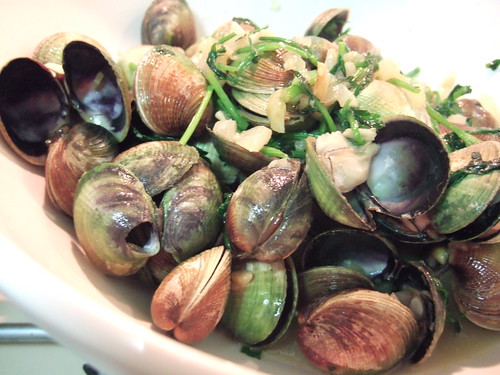
The Dr. requested seafood for dinner in exchange for his accompanying me to Roosevelt Island. While preparing for our meal, I entertained him with a smoked salmon appetizer. With a roasted branzino stuffed with lemon slices, I also served cockles in white wine sauce.

Ingredients:
1 bag of cockles, cleaned and scraped off
1 cup dry white wine
2 shallots, chopped
2 cloves of garlic, minced
a handful of flat parsley, chopped
olive oil

1. In a large pot, heat some oil and sauté garlic and shallots. Add the cockles and toss until a majority of them open up. Shake the pot to be sure that all the cockles are getting equal heat. Add white wine and cover for about 3 minutes to let the wine simmer.
2. Drain the cockles into a large bowl, saving the liquid. Discard unopened cockles. Return the liquid to the pot and bring to a boil. Add chopped parsley. Pour this sauce over the cockles and serve immediately.

Related post/s:
How about some steamer clams?
Perhaps the more familiar mussels?
Momofuku serves cockles with ham and eggs

Korean Bulgogi and Bibimbap

What possessed you? the Dr. asked as he cleaned off his bowl of bibimbap. I’ve always done Korean kalbi at home but have never done bulgogi, so I guess it was just about time. I haven’t had Korean food in a while and I was craving that sweet meat flavor.

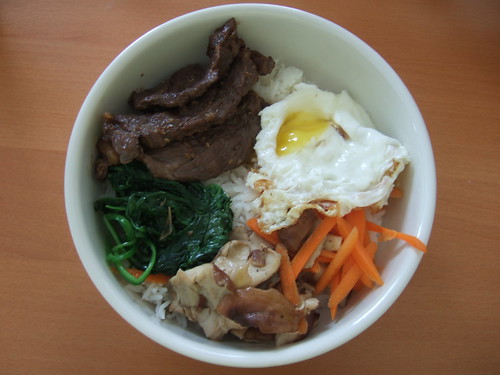
In Korean, bulgogi is “fire meat” because rib-eye or sirloin is traditionally grilled. Bibimbap is translated as “mixed rice.” A bibimbap bowl consists of warm white rice topped with sautéed vegetables, the bulgogi and a fried egg. Kochujang, a spicy Korean condiment made of fermented soy beans and chilis, is served with it. You mix everything together just before eating.

The Dr. said my version tasted “just like the real thing.” I even think it looked like the real thing! I think I deserve some points.

Ingredients:
1 small carrot, julienned
1 bunch spinach, thoroughly washed
4 shiitake mushrooms, dirt rubbed off using a dry paper towel
1 egg
1 tbsp sesame seeds, toasted
1 tbsp sesame oil
Korean kochujang paste

For the bulgogi:
1 pound rib-eye boneless beef steak, sliced in 1/4-inch thick pieces
1/2 cup soy sauce
1 Asian pear, grated with juices
2 tbsps finely chopped garlic
1 small white onion, roughly chopped
2 stalks scallions, roughly chopped
1 small knob ginger, peeled, grated
2 tbsps light brown sugar
1 tbsp honey
2 tbsps sesame seeds, toasted
2 tbsps sesame oil
a pinch of ground red pepper
black pepper

1. Whisk together all the bulgogi marinade ingredients in a large baking dish. Add the thinly sliced beef and turn to coat. Cover and refrigerate overnight.
2. When ready to prepare bibimbap, heat a stove top grill to high. Grill marinated beef for 1 to 2 minutes per side without overcrowding. Remove to a plate.
3. In the meantime, using a frying pan, heat some peanut oil and sauté spinach. Season with some salt. Remove to a plate. Using the same pan, add the mushrooms and sauté by adding in sesame oil. Remove to the same plate. Keeping the same frying pan, add a little more peanut oil and fry the egg over easy. Remove to the same plate.
4. To serve, put a serving of cooked rice in large slightly shallow bowl. Place bulgogi on top to one side. Cover the rest of the rice by adding the vegetables and mushrooms. Put egg on top. Sprinkle with sesame seeds. Serve with kochujang paste on the side. To eat, mix well.

Related post/s:
Korean kalbi is also as good
Serve with Korean pickles, or kimchi