• 105 First Avenue between 6th and 7th Streets
    212/982.5870
    $80 for two, with one cocktail, with tip
    wheelchair patron may dine al fresco or wheel in

    I picked Counter as the first vegetarian restaurant to visit for my special project with Erin. She had sent me links to several restaurants she liked after she requested for me to start reviewing more vegetarian restaurants on this site. We made a three-night date in one week to ensure that I would actually do it. Sure there was some apprehension–I do love my meat–but I can never say I’m open to eating anything if I don’t even give tempeh a chance.

    Counter had the most exciting menu that wasn’t Asian-inspired. If I was going to eat vegetarian food for dinner for almost a week, I didn’t want my meals to be regular meat dishes without the meat. Because what would have been the point of that? I could eat almost anywhere and just pick out the meat. (Sad.) I also signed up for this eating project because I wanted to see what vegetarian kitchens in the city can do besides the misconception of slathering tofu with soy and sesame oil.

    Counter’s tofu with kale and barbecued peaches on a bed of jalapeño polenta didn’t disappoint. The combination of textures was interesting: the tofu was very firm without being rubbery while the kale was crunchy and hearty. The polenta had that roasted taste that only green peppers have and gave the dish the depth it needed. I could easily see these Counter accoutrements with a flank steak in another restaurant that serves meat. (Harold Deiter’s Perilla, for example.)

    I also had Erin’s grilled seitan with Swiss chard in red wine-reduction sauce. Though I thought her dish needed some more salt, I liked the autumness of the entire plate since it could easily have been a braised short ribs dish. The seitan held its own without any beef support and took to the red wine really well.

    However, our server forgot we were there. Erin changed her mind about getting a cocktail and she had to keep her eye out for our waitress in the almost-empty restaurant. We were pretty much left alone at our table except for the occasional diners hovering over us to check out the 3D art hanging on the wall behind me and the busboy who was relentless in refilling our water glasses.

    All in all, I liked Counter for not looking like a vegetarian-only restaurant and for serving tofu and seitan with a creative spin. I was pretty satisfied by the time we got our bill, too, and even packed our leftovers to go.

    Related post/s:
    Perilla is in the West Village

  • I’m sorry to gloat, but I’m like a proud Mama Bear who just had her cub: I just harvested a second handful of mizuna greens from my terrace garden! I’ll be heart-broken when the plant is no more, but I’m going to milk it as much as I can. I’m also getting ready to plant a second round of salad greens for autumn which is fast approaching; hopefully, they’ll survive as the weather gets colder.

    This sandwich needed bitter greens because of the speck’s fatty composure and it needed to stand up against the spiciness of the mustard. Almost any salad green will do like arugula or mache, of course, but mizuna complemented the stinkiness of the taleggio cheese. If you can’t find speck, good-quality prosciutto will also work.

    Ingredients:
    a couple slices of taleggio, rind removed
    8 pieces of speck
    6 mizuna leaves
    whole-grain mustard
    1 whole wheat panini bread, halved
    a small knob of butter

    1. Assemble your sandwich. On one half of the panini, layer the taleggio evenly. Top with the speck and then the greens. On the other half of the panini, spread a dollop of mustard and then place on top of the first half.
    2. Melt half of the butter in a large skillet and heat the panini. Press with an iron grill press. After about two minutes, turn the sandwich gently with a spatula. Add the rest of the butter and distribute it around the sandwich while it melts. Press again for another minute and remove to a chopping block. Let it rest before slicing in two and serving.

    Related post/s:
    Taleggio is great for sandwiches

  • I was surprised to find green figs at the fruit stand downtown where I work. Even Whole Foods only sold the black figs. What I like about green figs is that they’re less sweet than the black ones even though they look like they would be rindy and bitter. The ripes ones are actually pretty soft and they easily give when sliced in half.

    You can use tempura batter here if you have access to an Asian grocery store, but the recipe that follows uses the flour you already have in the pantry. Any yogurt would do, too, but the plain Greek kind has that whipped texture that’s great for chopped fruits. I also find the Greek yogurt less tart and does not compete with the natural sweetness of the figs. My personal preference is the Total Classic kind from FAGE (pronounced “fa-yeh”).

    Ingredients:
    fresh green figs, washed, dried with paper towel
    1 cup of flour
    ice bath
    one egg
    oil
    Greek yogurt

    1. Make the tempura batter. Beat the egg in a bowl. Add ice water. Add flour in the bowl and mix lightly. Do not overmix.
    2. Heat a deep skillet with some oil. Just right before frying, drench the figs with the tempura batter and gently add to the hot oil to fry. When batter is light brown, spoon battered figs out using a slotted spoon and remove to a wire mesh colander on a plate to let the excess oil drip. Do not use paper towels as to not make them soggy. Serve with Greek yogurt on the side.

    Related post/s:
    One of my favorite tarts uses figs and Stilton together
    Make a fig preserve and save them for autumn dishes

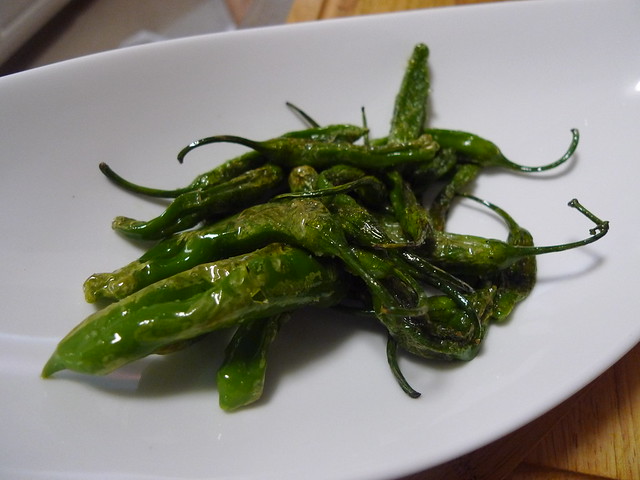
  • So far I can only buy shishito peppers from two places here in New York City during the late summer months: Sunrise Mart off St. Mark’s Place and the TriBeCa Greenmarket a couple of blocks from work on Wednesdays. I don’t ever get tired of eating or serving them. They’re so easy to prepare and, without fail, guests can’t get enough of them.

    Word is that the Japanese cultivated them because they can’t take the heat from the more popular peppers. I first had a taste of blistered peppers in Cal Pep when we were in Barcelona. They use pimento peppers over there which has the same subtle sweetness; the shishito are skinny while the pimentos are greener and a little bit more plump.

    When blistering either, make sure you watch out for the splattering hot oil. Remove them to a mesh colander on a plate after blistering–using paper towel to drain the oil will just make them soggy.

    Ingredients:
    oil
    2 handfuls of shishito peppers, stems intact, washed and dried thoroughly with paper towel
    sea salt

    1. Heat a large skillet. Add some oil and let it warm up until almost smoking. Add the shishito peppers and begin tossing around by swiveling the pan.
    2. When most of the peppers are blistered on all sides, use a slotted spoon and remove them to a wire mesh colander on a plate to let the excess oil drip and immediately sprinkle with salt. Serve.

    Related post/s:
    Where to eat in Barcelona, Spain

  • Among the things in my list of to-dos is to visit an American city I’ve never been to before. Sadly, there’s a lot on that list, so I at least wanted to check two off in 2010. For my first effort, I recruited Lily to join me in my weekend shenanigan after an eat-and-bitch session about not seeing enough of our friends because they’re all in different places in their lives. (Read: babies) We ended up in Raleigh, North Carolina because the flight was within our budget and it had an outdoor museum I wanted to check out, plus a downtown with up and coming dining places.

    Before I left New York, I had emailed the food editors of New Raleigh for their restaurant recommendations. When two of them suggested Poole’s Diner, I knew I shouldn’t miss it. The “diner” in the name did not deter me. If that’s what it’s like in places outside New York, I’ll still give it a chance. We had already decided to eat brunch at Poole’s but decided to pop-in after an oyster and mussel dinner the same night. I wanted a palate cleanser that wasn’t going to make me feel stuffed, but “mixed greens with your choice of dressing” didn’t really sound so good at the raw bar. We took the free R-line downtown and walked to Poole’s in the hopes that they would have better salad options even though it was getting close to 11pm.

    At Poole’s, I read lettuce with shaved Parmigiano and vinaigrette on their blackboard and I told Lily that that was exactly what I wanted to finish off with. I was immediately intrigued by the dinner menu that consisted of braised pork shoulder and ricotta gnocchi (for that end of the month Italian superstition, of course), complemented by appetizers using the ingredients we saw at the NC State Farmers’ Market earlier. Sprite melon was a cocktail with Stoli and Contreau and corn was a velouté as a starter. I wanted it to be the next morning already so we can eat a complete meal! Lily indulged with a coconut tart and a Jamaican red bush hot tea before we called it a night.

    After we checked out of our hotel the next morning, we parked our rental right in front and waited for Poole’s to open for brunch. We sat at the bar and watched as the restaurant filled up by 11:30am. By the time we started eating, there were already several couples waiting to be seated. The maître d’ from the night before recognized us, and so did our waitress, which then prompted a conversation about how we ended up choosing Raleigh as a place to visit. The bartender was told and so was the chef, Ashley Christensen. When there was a quick lull in the kitchen, she came out to say hi and introduced herself to us and we quickly talked about the New York City food scene. It turned out that she had just come from the Spotted Pig and is prepping for a partnership dinner and wine tasting with El Quinto Pinto. Learning about her work with two of my favorite restaurants in New York confirmed my suspicion about Raleigh—it will be the next city to explode in the dining scene.

    My roasted beets came with a buttermilk blue cheese dressing on the side. I barely touched it because the mesclun was dressed perfectly with a balsamic-based vinaigrette. Lily’s zucchini frites were so lightly fried that the roasted tomato gravy didn’t seem so thick at all. Pickled green tomatoes were a surprising crunchy touch. (Noted to add to my repertoire.) My carpaccio of salmon served with avocado was brilliantly executed. I wouldn’t have opted for salmon if I didn’t immediately trust that the kitchen will represent it pretty well. A mango vinaigrette added a touch of sweetness, while slivers of Poblano peppers gave the dish a much-needed kick. It was easily one of the best brunch dishes I’ve had in a while and I’m not even a fan of salmon or avocados. The Bloody Mary was well done as soon as the bartender was legally permitted to serve it at noon and that made us request for the mac and cheese to-go which we ravenously enjoyed after we passed through airport security.

    Poole’s Diner is at 426 South McDowell Street in Raleigh, North Carolina. No reservations are necessary for brunch, but there could be a wait. Call 919/832.4477 for upcoming dinner events and ask about the documentary they are working on about the Raleigh food scene.

    Related post/s:
    A quick jaunt to Raleigh, North Carolina photos on Flickr
    Check out New Raleigh for other recommendations

  • I wish I came up with this sandwich recipe because it’s truly the most complicated-tasting sandwich I’ve had in a very long time. I think a sandwich is never enough for a meal during the day, but this Salume-inspired panini put together all my favorite tastes and textures in my mouth in one seating. I remember eating this for the first time and wondering why I paid $10 for it, but also rolling my eyes back after the first bite. There’s that soft brie that’s even better when melted; the hot and spicy salami for that depth and chewiness and then the sourness and crunchiness of the cornichons all held up by sturdy whole wheat bread. It’s not exactly the $10 Tropea sandwich that I love ordering from Salume here in New York City, but I think it’s a pretty close adaptation considering I spent $20 to make four of them in one week for both the beach and for lunch.

    I bought the hot salami from Di Palo’s–just ask for one of the hanging saawsages from their ceiling and have them slice it so you don’t have to worry about the thinness of each piece. The Vermont brie was from my Holton Farms CSA and the whole wheat panini bread was from Whole Foods. I highly recommend good quality cornichons here because you definitely don’t want to miss out on the crunch. Add a jig of Tabasco sauce for extra spice and you’re good to go to spend the last few weekends of the summer on the beach.

    I used my trustworthy iron grill press here, but if you don’t have one, pressing on it using a heavy lid that’s smaller than the skillet will do. Otherwise, find a small, clean brick and wrap it with foil for a do-it-yourself sandwich press.

    Ingredients:
    a couple slices of Brie, rind removed
    8 pieces of hot salami, thinly sliced
    6 pieces of cornichons, halved
    Tabasco sauce
    1 whole wheat panini bread, halved
    a small knob of butter

    1. Assemble your sandwich. On one half of the panini, lay out the Brie evenly. Top with the salami and then the cornichons. If you want it extra spicy, add a few jigs of Tabasco sauce. Cover with the other half of the panini.
    2. Melt half of the butter in a large skillet and heat the panini. Press with an iron grill press. After about two minutes, turn the sandwich gently with a spatula, making sure the cornichons do not spill out. Add the rest of the butter and distribute it around the sandwich while it melts. Press again for another minute and remove to a chopping block. Let it rest before slicing in two and serving.

    Related post/s:
    Speaking of complicated sandwiches, this let me express myself after getting laid off a second time

  • 231 East 9th Street between Second and Third Avenues
    212/979.9674
    $135 for two, with a drink, without tip
    ♥ ♥

    Clair and I didn’t have reservations at Robataya when we walked in so we missed out on the whole scene up front where you point at the produce you like and the robed guys sitting on their shins grill them for you. We ended up sitting in the back with all of the Japanese salarymen where we enjoyed our food sans the show.

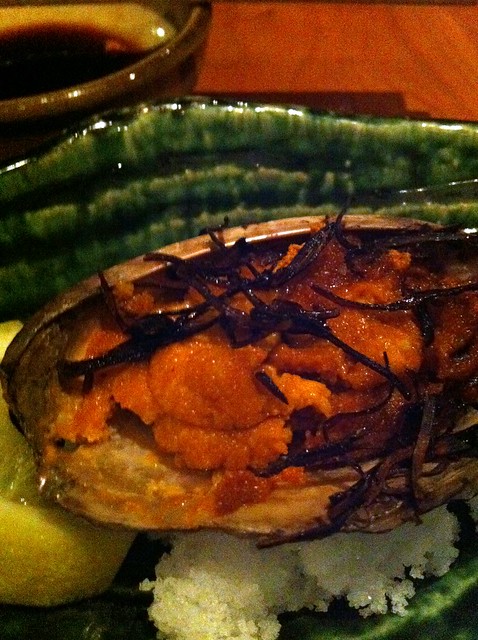
    I haven’t flinched at a bill in a very long time and boy, did I flinch when I got this one. We ate well, but things added up quickly that we lost track of all the $11 grilled unis sliding down our throats. A six-piece sashimi dish of tuna, salmon and sea urchin was $35. Grilled vegetables of okra, enoki mushrooms and shishito peppers ranged from $5 to $8 per plate. The kamameshi, or rice cooked in an earthenware pot, included small fish with black dots as eyes served two and cost $15. Two pieces of Aussie Kobe beef fillets cost $9.

    Everything was delicious and the service was warm and attentive, but man, did it have to cost that much?

    Related post/s:
    Inakaya is also a robatayaki

  • I just summitted Kilimanjaro. I just summitted Kilimanjaro. I just summitted Kilimanjaro.

    I still can’t believe we did it! After five days of hiking from camp to camp we finally made it to Uhuru Peak, the top of Kibo and the highest point in all of Africa at 19,340 feet.
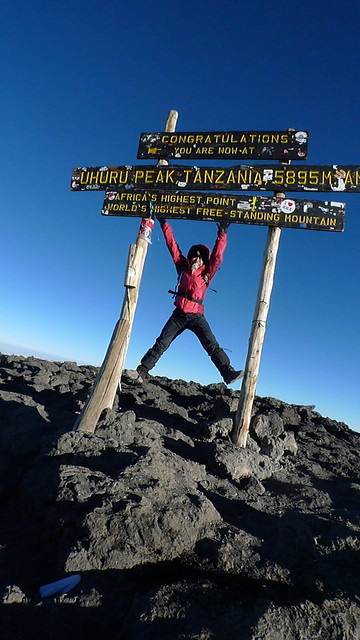
    Around 11pm, I heard Peter M call my name right outside my tent. It wasn’t hard to wake up because I spent a sleepless and an uncomfortable night. Barafu was our highest and coldest camp yet. I met Scott and Christopher in the mess tent where we had our usual first meal of hot tea and coffee–it was both too late and too early to be eating porridge. After the porters handed us our water supply for the eight-hour summit, we suited up and started our walk out of Barafu Hut and into pure darkness.

    I don’t think I realized at the time what eight hours of hiking in the dark could and would feel like. I felt that I was just along for the ride. After only four hours of sleep, I felt groggy as soon as I started to hear the crunch of gravel under my boots. Unable to see anything except what was being illuminated in front of us by our head lamps, there was nothing to keep us entertained; nothing to keep our minds off the robotic process of climbing Kibo in the middle of the night.

    Crunch, crunch, crunch.

    It was cold but I don’t remember freezing. I had thick snowboard gloves on over my usual winter gloves. I had a borrowed ski jacket (I stupidly forgot to pack mine!) on top of five layers of winter garb; four layers of pants helped my knees from feeling cold and two pairs of socks supported my feet without being too uncomfortable.

    I don’t remember freezing maybe because I was literally sleepwalking the rest of the way. Godibless led the line and he kept turning around to give me a slight push on my shoulder to wake me up. Cia, no sleeping. Cia,don’t sleep. I asked if we could stop and rest several times so I may nod off, but Godibless stopped granting my request after the second one. I turned around a few times too to see if Samuel and the boys were still behind me. I barely heard a peep from them and I began to wonder if I was the only one having difficulty staying awake.

    I also don’t remember feeling any pain because of the high altitude. I was just numb. As we gained a total of 4,140 feet, I started hallucinating. In my field of vision, I would see a pair of walking poles leaning against the boulders we were skirting around. I expected to see another group resting in front of us whenever I would look up from the poles, but no one was ever there. This happened twice until I finally realized that there was never anything in front of me except rocks. I started to talk to myself to stay awake and aware of my real surroundings. The funny thing is that I knew enough not to say anything to Samuel or Godibless lest they send me back down because I was going crazy.

    Crunch, crunch, crunch.

    The sun started to rise on our way to Stella Point which was named after the wife of Kingsley Latham, the South African king, who could only make it this far of the hike in 1925. All of a sudden, everything around us was orange and violet and everything in me was awaken. To my dismay, we still had at least 45 minutes until the summit. I felt like I just couldn’t walk anymore. I needed to lie down, rest and sleep.
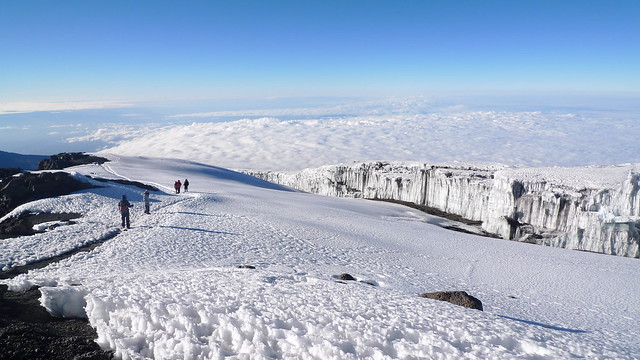
    We started to see the glaciers people have been talking about all these years. Samuel confirmed that they have indeed receded from his ten-year experience hiking Kibo. Everything was so white that it hurt our eyes to look directly towards them as the morning sun illuminated the sky. The snow towards Uhuru Peak look like merangue puffs because of the wind. A single trail of dirt that cut through the ice led us to the finish line.
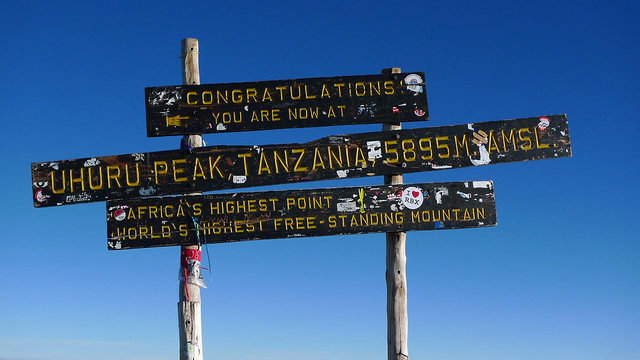
    I was unable to speak when I finally got close to the infamous wooden sign of Uhuru Peak. (And not just because my face was wrapped in a ski cap and a scarf.) We stood close by waiting for our turn to take photos. The dots of light ahead of us when we were hiking belonged to these early risers–those were not part of my hallucination! We all made it this far and this high up and everyone congratulated each other for surviving; everyone was patient and waited for their turn in the spotlight.

    When it was finally our turn to take photos, we posed, jumped, smiled, laughed and celebrated our accomplishment. Hugs and shaking of hands were exchanged and thank yous to Samuel and Godibless were delivered for helping us get up there. (The rest of the porters stayed in camp because they do not have the proper licenses to summit.)

    What killed me was that we had to hike back down to Barafu Hut for the next four hours. You’d think that walking down a “short-cut” would be easier, but the trail was made up of ground rocks that felt like rough sand. All I kept thinking was, I’ve done what I wanted to do, now get me out of here. I couldn’t believe that I still had to keep working even after accomplishing that feat. Without enough sleep, I was extra crabby and whiny. Every other hiker slid down past me, seemingly enjoying their fast descent, but my left knee was acting up and I just couldn’t get the momentum to slide and go down all the way back to Barafu Hut.

    The rest of the group made it down in three hours. Samuel stayed with me and my whimpering for an extra hour until I was able to drag myself from the bottom of Kibo, down some more sharp rocks and back to my tent at the edge of Barafu. It was noon and the sun was out in full force. All I wanted was to take my clothes off and sleep in my tent but then I heard Samuel say, Take an hour nap and then we go. It was a shock to me that even after eleven hours of hiking with only four hours of sleep the night before, we were still expected to hike another four down to our final camp. It made sense that we had to come back down on altitude and also go to a camp with a reliable water source, but not only was I not physically ready to keep on hiking, I was also not emotionally prepared to psyche myself up to continue to the real finish line.
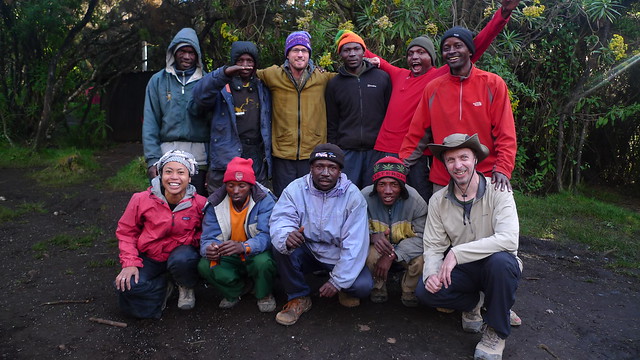
    I slept like a log for that hour until Peter M woke me up again to eat lunch. I never felt so beaten. We haven’t washed our hands and faces for a full day and my contacts were so dried up after wearing them continuously during and after summit. Scott and Christopher showed such strong resolve that I knew I just had to shut up and do what we came to do. So more crunch, crunch, crunch until we made it past Millennium Camp and then to our base for the night, Mweka, where we bought the entire group cold bottles of Kilimanjaro beers to celebrate our week together.

    Related post/s:
    Hiking Kilimanjaro Day 5: Barafu Hut to Uhuru Peak to Mweka Camp photos
    Hiking Kilimanjaro Day 4: Barranco Camp to Barafu Hut

  • The Dr. tuned me into the new Cooking Channel when he came in from Boston to visit. I’ve stopped watching the Food Network a long time ago after I’ve noticed that most of their shows were targeting eaters that are not too adventurous. It seems that the Cooking Channel is their way to separate that content from the ones that involve personalities and cuisines of different origins. In a few hours alone, I saw segments shot in Vietnam, India and Italy which did not involve any screaming or bleached blonde hair.

    My favorite so far is Luke Nguyen mainly because he’s traveling all over Vietnam with that ridiculously curious Vietnamese-Australian accent. He was in a green peppercorn farm that reminded me so much of the Philippines countryside. I actually remembered seeing the peppercorns the last time I was in Kalustyan’s but had no idea what to use them for, so after watching his show, I made a return trip to buy a packet.

    The recipe also called for chicken. I had ordered a whole chicken from Holton Farms in Vermont who’s currently running an ingenious idea on how Community-Supported Agriculture could change the way we buy produce. My neighborhood in Harlem became one of their test spots after I convinced them to deliver in my neighborhood in exchange for getting them new customers who also live in my building. When I saw this recipe on TV, I thought it’d be a relief not to make another roasted chicken.

    You can buy green peppercorns from Kalustyan’s, the heavenly spice store on Lexington Avenue in Curry Hill here in New York City. While there, pick up a sachet of annatto powder as well, but really, I didn’t think it added any thing special to the dish except for some more reddish-orange color. The original recipe called for oil, but the powder was less expensive so I opted for that instead. I also forgot to pick up tomatoes, so I ended up using half of the small can of tomato paste I had in my pantry.

    I imagined this to be richer in taste, but it was subtle in flavor. Perhaps it was the coconut juice that made it a tad sweet and differentiated it from other tomato-based stews I’ve made before.

    Ingredients:
    green peppercorns
    3 cloves of garlic, minced
    salt
    1 tbsp sugar
    1 whole fresh chicken, washed, patted dry with a paper towel
    oil
    4 tbsps tomato paste
    2 small carrots, chopped in bite-sized pieces
    1 tsp annatto powder
    4 shallots, sliced
    3 cans of coconut juice
    a splash of fish sauce

    1. Lightly bruise 4 tbsps of peppercorns in a mortar and pestle. Remove and transfer to a small bowl. Add half of the minced garlic, a dash of salt and sugar and mix. Use this as a rub for the chicken and massage all over. Cover and marinate in the refrigerator for 1 hour.
    2. In a large Dutch oven, heat some oil and sauté the remaining garlic and 2 tbsps peppercorns until fragrant. Set aside in the pot and add the whole chicken. Brown chicken on all sides for some nice color and then carefully remove to a plate.
    3. In the same pot, add the tomato paste, carrots and annatto powder. Stir to combine and then add shallots, coconut juice and fish sauce.
    4. Bring the mixture to a boil and skim off any impurities that rise to the top. Return the whole chicken and simmer, covered, for about 40 minutes. Turn the chicken after about 20 just to make sure the other side is also submerged into the coconut broth.

    Related post/s:
    Learn about the good things that Holton Farms is doing for our communities
    OpenSky sells a nice 3.5 Le Creuset in flame

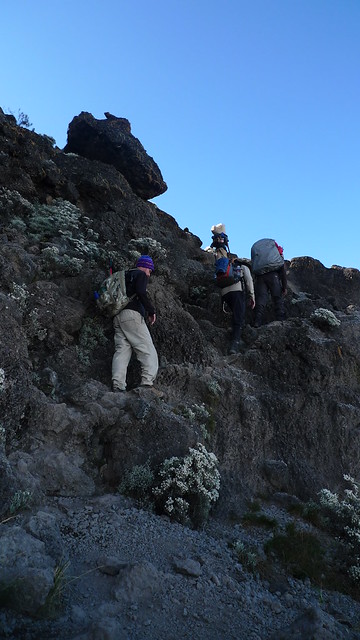
  • We scaled Barranco Wall using mostly our hands to hoist ourselves up. It reminded me of my days bouldering in the city gym on 59th Street: hands getting rough and calloused just to get to the top only to come back down again, all without chalk, harness or someone belaying below. The path was sometimes narrow and dangerous; one misstep would make rocks crumble beneath our feet and remind us how high we’ve gone up in only two hours. But the hike was more challenging than it was difficult and I didn’t feel any more of the tingling sensation in my fingers and toes. I felt like I’ve acclimatized with the high altitude.

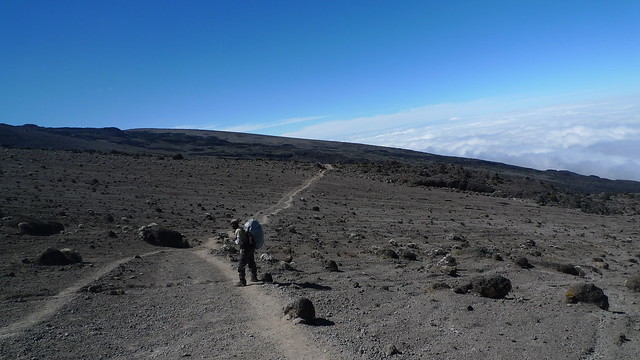
    At the top of Barranco Wall, we were above the clouds. It was exhilarating to get to the top, not realizing the “top” we were aiming for was still another day away. Unfortunately, we couldn’t stay too long to enjoy the view–Karanga Valley was waiting. For the next three hours, we were on a one-lane trek to our lunch point. Everything ahead of us was flat and desolate. There weren’t any more of the giant trees, only paper-thin everlasting flowers and plants that smelled like thyme. It was very hot and very dry. I could feel the sun beating down on my shoulders and scoring a mark under my tank top. My pants and boots were covered in desert dust even before lunch time.

    At Karanga Camp and 12,893 feet later, we took a break and ate watermelon and fries. The sun was even more intense up there where we all laid out our top-layer shirts on rocks to dry them off. Named after the Swahili word for “peanut”, Karanga is also the last water point before the summit. It is so named because the water from the melting glacier atop Kibo runs through the valley and provides for the peanut plantation down below. We saw several porters collect water from the river, hike past us and return to get some more. From this day on, we must conserve water until the next camp. Tonight, there will be no washing of face, hands and feet and we must sleep with the whole day caked on us.

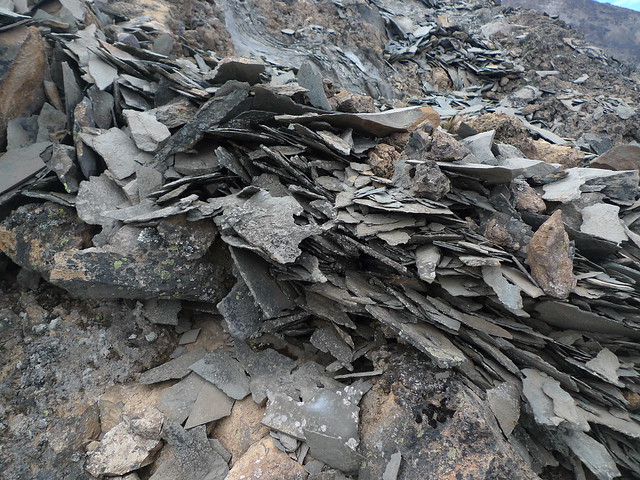
    The volcanic gravel turned into shards of sharp rock on the way up to Barafu Hut. There were huge boulder formations where hikers ahead of us stacked up small pieces of rock for good luck. We did our part and hoped for the best. The weather change dramatically, too. It got colder as we moved higher up and an ominous bank of dark clouds covered what we were about to scale and what we left behind.

    A total of eight long hours of walking later, we reached 15,200 feet at Barafu Hut where we witnessed a small group of hikers and porters surround a guy who had an oxygen mask on. Though it made me feel secure that someone actually had an oxygen tank this high up in Kilimanjaro, I realized that we could be in the same position by tomorrow morning.

    I was anxious during dinner and was even more nervous the rest of the night. I wore everything I packed to bed because it was so cold. In three hours, we will wake up in the middle of the night to start climbing the summit with little time to get ready for what would be the most difficult thing I’ve ever had to do in my life: hike in the dark for another eight hours to finally catch a most breathtaking sunrise on top of Africa’s highest peak.

    Related post/s:
    Hiking Kilimanjaro Day 4: Barranco Camp to Barafu Hut photos
    Hiking Kilimanjaro Day 3: Shira Camp to Barranco Camp

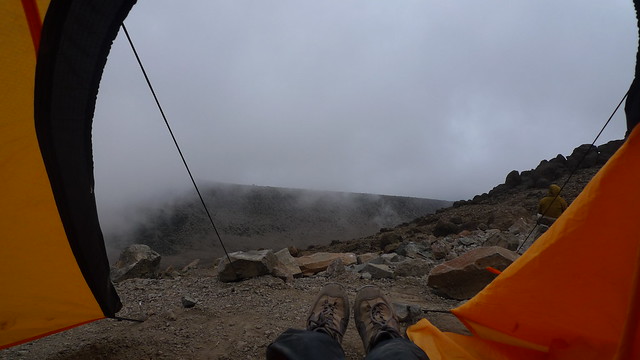
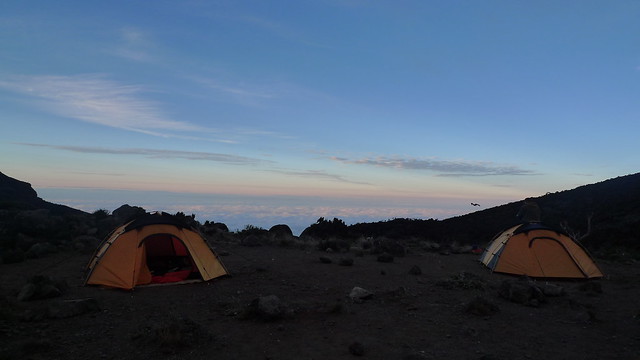
  • I was inside my tent by 8pm last night and tried to listen to a podcast before going to sleep, but I ended up passing out a few minutes later still wearing my jacket, fleece and head scarf. My sleeping bag is really warm and I usually end up sleeping stripped down when camping, but I guess I underestimated how cold it really was in Barranco Camp that I woke up in the morning still completely dressed.

    I ate two portions of porridge for breakfast to try and support the Diamox in my system. I didn’t feel ill at all but the tips of my fingers and toes were definitely tingly. We had a very long hike to Lava Tower and I was definitely catching my breath the first three hours. The landscape was open but everyone trekked in a single file to keep apace and to ensure we weren’t going so fast. No matter how much I reminded myself pole-pole, my lungs felt how thin the air was.

    Lava Tower didn’t look much when we were approaching it, but as soon as we rounded a bend it mightily stood over us. For the first time in our hike, we saw a running trail of glacial water coming from Kibo. There was unfortunately more trash on the trail because the route meets with the more popular Marangu Route and the path climbers use to scale Kibo.

    We had lunch in the shadow of Lava Tower. The rocks were black and sharp–we would see more of them as we escalate closer to the summit. After eating, we walked downhill and finally depended on our walking poles.

    We kept stopping to take photos because the view ahead of us was just incredible. We walked by a waterfall and a beautiful ravine right under Kibo. We could see the porters cutting through another mountain ahead of us. They were like ants in one file with heavy load on top of their heads. I was grateful for their help; I couldn’t have hiked this high if I had to carry more than 3 liters of water and my change of clothes for the day.

    Closer to Barranco Camp, the landscape started to look like the moon–barren and eerie with these giant trees that looked like Where the Wild Things Are feet. Samuel told us that the taller ones were at least 150 years old. There were also these succulent plants that were wet and cool to the touch. They turned out to be anti-freeze plants. It was cool to put your hands in between the aloe-like layers and feel the cold sensation in your fingers.

    Samuel pointed at the gray wall to our left when we were approaching Barranco Camp. That’s Barranco Wall, he said, and we will climb that tomorrow morning. Through where? I asked, because I couldn’t see a trail that led up to it. He just waved his hand up to say, Just up.

    Related post/s:
    Hiking Kilimanjaro Day 3: Shira Camp to Barranco Camp photos
    Hiking Kilimanjaro Day 2: Machame Camp to Shira Camp

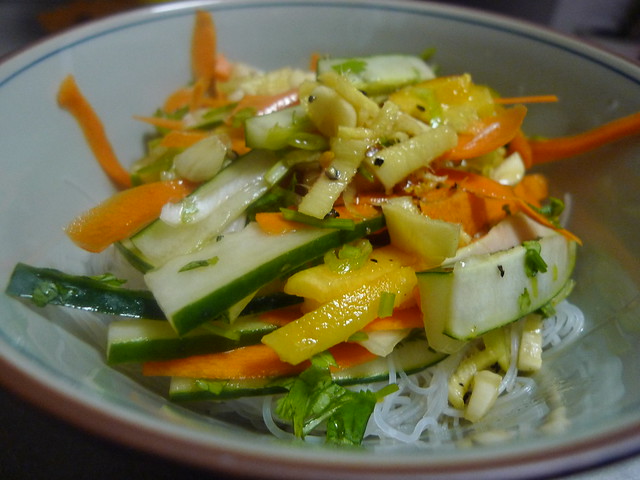
  • The Edible magazines you see at farmers’ markets are usually a good source for recipes using seasonal ingredients. I picked up Edible Piedmont while I was in North Carolina and adapted Sandra Gutierrez’s peach salad recipe. The peaches in Raleigh were ridiculously sweet and juicy. I only had a carry-on luggage with me, but I ended up lugging two shopping bags full of produce back which included a large basket of ripe peaches.

    Whenever I travel, I make sure to stop at the local markets. Besides checking out the interesting and local produce, markets make good people-watching. And where there are working people, there’s usually food. It was no different in the North Carolina State Farmers’ Market. I ate sweet, sweet corn, fleshy sprite melons and cantaloupes, ripe heirloom tomatoes and picked on all kinds of plums, all for half the price of what they would be in New York City! I ate most of the peaches as they were, but with the remaining pieces, I made this salad to beat the summer heat.

    Ingredients:
    1/3 cup of rice vinegar
    2 tbsps sesame oil
    a knob of ginger, peeled, grated
    1 Thai chile, halved
    3 garlic cloves, minced
    salt
    pepper
    ice bath
    1 package vermicelli noodles
    2 scallions, chopped
    2 ripe but firm peaches, pitted, sliced
    1 carrot, thinly sliced
    1 cucumber, seeded, thinly sliced
    a handful of cilantro, roughly chopped

    1. Make the vinaigrette. Combine the rice vinegar, sesame oil, ginger, chile and garlic in a blender and blend until smooth. Taste and season with salt and pepper. Set aside until ready to use.
    2. Boil some water in a pot. While waiting for the water to boil, soak vermicelli noodles in cold water for about 15 minutes. Drain and set aside. Add to the boiling water and cook for 3 minutes. Drain and transfer to an ice bath. Drain again and dry with paper towels.
    3. Assemble the salad. In a large bowl, toss the noodles with the vegetables and the peaches. Splash with the vinaigrette and mix until well-combined. Serve or chill before serving.

    Related post/s:
    See? I was already trying to bake in 2008!
    My first visit to Le Bernardin had warm peaches topped with strawberries