• 72 Hudson Avenue between Front and Water Streets, near DUMBO Brooklyn
    718/522.1018
    $40 each for a group of 5, with drinks and tip
    ♥ ♥

    If you’re tired of the lumberjack look because you’ve seen enough of the same style at Freemans, Hearth and even the J. Crew Men’s Shop in TriBeCa, you’re better off going elsewhere. If you like plaid shirts and facial hair, plus a more accommodating service than any of those hipster places in Manhattan, Vinegar Hill House is just your place. (The couple who owns the restaurant met on the job at Freemans.) In a week’s time between my two visits, the vibe in Vinegar Hill House changed dramatically: it was the booze. The restaurant was a little more somber and comforting before they got their liquor license, but now with the hot toddies going around, the buzz is louder and, well, more intoxicating.

    A lot has been said about the chicken at Vinegar Hill House and all the good things about it are true: it’s moist and liberally seasoned. But it is still just chicken, and at $16, it should be moist and well-seasoned. The Brussels sprouts were softer during my second visit and I wondered if they were baked that time around instead of roasted. The delicate squares of ravioli were just that, and the pork and trout dishes were without frills. All together, they made a nice meal even if everything is streamlined and very simple, capped with a slice of not-so-Guinness chocolate cake.

    I do like a little adventure on my menu and nothing gets me more excited than something out of the box when it comes to classic dishes. I know Jean Adamson is a capable chef, so I wouldn’t be surprised if she brings out the guns as more and more seasonal ingredients come out in the spring. Perhaps it’s to keep Manhattanites away; and in this day and age of too many plaid shirts, that’s just fine with me.

    Related post/s:
    Freemans is now easier to find
    Hearth has a better wine list

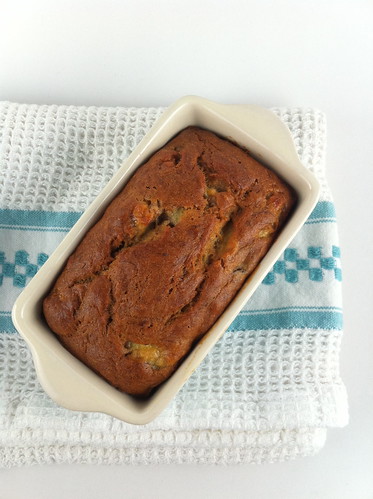
  • I ended up doubling the ingredients here to fill a silicone mold and a 4×8-inch loaf pan. The good thing is that you don’t need a mixer; just a strong arm and a wooden spoon. Keep the measurements precise and I promise it will be the best banana bread you’ll ever bake.

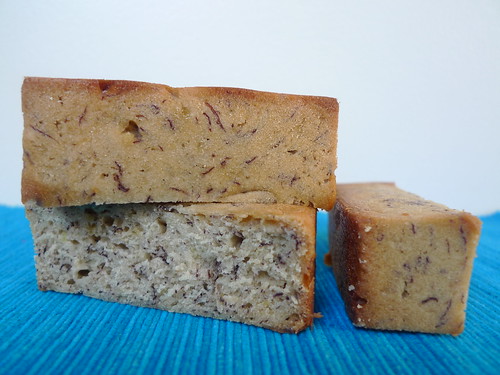
    I filled the silicone molds more than halfway and the cooked banana bread puffed up, making their own muffin-like tops. I sliced the tops off and I had these cool-looking banana bread bars. Because I baked late in the afternoon, I could only distribute the tops to save the end-products for the next day’s photo shoot and that reminded me of one of my favorite Seinfeld episodes.

    Ingredients:
    4 ripe bananas, smashed
    1 1/2 cups all-purpose flour
    1/3 cup butter, melted in microwave; some more to butter the loaf pan
    3/4 cup sugar
    1 egg, beaten
    1 tsp vanilla
    1 tsp baking soda
    a pinch of salt

    1. Preheat the oven to 350ºF. With a wooden spoon, mix butter into the mashed bananas in a large mixing bowl. Add the sugar, egg and vanilla. Toss in the baking soda and salt. Keep mixing. Lastly, add the flour and continue to mix until well-combined.
    2. Pour mixture into a buttered 4×8-inch loaf pan. Place the loaf pan on a baking sheet and transfer in the oven and bake for 1 hour. Cool completely on a rack before slicing to serve.

    Related post/s:
    JB Prince has all the silicone molds you’ll ever need
    My first time baking something fancy

  • Here’s another Italian recipe I butchered. Cioppino is a traditional Italian stew using the catch of the day and I used all the seafood I “caught” from the sea-permarket (ha!) except for fish because my mother is allergic; otherwise I would choose monkfish fillets to have something very meaty and tender. The clams and mussels are perfectly cooked here, but that also means they didn’t get enough time in the hot broth, so I think clam juice in a can is an absolute necessity. If your eaters are not fussy, using shrimp with their heads on can add more natural flavor to the soup. I also decided to skip the pasta in my version and opted to serve it with a few slices of toasted baguette.

    Ingredients:
    1 lb squid, cleaned, sliced in small rings
    1/2 lb shrimp, heads on, sprinkled with salt and pepper
    12 littleneck clams
    12 mussels, bearded
    1 cup white wine
    1 medium can of crushed tomatoes
    1 small can of clam juice
    a handful of parsley, roughly chopped
    a few pieces basil leaves, chiffonade
    6 cloves garlic, minced
    1 tbsp white sugar
    1 tsp red pepper flakes
    salt, pepper, oil
    1 small baguette, sliced, toasted

    1. In a large Dutch oven, heat some oil. Cook the shrimp for 3 minutes. Remove to a large bowl.
    2. In the same pot, sauté garlic with red pepper flakes until golden brown. Add white wine and 1/2 cup of water. Simmer in low fire.
    3. Add clams and cover. Simmer for 3 minutes. Clams are cooked when they are open. Discard those that didn’t open. Remove to a large bowl. Add mussels to the pot and cover. Simmer for 5 minutes. Mussels are also cooked when they are open. Discard those that didn’t. Remove to the same bowl with the clams.
    4. Add clam juice, tomatoes and 3 cups of water to the pot with all the seafood and wine flavor. Let simmer for about 20 minutes while occasionally stirring. Add squid and cook for 2 minutes. Add back the shrimp, clams and mussels and carefully toss together with the tomato broth. Remove from heat. The squid will finish cooking in the remaining heat. Ladle in big open bowls and serve with toasted baguette.

    Related post/s:
    Moules marinieres recipe
    Cockles in white wine sauce recipe

  • I haven’t been in the mood to cook even though I’ve been spending a lot of time at home. But while inside the Grand Central Terminal Market earlier, I was inspired to go back to the kitchen after I saw a small container of really fragrant dried porcini mushrooms on sale for $3.50. I turned to soup-making after assessing the contents of the cupboard, and whadayaknow, I had a porcini-flavored dried salami in stock: I chopped a few small slivers and used them as extra topping to this very earthy broth.

    Ingredients:
    1/4 lb dried porcini mushrooms
    half a bundle of somen noodles
    3 small potatoes, cubed
    1 red onion, sliced
    3 cloves of garlic, minced
    2 sprigs of rosemary, finely chopped
    2 sprigs of thyme
    a small knob of Piave cheese
    salt, oil

    1. Soak dried porcini mushrooms in 2 cups of lukewarm water for about 20 minutes, or until they are soft. Drain and save the water. Roughly chop soaked mushrooms and set aside.
    2. In a large Dutch oven, heat some oil. Sauté garlic until brown and onions until soft. Add potatoes, rosemary and thyme and cook until potatoes are browning.
    3. Add the mushrooms and the mushroom-flavored water and simmer for 10 minutes. Add 2 to 3 more cups of water, depending on how much broth you want. Season liberally with salt because the broth will be bland, but the salt will bring out the mushroom’s earthy flavor. Keep in low simmer until potatoes are cooked and all the flavors are incorporated.
    4. Throw in somen and stir for 3 minutes; this will quickly cook the noodles. Turn off heat and let remaining warmth finish cooking the noodles. Ladle in bowls and shave cheese on top before serving.

    Related post/s:
    Here’s another soup recipe using somen noodles

  • 211 East 43rd Street off Third Avenue
    212/557.8200
    about $80 for two people, with sake, with tip
    ♥ ♥ ♥

    I don’t need any horoscope to tell me that I’ve been living a lifestyle I can’t afford, but it was right there on OK! Magazine, a copy I picked up after someone left it in the subway. I have been mooching off the Dr. the last couple of weeks, what with my unemployment insurance delayed and all, and feeling bad that he’s been spending for two. Last week, he wanted to eat soup and he invited me to come with him. How could I say no?

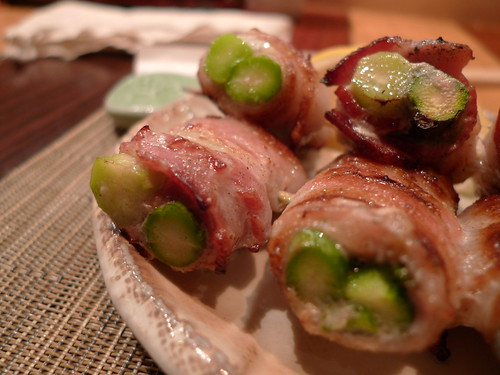
    We sat at the bar and watched the place fill up. The kitchen in front of us went up in smokes whenever the guys grilled some yakitoris. We started with a few: bacon-wrapped asparagus, chicken knee bones (mmm, soft cartilage), some very livery riba and a plate of charred green peppers. A small bottle of a super dry sake helped us washed everything down.

    But what we really came for is Soba Totto’s soba. I had the duck, kamo nanban, while the Dr. tried the mushroom. They were so different from each other: his broth had a subtle but earthy taste and mine was straight-up rich in flavor. The noodles easily gave, the duck melted in my mouth and the mushrooms provided some texture. Neither needed extra condiments–they were perfect the way they were served. Our bowls didn’t look like much, but sometimes soba is all you need even if someone else offers to pick up the tab.

    Related post/s:
    Soba Totto photos on Flickr
    Aburiya Kinnosuke is around the block

  • It was like my personal heaven walking in JB Prince, the service and bakeware store on 31st Street between Madison and Park Avenues. It’s been on my list to stop by but I have been unable to until this week because they’re only open on weekdays from 9 to 5. Their Web site sucks so I didn’t expect much from the store, but it was immaculate when I walked in. I touched everything I could touch, especially the Fat Duck and the El Bulli books. The sous vide machines were all lined up in a row and baking sheets and pans of all sizes hanged by clips. Just seeing the individual serving pieces made of plastic and bamboo made me want to throw a huge amuse-bouche party.

    It’s amazing what I get to do while unemployed. There are so many errands, I don’t know how they got done when I had a job. The past week alone, I ran all over the city finishing all sorts of businesses while also going to job interviews, seeing people I haven’t seen in a while and watching movies in the middle of the afternoon. If I didn’t have financial responsibilities, I swear I’d be enjoying this time more so than I did eight years ago when the Web first broke my heart. Heck, I’d be in Singapore with my brother and his wife, blowing through my savings and traveling all over Asia. Fuck, I hate being an adult!

    But back to reality: I wanted to check another thing off my Things-To-Do list which is to start experimenting with baked goods. (You understand that I didn’t say “baking”, right? Because I’m a little bit of a pussy and I’m afraid of commitments.) I received a nice, hefty birthday gift certificate from a few friends and, though I already know it will go towards the Kitchen Aid Pro with sausage, pasta and ice cream maker attachments, I’m saving it until I’m ready to use it like a pro.

    Financiers came to mind after scouring through my many cookbooks and realizing that it’s one of those basic French recipes that don’t require the use of an equipment. But because I’m also precise, I splurged on a $15 financier silicone mold–which explains the trip to JB Prince. I tried different flavors for my first batch of batter. I divided it into three small bowls and in one, I mixed in a tsp of ground coffee. In another, I added orange zest; I added finely chopped dried cranberries to the last batch. (Add your own flavor in Step 3 below.) After baking my first-ever financiers, I let them cool completely so as not to bother them in their molds until they were set. When I revisited them, they were basically popping themselves out of the molds and I didn’t have to turn them over. I have to say that my favorite were the ones with orange zest. This recipe makes twenty two-inch financiers in one mold tray.

    Ingredients:
    a handful of raw almonds
    1/4 cup white sugar
    1/4 cup of flour, sifted
    2 egg whites
    1/3 cup of butter
    zest from a small orange
    another small knob of butter to coat the molds, melted in the microwave for a few seconds

    1. Preheat oven at 360º. Meanwhile, make your almond meal. In a food processor, process almonds until powdery. It’s okay that’s it’s grainy.
    2. Make your beurre noisette. In a saucepan, melt the butter over low fire. Bring to a simmer and cook for 2 minutes, or until light brown and nutty-smelling. Set aside.
    3. In a medium glass bowl, combine sugar and almond meal. Fold in the egg whites and mix well with a fork. Add the melted butter and continue to mix together. Stir in the flour and the orange zest and make sure everything is well-combined.
    4. Butter your financier molds using a pastry brush. Pour the batter in each mold, filling it up just to the brim. Place batter-filled mold on a baking sheet. Bake for 18 minutes. Your financiers will puff up a bit and will get slightly crusty and golden on the edges, but soft on top. Remove from the oven and cool completely before turning them over on parchment paper.

    Related post/s:
    Feel free to feel bad for jobless me and buy me the Big Fat Duck book
    Or the Kitchen Aid Mixer Pro
    JB Prince is on the 11th floor of 36 East 31st Street, between Madison and Park Avenues

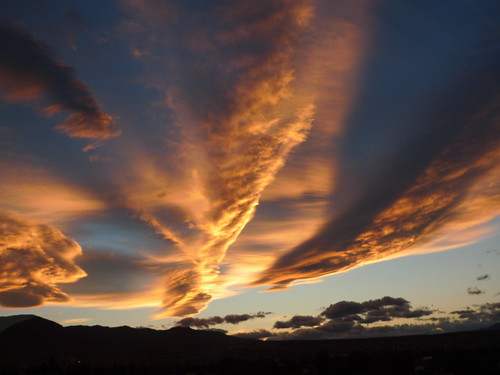
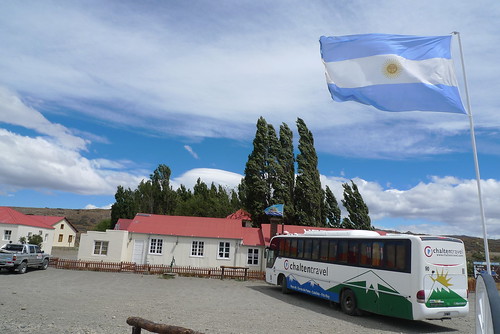
  • We took the bus back to El Calafate yesterday and said our good-byes to Monte Fitz Roy (Fitzie), Cerro Torre and the whole of El Chalten. Being in a bigger and busier town has its pluses, but walking along the main drag with all the amenities brought me closer to home and reminded me that we’re halfway through our two-week vacation. For the first time in almost a week though, we finally saw the sun set. Here in Patagonia, the sun sets at around 11pm and we’ve missed the last few because we would be indoors, inebriated from too much red wine and comatose from the day’s hike. (Cue in song, With a Little Help From My Friends…)

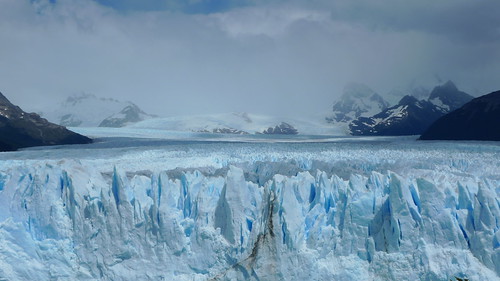
    I fall in and out of sleep while on the bus to Perito Moreno Glacier, only to wake up with the same view around me: big mountain in front, water on the left, forest on the right; but no ice. It’s been more than an hour and I just can’t wait to get out of the bus and stand up. At the park’s entrance, a guide goes around with a small ticket machine charging us $60 Argentinian (about US$20) to enter. A few on the bus only had to say, Nacional, and they get a citizen’s discount at $20 Argentinian. This is the first time my group is charged for any sort of activity in Patagonia and all eyes are on me to make sure the fee is worth it.

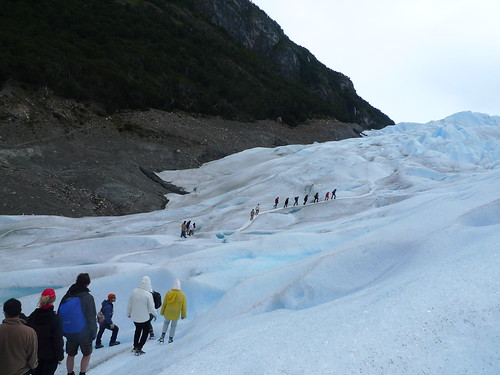
    Back in New York, I’ve signed everybody up to do a mini-trek on Perito Moreno instead of just a bus ride to view the giant glacier from the balcony. It cost each of us US$100, which we all consider steep since we’re not the kind of travelers who pay for organized tour groups. But there is no such thing as shopping for a tour guide to do the mini-trek. Hielo Adventura has the monopoly to ferry tourists across the lake, suit them up with crampons and lead them on the glacier for an hour and a half before sending them back to their hotels. I later appreciate this because I couldn’t imagine hoards of people on the glacier trekking everywhere if one outfit didn’t control the number of visits to the top.

    So what is a glacier? It’s technically a big mass of ice with two zones: accumulation and percolation. It’s constantly snowing in the accumulation zone while the ice is melting in the percolation zone. The ice moves down the slope from where they are situated and ends in lakes or cliffs and forms terminal moraines, or stones and dirt pushed by the glacier.

    Named after the Argentinian explorer Francisco Pascacio Moreno, the glacier is popular because it’s one of the few that can be accessed as simply and easily as this. While most glaciers are in very high altitudes and extreme temperatures, Perito Moreno is only 50 miles from El Calafate and only 279 feet above sea level. Since 1917, the glacier has been stable: its surface, width and length have remained the same because the snow increase in the accumulation zone is enough to compensate for whatever’s melting in the percolation zone. Moreno acted as the expert–that’s why he was called perito–when the Patagonian border was being disputed between Argentina and Chile and donated the land for the first Argentinian National Park, but he never saw the glacier that was named after him.

    We spend about twenty minutes ooh- and aah-ing at the glacier. It really is amazing how massive and far out it goes. The wind is steady and it’s warm enough to stay at the balcony with cameras in hand, waiting for a small piece to crack and fall into the river. (It’s probably one of the few places where you can hear people beg for the glacier to start cracking.) Whenever there is a crack–and it happens every few minutes–there is a thunderous noise, followed by a loud snap, like a gunshot, when the ice falls into the river. No matter how small, the fallen ice creates a ripple and another loud whoosh occurs. Everyone is on high alert when this happens because they want to capture the action on film, but most of the time, the crack happens somewhere we can’t see. There is always a cheer from people who catch the exact moment and it’s funny how automatic the reaction from the crowd gets after a few minutes.

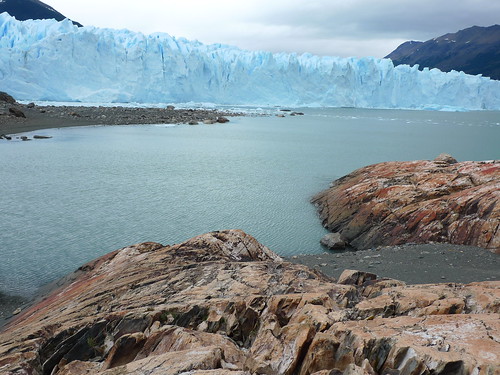
    Two hours later, we board the bus to the pier and then the ferry across Rico Arm. From the boat, we can see the glacier’s front walls and some iceberg channels. Everything is of that blue-ice color. (Oh, why? Snow and ice is white, but when sunlight goes through a glacier’s solid ice crystals, it gets broken down into different colors. Blue light has enough extra energy to get away from the crystals without getting absorbed by the thick ice, so we see that blue that “escapes”.)

    On the other side, we hike through a forest and see the contrast of the earth against the blue ice. It’s like walking into some kind of video game: dry land here, water in the middle, ice over there. All you have to do is hop over and you’re in a completely different landscape. One of the guides, after hearing that I’m from New York City, tells me that one of the most important movies shot in the city is also his favorite movie of all-time: Madagascar. I laugh, join in the joke and tell him that the penguins are probably still up to no good. The Dr. remains stoic because he never saw the movie. We put our crampons on.

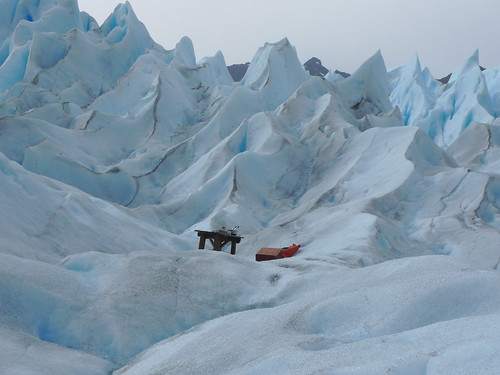
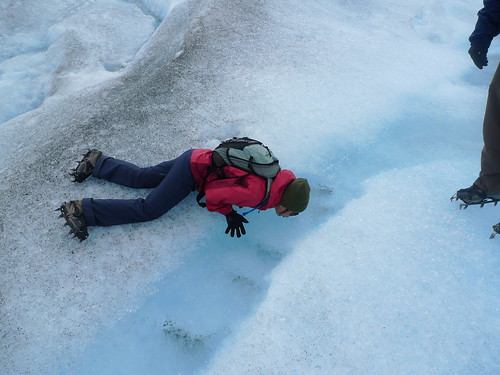
    We see several groups of twenty ahead of us. The guides smartly separate all of us in a timely manner so that we all enjoy the glacier at our own group time. It’s never crowded while we trek and we never come across the other folks. We trek in one line and follow our guide, hunching forward when walking and leaning back when descending. I love the sound of crushing ice and I over-react and march with my knees up to get more of it. I take photos after photos of cracks and crevices and of small pools and trickles. I can’t get enough of the view. Ahead of me, the ripples of ice look like a meringue. It’s like some giant hand came down and whipped the ice to make soft peaks, you know? I know that sounds really gay, but it’s just that everything looked saaawft.

    We stop where we drank from the small pond that has formed on the ice. The water is naturally cold and refreshing, but we still manage to convince ourselves that it is the best-tasting water we’ve ever had. For only US$100!

    I jump when the guide isn’t looking and we do ridiculous poses when we get a chance to stop. They take us to small caves and let us peek down dangerous crevices. We walk across thin ice, jump over safe indentations and hike up and down small hills to get a feel of the massiveness of Perito Moreno. We end at a table where our guide chips off glacial ice to drink with the Famous Grouse whisky they’ve set up beforehand. Everyone toasts and munches on the dulce de leche candies they distribute. It’s the perfect end to our day.

    Later, the group tells me that the money they paid was all worth it.

    Related post/s:
    Perito Moreno Glacier photos on Flickr
    Day 3: Hiking to Cerro Torre
    Hielo Adventura

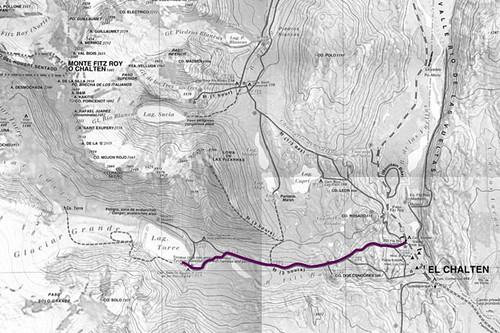
  • After hauling aSs down from Camp Poincenot yesterday, G’s foot started to hurt; he opted out of today’s hike. The three of us start our longest hike this week via the path behind the Cerro Torre Hotel in El Chalten. We feel more energized after yesterday’s shower and last night’s sleep on real beds. I am ready to take it easy with just a day pack even though the hike is longer than the others.

    After an unmarked steep hill, we hike through a forest. The trees are dry and sharp, like from a Tim Burton movie. The earth itself is very thin and dusty. The ranger the other day told us that this hike is where you can view Cerro Torre and Monte Fitz Roy together, but it’s not worth doing if visibility is zero. A lot of people hike El Chalten and miss the chance to see them at once because of the finicky weather, but it’s looking like we will be very lucky today. I hold my breath.

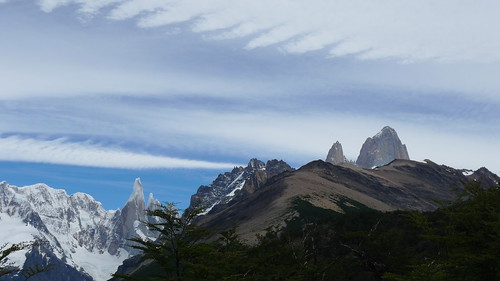
    The hike takes forever and the landscape change from forest to uphills to dry marsh to another forest and then to large rocks. There are a lot of yellow flowers low on the ground which is what I pretty much imagined seeing before getting here. We pass by a swamp with thorny trees before we start walking along the Rio Fitz Roy. Cerro Torre shows itself early and I’m delighted that, although there is a watercolor-like smear of white above it, everything else looks clear blue. We take a turn towards the viewpoint and Monte Fitz Roy also says hello.

    So this is what the ranger and the others before us have been talking about. I notice that there is more snow on the Cerro Torre side than on Fitz Roy’s. As soon as we go through the flat plains, the wind immediately picks up and the three of us put on our jackets. It’s like being in a wind tunnel: you push an invisible force forward without looking at where you’re going and you try to block your face from being completely blown away. The gravel makes it even harder to ascend up the hill that reveals Lago Torre.

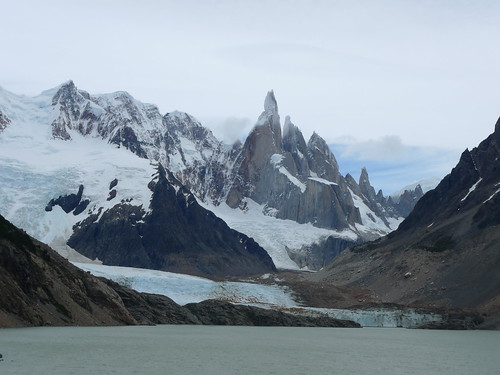
    But oh, as soon as I get to the top, it’s like being transported to a different land; a different country. The wind is howling and there is a heavy feeling about it. It looks like something scary is about to happen, as if there was already a story before time began. I notice right away that Cerro Torre is thinner, spikier and angrier than Monte Fitz Roy. The tips of each spire has a mushroom cap of ice because of the Pacific storms that blow from the Patagonian Ice Cap.

    In 1959, Cesare Maestri and Toni Egger supposedly reached the summit, but inconsistencies in Maestri’s account made other climbers doubtful. Egger died in an avalanche during that attempt, and the second tallest spire was named after him, but it left Maestri’s account unverified. In 2005, a confirmed route was put up on the face that Maestri claimed to have climbed by Ermanno Salvaterra, Alessandro Beltrami and Rolando Garibotti. It was only a year ago, in January 2008, when the same Garibotti, with American Colin Haley, climbed Aguja Standhardt, Punta Herron, Torre Egger and Cerro Torre together, accomplishing the first complete traverse of the entire massif with a 7,200-feet total vertical gain.

    I feel like a wimp again as we go down the path and to the safe confines of Camp D’Agostini just below it. I try to imagine those who have climbed Cerro Torre to give the sport a good name and people like me a glimpse of the impossible becoming possible. We settle and eat our last camp-style lunch before we begin to head back down to El Chalten.

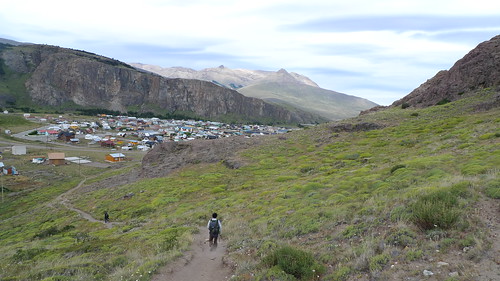
    On the way back, I get to enjoy the view I missed on the way. The river doesn’t look so rapid from this far away and everything around me looks more like the Swiss Alps than Patagonia. I pause after I say this to the Dr. and add, What I imagine Switzerland to look like anyway, because I’ve never been there. Funnily enough, our friend commented of our last trail during dinner: That looked like the time I was in Switzerland.

    All that eerie feeling is replace by the Sound of Music. All of a sudden, there are white blossoms and Alpine-style cabins. The starkness of Cerro Torre that’s in my head becomes more manageable and transforms into a panoramic photograph featured on calendars. I can’t say that I like it better, but it certainly makes the end of our Chalten hike more pleasant.

    Day 3 itinerary:

    Related post/s:
    Cerro Torre photos on Flickr
    Day 2: Hiking to Lago de los Tres and Laco Sucia
    This is great story on Maestri and Cerro Torre
    Here’s the stupendous account of Garibotti and Haley
    Photos that make me shiver from Ermanno Salvaterra

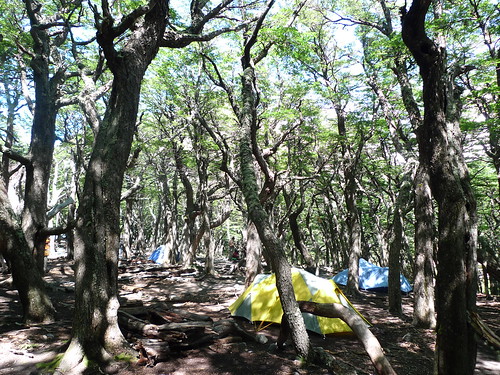
  • It was a very cold night on Camp Poincenot. Our sleeping bags were warm but the Dr. had a restless sleep, wearing almost everything he’d pack to keep extra warm. I was okay in a long-sleeved Capilene and underpants until around 3am when I felt a cold breeze coming from the side of our tent. I had the chills and squirmed inside my sleeping bag to put extra layers on. It was my first time to camp in the woods, and though I liked the process of the whole thing, I can’t say sleeping in a bag so close to the ground is my favorite thing.

    Today I wake up first to boil some water and get the coffee ready. I know the boys will need it especially if I want them to be good sports about the vertical hike that’s to come. I send them to the river where it’s warmer to collect some water to drink so they can stretch while waiting for the congee to cook. Here in Patagonia, water from running rivers is potable. We were apprehensive at first, but because everyone else was doing it, we joined in. We never had to use our $50 purification system after all.
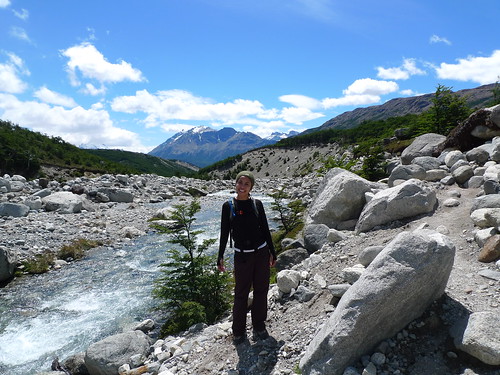
    From the camp, we begin our hike to Lago de los Tres with only our day packs. We hike through another forest and continue to go up for the next hour and a half. From the highest viewpoints, we see several lakes and never-ending trees. I imagine how white everything would be if it isn’t summer. I remember from the other day when the ranger told us that this hike is easy because of the stairs. There are stairs all right, but they are steep and they keep going up. The sun is out in full force though, and I am only wearing a tank top to keep myself cool.
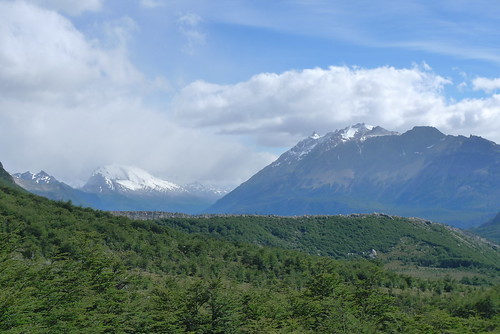
    The path starts to transform into gravel and crushed soil, almost like sand. You sink whenever you take a step, but I know a closer look at Monte Fitz Roy is just ahead. When I walk over the last hill, the last hurdle to the finish line, I gasp because I did not expect to see what’s immediately in front of me: the greenest of the green with the bluest of the blue water, surrounded by boulders spotted with fresh white snow. I want to cry.
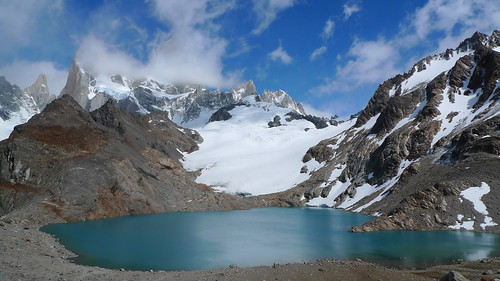
    At this close proximity, I acknowledge the entirety of the Fitz Roy range. Starting from Fitz Roy’s 12,300 feet going to my left is Poincenot, also our camp’s namesake, at about 9,850; Aguja Raphael at about 8,100; Aguja Saint-Exupéry at about 8,400; and Aguja de la S, aka Aguja Innominata, at about 7,600. The three granite agujas, or needles, are the “tres” in the name Lago de los Tres, or Lake of the Three.
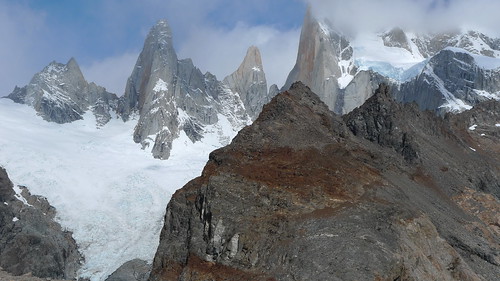
    In 1952, the French alpinist Jacques Poincenot fell in the river and died during a trip to conquer Fitz Roy. Antoine de Saint-Exupéry, of Le Petit Prince fame, delivered mail to Patagonia via the French airline Aerospostale from 1929 to 1932. His co-pilots are honored with the two summits north of Fitz Roy: Aguja (Jean) Mermoz and Aguja (Henri) Guillaumet.

    The entire thing is more majestic and spectacular this close. Of course, a cloud is swirling around the spires, but even with the wind, it’s calm and it’s giving me that feeling that everything around me is older than time. I realize that this earth is truly a place one can’t stop appreciating because at every other turn, it will leave you in awe.

    I see people closer to the water and leave my group to walk down. It’s the wrong and dangerous choice because on every step, a few rocks loosen behind me and roll. It’s too late to stop and walk back up; I am on my aSs just trying to slide down gingerly. When I get to the bottom, I lie on a big rock and look up the blue sky. Upside-down, I can see more people now and they’re all sitting at where I was before. Everyone is speechless and staring at the Fitz Roy range. I bask under the sun and get my raccoon tan.
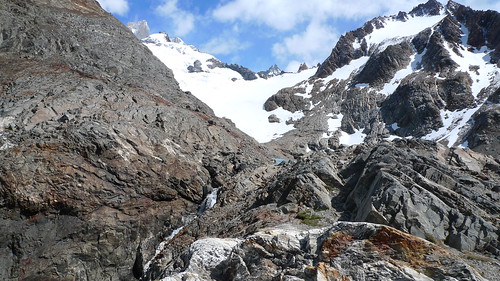
    After a few minutes, I decide to walk the opposite way and see what else is around. I see a spike with a yellow tip and realize it’s a trail marker from where we entered. It’s the path I should have taken instead of blazing down the rocks. At least now I know how to safely go back up. I’m alone when I make the next hill over and while I’m thinking that that was the best viewpoint yet, I come across a danger sign to warn me that the trail stops there. I take a couple of steps down and follow the sound of a waterfall. It’s a small trickle, but the sound echoes loud enough as if I was in a cathedral. I laugh to myself as soon as I discover where the water was going. All I can think of is, Where the hell am I?
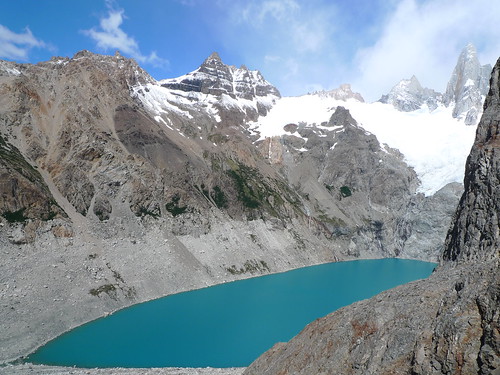
    I unfold my map and realize that I am right above Lago Sucia. Even though the name means “dirty”, there is nothing dirty about the water except for the fact that it has a deeper hue than Lago de los Tres. It’s even more still here because it’s surrounded by Cerro Techado Negro, the range that climbers must pass through to camp on Glaciar Rio Blanco before they attempt an ascend.

    I reunite with the group again and I encourage them to take the short trail down to Sucia. I wait for them behind a large rock and borrow a pair of binoculars from two other hikers who were pointing towards Fitz Roy: there are at least four ant-sized people on the snow going up. I imagine what they must be feeling now. I send them good vibes and hope they make it as high as they want to go.
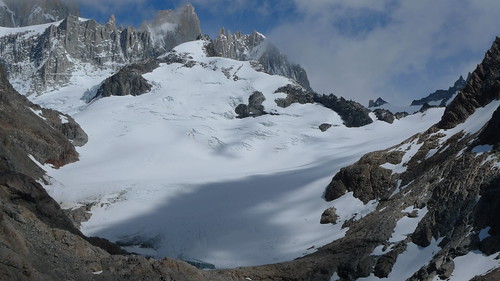
    On the way down, we run into more people going up. We don’t recognize them from camp so we assume they have come all the way from El Chalten to do the whole trail as a day trip. Alas, there are people who are stronger than I am. I tread carefully and take care of my left knee. Miraculously, it hasn’t hurt and I am determined to keep it that way.

    Back at Camp Poincenot, we all agree to pack up and go back down to El Chalten to escape another chilly night in our tents. We use the other route down via Lago Capri and watch families with children set up picnics by the water. I feel like a wimp for hiking with so much weight only to stay for one night, but the temptation of having a sit-down dinner with a bottle of Malbec is too hard to resist; not to mention a hot shower and a working toilet.

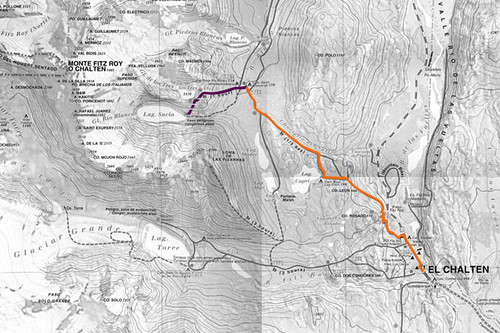
    Day 2 itinerary:
    Related post/s:
    Lago de los Tres and Lago Sucia photos on Flickr
    Day 1: Hiking from El Chalten to Monte Fitz Roy
    I highly recommended Enduring Patagonia as a must-read
    This is an awesome site detailing the climbs and attempts on Fitz Roy
  • I am excited but at the same time nervous. I’m geared up and waiting for the rest of my group outside Rancho Grande Hostel to begin our first day of hiking. Today’s plan is to hike along Chorillo del Salto and get our first glimpse of Monte Fitz Roy, one of the two that tower over El Chalten in this part of Argentina’s Patagonia. I am carrying about thirty pounds worth of clothes, my sleeping bag and our toiletries, while the Dr. is carrying our tent with his own gear. We’ve split our provisions between us, but I still made sure he carried the heavier jjajang tuna cans.

    Yesterday, I was antsy during the five-hour drive from El Calafate to El Chalten. When I started to see Glacier Viedma up front, the largest glacier on the eastern slopes of the Andes, I turned to see if my companions were awake. My heart thumped: I made it! I made it to Patagonia! Rain flecked my window and I thought, Rain all you want now but please, please stop for the next five days. I am reminded that the name Chalten comes from a Tehuelche word meaning “smoking mountain”, due to a cloud that usually forms in the top.

    We all stopped by the National Parks office to get an introduction and to listen to the rules of the park before the bus dropped us off at Rancho Grande where we had reservations for four bunk beds. Our humble room will be one of the many reminders of our hike in the Spanish Pyrenees back in 2006. It’s the beginning of peak season and we were surrounded by people who were also ready to hike: tall backpacks leaned against the walls and boots stacked up by the main door. Some of them we’ll encounter again on the trail and all of them we’ll share this Patagonian experience with.

    We start walking towards the yellow house at the end of the road. The sun is striking at 10am and there is barely a cloud in the sky. I quietly hope that it stays that way. Here in Santa Cruz, Argentina, the weather is finicky and unpredictable. From reading Greg Crouch’s Enduring Patagonia before I left New York City, I learned that the wind will be our enemy. We start slow and up; my shoulders getting used to the weight on my back. I’m bundled up, but I’m hot and I know if I remove my fleece, I’d have to put it back on again when I turn the next corner. The trail is well-marked but rough. The soil is very dry and padded with small rocks and I can’t stop to take photographs of the dots of yellow and purple flowers along the way because there are others behind me.

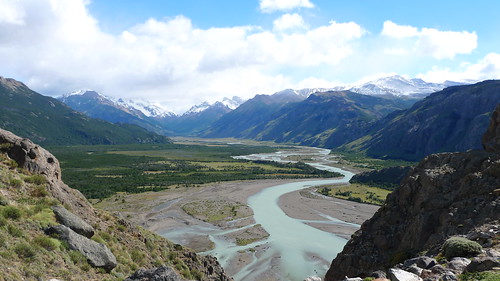
    We reach our first viewpoint where we could see the swirls of the Chorillo River. At last, rest. I’m surprised at how green everything is. I imagined tumbleweeds rolling along the flat plains while the wind whistled in the background. It hasn’t been an hour yet and Patagonia is already throwing surprises at me. We mostly hike narrow paths through the forest until the trail finally opens up where we walk on cliffs and then onto flat land with small ponds.

    All of a sudden, there it is: Monte Fitz Roy and its ever-recognizable shape. I know because I’ve spent five months planning this trip for the group and I have seen numerous photos of its grandeur and glory. Right now, I can’t believe I’m finally looking at it in person. Its name was bestowed by explorer Perito Moreno after the Beagle’s captain, Robert Fitzroy, who sailed the area around 1834. Even though it’s not even half the height of the Himalayas, its granite makes climbing it harder even for the most experienced. More than a hundred people summit Mount Everest a day, but only one successfully ascends Monte Fitz Roy a year.
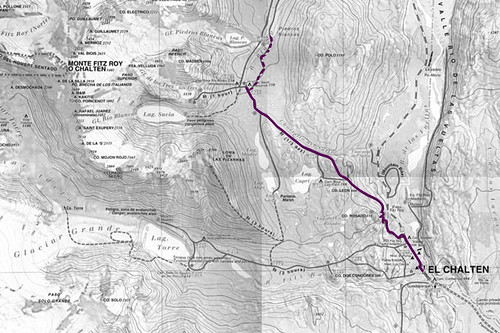
    Everyone is taking photos and it takes a few tries and more energy than I can muster to jump for one of my Cia photos. I haven’t worn my sweater in the last hour and I already have a criss-cross tan below my neck. I want to stay and savor the view even though I know there will be more.

    At Camp Poincenot, we pick a spot where the boys set up our two tents. We stretch and get used to our backs without all the weight and we eat our first energy bars for lunch. Because it was the middle of the afternoon, we decide to take a quick walk to see Lago Piedras Blancas where the glacier truly looks like flowing water frozen in time. It’s a much easier hike without our packs, but not less rewarding.

    Back in camp, we begin to unwind and rest for the night–just in time when that swish of a cloud around Fitz Roy start to look like it’s going to make its way down. The clouds are more gray and we feel some rain coming. We are all surprised that the hike up here took less than four hours, but while we cook and eat our first meal of vegetable Jambalaya, miso soup and Korean tuna, we know that it was enough for today.
    Day 1 itinerary:

    Related post/s:
    Monte Fitz Roy and Lago Piedras Blancas photos on Flickr
    Route 40 drive photos on Flickr from El Calafate to El Chalten
    I highly recommended Enduring Patagonia as a must-read

  • 214 East 10th Street between First and Second Avenues
    866/602-8779
    about $25 for two, with drinks, without tip

    Yohshoku, or Western dishes adapted to fit the Japanese taste, kept me alive when I was younger and wasn’t making a lot of or any money. In West L.A., I loved Curry House because I could get a hefty lunch for $5. When I was in Tokyo, I ate a lot of gyuudon and tonkatsu (beef bowls and deep-fried pork cutlets) because they were the most affordable for us kids with a tight budget. Believe it or not, back then I spent my money on design books instead of food.

    So when Curry-Ya opened last year, I was excited to go even for the sake of reliving those days. True to form, my kareh raisu, the Japanese-style curry so far removed from its inspiration, tasted like how I remember them: rich, gooey, salty, and just super tasty. Unfortunately, I’m older now and I paid a higher price digesting it afterwards.

    I still appreciate good design and Curry-Ya has that style I would like to adapt if ever I opened my own restaurant: marble bar, less than twenty stools up against it, open kitchen. I’m not any younger, but I’m back to having less money because of this economy and I can see more Curry-Ya in my future.

    Related post/s:
    Curry-Ya shares the same owner with Rai Rai Ken next door
    For a more Indian curry, go to Brick Lane a few blocks down

  • My first exposure to dosas was from Hampton Chutney and, I must admit, wasn’t the most authentic. I still like eating at Hampton Chutney once in a while even though they’re overpriced and I’ve since searched for good, and less expensive, dosas in the city. Shit, I’ve even spent several hours trying to make a Nepalese version at home.

    My parents and I met up with Honey and Paolo in Jersey City to check out a Filipino man in the suburbs who apparently can give you the same diagnosis as a chiropractor and help you as much as a physical therapist can. My father has always complained of lower back problems; my mother almost broke her hip and wrist when she fell off a ladder; I still have a busted left knee from hiking the Pyrenees. He didn’t accept any kind of payment–though we ended up buying tocino and longanisa from the wife who makes them at home–so we didn’t see any harm in visiting him.

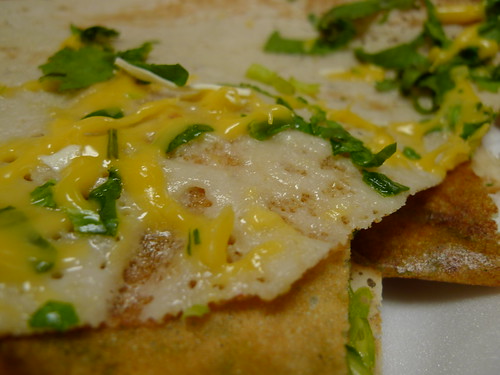
    An hour later, we were famished. Honey drove us to Dosa Hut for lunch where I introduced my parents to vegetarian meals that actually made them full. My parents, always hard to please, refer to all kinds of South Asian food as “Bombay”. They’ve never seen a dosa before and wouldn’t be able to tell one curry from the next. So when I ordered, I asked the lady behind the counter what made their “special dosa” special. It contained cabbage, green bell peppers and onions and was fit for two people. The flavor wasn’t as special as the classic dosa however, stuffed with cheese and parsley. It didn’t seem much at first, but it was deliciously light yet still filling. The crepe itself was crisp and the different chutneys gave my folks a good education about dips outside of the usual Filipino soy sauce and vinegar.

    Oh, my left knee has been okay since that visit.

    Dosa Hut is at 777 Newark Avenue in Jersey City, New Jersey and is all vegetarian. You can call them at 201/420.6660.

    Related post/s:
    The Nepalese have the chataamaris
    Saravanaa Bhavan has a few choices that can fill you up