• A Vietnamese sandwich, or bánh mì, has minced pork, potted meat, salami, carrots, cucumbers and cilantro. They are served in a slightly toasted French baguette with a special sauce that brings all the fillings together. Skip on the mayonnaise and order an iced Vietnamese coffee while you wait. There are also the neo-bánh mìs like vermicelli glass noodles, beef fillets, chicken and even tofu. Most of the stores carry other Vietnamese snacks and your best bet would be the summer rolls or the rice cakes. Sáu Voi Corp also sells Vietnamese CDs and DVDs for some soundtrack while you eat. (I’ve updated this post since 2004 with the latest bánh mì stores.)
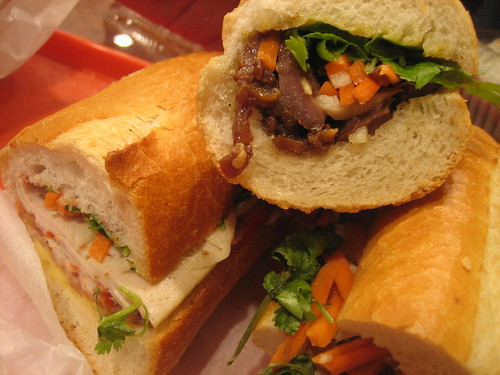
    I’ve listed my favorites below and they all get ♥ ♥

    Viet-Nam Bánh Mì So 1
    369 Broome Street off Mott
    212/219-8341
    Updated, 2008: Renamed Saigon

    Sáu Voi Corp
    101-105 Corner of Lafayette and Walker Street
    212/226.8184

    Paris Bakery
    113 Mott Street between Canal and Hester
    212/226.7221

    Á Châu Deli
    82A Mulberry between Canal and Bayard
    212/766.3332

  • You came from New York City to get lost here?!, the lady at one of the refuges exclaimed when we told her where we came from. “Here” was the Pyrenees on the Catalan side, six hours from Barcelona by bus through the town of Vielha, and “lost” were two amateur hikers in the middle of the mountains, cold, soaking wet, scared and panicked about sundown.

    Our adventure in the Pyrenees started four years ago, when we read about Carros de Foc, a company in Spain that established a route to connect the nine existing refuges in and around Aigüestortes i Estany de Sant Maurici National Park. Each stop at a refuge earns you a stamp
    on your “forfait,” or hiking passport, and ten–the last one is the same as the first, which completes your loop–earns you a T-shirt exclusively given to those who finish the trek. At first, it was all about the T-shirt, but as we ascended over granite after granite in the rain and descended down slippery trails in the snow, our goal became more simple: to live with ourselves shamelessly afterward.

    Aiguestortes means “twisted waters” in Catalan. Every hike up gave us clear lakes and ponds to look at. Every trek down showed us waterfalls coming out of every crevice. We had never seen anything more beautiful in our lives.

    If it weren’t for the hail striking our faces, the wind pushing us back and the snow freezing our hands, we would stop and enjoy the view. There were days when the sun came out blazing, and those were the days we enjoyed the most, even with our 25-pound backpacks. But the most rewarding were those we spent wet and miserable on the trail, finding our way to the refuge we were scheduled to spend the night in after eight hours of hiking, coffee with brandy waiting to warm our bodies and our hearts.

    It was definitely the most emotional and the most physically grueling trip we’ve ever taken together. Nothing could have prepared us from trekking the Pyrenees, Catalan style.

    Related post/s:
    An entire collection of photos taken during our trek on Flickr
    Carros de Foc trail

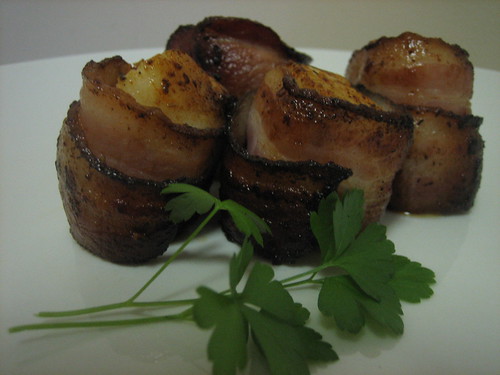
  • I’m not sick of bacon just yet. The third yield from my first shipment of bacon became dinner. This would be awesome with some mashed potatoes on the side.

    Ingredients:
    6 pieces of large scallops
    6 slices of bacon

    1. Season scallops with salt, pepper and paprika. Wrap each scallop with a piece of bacon.
    2. Using a skillet, sear each bacon-wrapped scallop until bacon is crisp and golden brown. Sear the side where the bacon ends first. Using tongs, gently turn them and cook the other sides. To make sure the bacon stays closed, sear the end again for the last few seconds. Remove to a paper towel-lined plate. Serve on a different plate after 1 minute.

    Related post/s:
    Turkey Bacon Avocado Portobello Sandwich
    Bacon Corn Muffins

  • Talk about a quick lunch with bacon. I was hungry but I didn’t want a limp and sorry-looking sandwich. I wanted something filling, semi-healthy, and of course, robust. (I think robust is a good word to describe this sandwich.) The only shortcut I took here is to buy a few slices of honey-roasted turkey from the grocery deli. Using one loaf of French bread, this recipe fed two hungry people.

    Ingredients:
    4 slices of honey-roasted turkey breast
    4 slices of bacon
    1 avocado, halved, pitted, thinly sliced
    1 portobello mushroom
    1 bunch of arugula, rinsed and patted dry
    French bread, halved, toasted

    For onion relish:
    1 yellow onion, thinly sliced
    1/8 cup dark brown sugar
    1/4 cup red-wine vinegar
    1/4 cup balsamic vinegar

    For aïoli:
    1 egg yolk
    1 garlic clove, minced
    1 tsp Dijon mustard
    2 tbsp sherry vinegar
    oil, salt, pepper

    1. Make onion relish. In a saucepan, boil the onions in water until soft. Remove from heat and drain. Return to the pot and add brown sugar, red-wine vinegar and balsamic vinegar. Simmer in low fire until liquid is thick–I had this simmering until I was ready to assemble the sandwich. Stir occasionally.
    2. In the meantime, roast portobello mushroom. Preheat oven to 400º. Place mushroom, pleats side up, on a baking sheet. Drizzle some olive oil and balsamic vinegar on mushroom and roast until soft. When cool to the touch, slice and set aside.
    3. Cook bacon. Using a skillet, cook about 4 slices of bacon until crisp. Remove to a paper towel-lined plate. Set aside.
    4. Make aïoli. In a blender, purée yolk, garlic, mustard and sherry vinegar until smooth and creamy, 2 minutes. Slowly drizzle olive oil into running blender until completely emulsified, about 2 minutes. If aïoli gets too thick, add a small amount of warm water, 1 tsp at a time. Season with salt and pepper and cover and refrigerate until ready to use.
    5. Assemble sandwich! Lay toasted bread halves on a chopping board. On one half, spoon the onions and top with the meats and vegetables. Drizzle with aïoli. Top with the other half and hold together using a toothpick.

    Related post/s:
    Bacon-Wrapped Scallops
    Bacon Corn Muffins

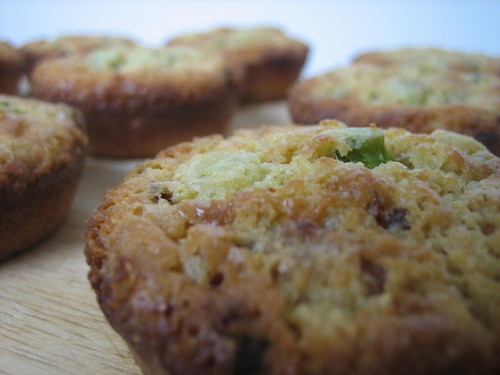
  • One of the best presents I received this year was a 3-month Bacon of the Month Club membership from Zingerman’s. Cameron just knows what the hell I would squeal over for my birthday. I love that Aaron and Pete understood that a box of pork delivered at work would be something I would actually want.

    For the first installment, I received a pound of Applewood bacon. I could have easily had bacon and egg breakfasts throughout my entire week off from work until all the fat killed me, but I wanted to do something more special with my present. I searched for several bacon recipes, edited them to my own style and shared the bounty with family and friends. After all, what is Christmas without the sharing? When these bacon corn muffins were warm enough, they were packed in a large Ziploc bag and stuffed in a hand-carry tote, eaten onboard a plane.

    Ingredients:
    1 1/4 cups whole milk
    1 large egg
    3/4 stick unsalted butter, melted
    1 cup yellow cornmeal
    3/4 cup all-purpose flour
    4 stalks scallions, chopped
    4 bacon slices
    2 tbsp sugar
    1 tbsp baking powder
    pinch of salt

    1. Cook bacon. Using a skillet, cook bacon until almost-crisp. Remove to a paper towel-lined plate. When cool to touch, roughly chop. Set aside.
    2. Preheat oven to 375º. Whisk together milk, egg and butter in a small bowl. In a different bowl, whisk together remaining ingredients. Add bacon. Combine both mixtures and stir.
    3. Grease a 12-muffin pan and fill in with mixture. Bake on middle rack until golden and a toothpick comes out clean, about 15 minutes. Turn off heat and cool in oven for about 5 more minutes.

    Related post/s:
    Zingerman’s Bacon of the Month Club
    Turkey Bacon Avocado Portobello Sandwich
    Bacon-Wrapped Scallops

  • 608 Fifth Avenue at 49th Street
    212/489.3747
    from $2.50 to $11 each

    Wagashi, or Japanese pastry, is served in traditional tea ceremonies. They are usually made of Azuki, kidney or soy beans combined with mochi-rice or wheat. The most common types are the jelly and rice cakes which come in different fruit flavors and colors. Minamoto Kitchoan is not a restaurant, but stopping by the store on Christmas day, I couldn’t help but be tickled by the beautifully packaged pastries. You can pick and buy whatever you want or else one of the Japanese clerks will follow you around with a tray so they can handle the delicate goods themselves. The ones pre-packaged start at $2.50 each but there were some expensive kinds inside the glass cabinets. They’re all perishable of course, so they must be eaten within a two-week timeframe. Every $5 you spend will earn you a stamp on a card and you can get a small discount when you’ve spent at least $100. And at Minamoto Kitchoan, it’s easy to do just that. Pretty store, pretty little things.

  • Our cameras were packed for our trek back to Restanca. We were in a hurry, not only to finish our hike and get the T-shirt we’ve been working our aSses for the last seven days, but we also had to catch the last bus back to Barcelona at 1pm. When we woke up at Ventosa the next morning, it was snowing. We trudged in the snow on the lookout for trail markers. Most of them were already buried in white, but we persevered even though the Dr. was bleeding from the chafing of his wet pants to his knees.

    At Restanca, we received our tenth and last stamp on our forfait. One of the staff members handed us our T-shirts without any fanfare. I didn’t even care that the only size available was an extra large. We got out of there with fire in our pants and hiked for another hour to catch the cab waiting at the foot of the mountain that took us to the bus station.

    Video diary, day 7: Surviving the Catalan Pyrenees

    Aboard the six-hour bus ride back to the city, the Dr. and I would occasionally look at each other in disbelief. What were we doing for seven days in the mountains? Did we really get lost twice? What would have happened if we didn’t serendipitously find the house of the Long Island man? What if we didn’t get out of the forked road to Estanc Llong?

    We had three days left on our vacation to contemplate all those questions. At the moment, Barcelona and civilization were waiting.

    Related post/s:
    Photos of Ventosa back to Restanca on Flickr
    Our reward was waiting in Barcelona
    Video courtesy of Tripfilms.com

  • Corner of 145th Street and Edgecombe Avenue
    no phone number
    $1 for each tamale

    The Dr. texted me at 7am, an ungodly hour, to let me know that the tamales lady was there. It took me another 30 minutes to get out of bed and put on my jeans over my pajamas. I schlepped over to 145th Street, half awake, to finally buy the tamales the Dr. has been curious about since he started his commute to the hospital earlier this year. I was going to be his test case: try the tamales and let him know how they taste so he can buy them on his own. Man, I don’t even wake up at 7:30 to go to work, but I’ve also been curious ever since he told me about the lady in the corner selling tamales from her cooler every morning. I go the other way for my own commute so I never see her, but if I didn’t do it today, I’d certainly won’t do it when it’s the dead of winter.

    I crossed the street and held out my hand with the peace sign. Dos. She asked, Verde? With Mexican food, if there is green, there must be red, so I said, Verde y rojo, por favor. She opened her cooler and revealed a whole trove of steaming corn husks, grabbed two tamales and wrapped them in aluminum foil and handed them over to me in exchange for $2. I walked back home, sat at the kitchen counter and started eating breakfast. I don’t have tabasco sauce but I have some piri-piri, a Portuguese chili, to dot them and add a little kick. In Mexico, we ate a few tamales from the Zócalo. I’m more than 2,000 miles from the ciudad today but these tamales were comparable, if not better. The corn meal was so fine it melted in my mouth. There was even more chicken meat in this Harlem version, and thankfully, they were boneless. (Some vendors get lazy and put chicken wings in there!) Overall, a pretty good breakfast before 8am.

  • We left Estanc Llong with a group of women, one of whom was a Canadian expat who spoke to us in English. She invited us to hike down the mountain with them where we grabbed a 4×4 to the opening of the trail to Ventosa i Calvell. Was it cheating? We didn’t think so. If the park ranger told us to take the shortcut to Blanc, we can take the shortcut to Ventosa. The hike was almost three hours from the visitors’ station up to mountains anyway. On our sixth day, we just wanted to finish our trek and make our way back to Barcelona.

    After we separated from the women, the hike to Ventosa was chilly but pleasant. When we made it to the refuge, we saw snow on the mountains. We had the entire afternoon to rest, and we knew we needed it because the next day involved trekking back to our starting point at Restanca, going down the mountain, and making the 1pm bus back to Barcelona.

    Video diary, day 6: Hiking to Ventosa i Calvell, snow in September

    Related post/s:
    Photos of Llong to Ventosa i Calvell on Flickr
    Video courtesy of Tripfilms.com

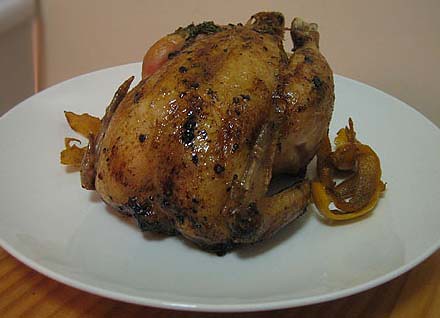
  • This was probably the easiest Christmas dish I’ve ever cooked. The two Cornish hens I bought in Chinatown cost me less than $10. All I had to do was ask the butcher to cut off the head and the feet. My large Dutch oven fit both of them that I was able to brown and roast under 45 minutes. The first time I tried this recipe, I used Silkie chicken. This time, I used the game hens but made the marinade with pomegranate molasses rather than seeds. My favorite part is sautéeing the orange peels in butter until fragrant–one of the least expensive ways to make a dish smell and look festive. I wish you were here. Merry Christmas.

    Ingredients:
    2 Cornish game hens, rinsed and patted dry
    1 cup Marsala
    2 tbsps pomegranate molasses
    fresh sage leaves
    a handful of mint leaves, chopped
    zest of 1 orange, cut into 1/4-inch strips
    1 tbsp butter
    salt, pepper, olive oil

    1. Make marinade. In a small bowl, mix the Marsala with the pomegranate and mint. Set aside, covered, for 1 hour.
    2. When ready to cook, preheat oven to 350º. Season the birds inside and out with salt and pepper. Tie the legs together with kitchen twine. In a Dutch oven, heat the butter with olive oil over high heat. Add 3 sage leaves and cook for 1 minute. Brown the hens on all sides. Lower the heat and add the rest of the sage leaves.
    3. Transfer the pot to the oven and roast the hens for 7 minutes. Remove the pan from the oven, drizzle 3 tablespoons of the marinade and dot with some butter. Baste the hens with the juices and roast for another 10 minutes or until the juices run clear when the thighs are pierced with a fork.
    4. Meanwhile, in a small pot, heat some more butter and cook orange zest for 5 minutes until the zest absorbs the butter. Remove from heat.
    5. Transfer the hens in a dish, sprinkle with zest and drizzle with pan juices.

    Related post/s:
    Where to buy Cornish hens and pomegranate molasses
    Or else, use Silkie chicken

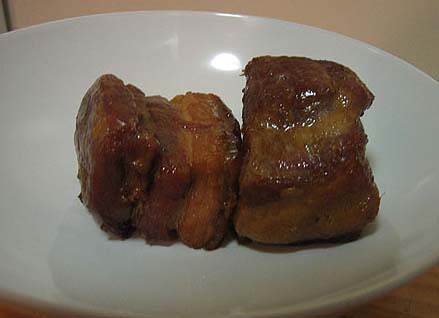
  • For Christmas Eve dinner this year, I wanted something more substantial than just lechon kawali. Deep-frying was the only way I knew how to cook pork belly until I ate at Gramercy Tavern for the first time years ago. So of course today, I turn to Tom Colicchio’s recipe to recreate the eyes-rolling-back feeling at home. The photo below looks a lot like the one from the Filipino version but this one was heftier–you can smell and taste the concentrated flavor of the braised vegetables. The skin was chewy on this version and it’s recommended that it be discarded before serving, but the meat and the fat easily give when pierced with a fork. Patience is a virtue. This dish will make any pork lover swoon.

    Ingredients:
    2 pork bellies, cut into 4 large chunks
    2 carrots, coarsely chopped
    2 celery stalks, coarsely chopped
    1 leek, white part only, trimmed and chopped
    1 onion, coarsely chopped
    2 garlic cloves, peeled
    3 cups chicken stock
    1 tbsp peanut oil
    salt and pepper

    1. A day or a few hours before cooking, rinse the pork bellies and season with salt and pork. Air-dry for several hours and then store in freezer, each piece separated, on a plate.
    2. When ready to cook, preheat oven to 350º. Heat the peanut oil in an ovenproof skillet over medium heat. Remove the pork from the freezer only when ready to cook. Add them, fat side down, to the skillet. Cook until the skin is browned, about 15 minutes. Brown the other sides for a few extra minutes then transfer to a plate.
    3. Pour off all but about 2 tablespoons of fat and add the garlic, onion, carrots, celery and leek to the skillet. Cook the vegetables, stirring occasionally, until they are tender and beginning to brown, about 20 minutes. Return the pork belly to the skillet, fat side up, and add about 2 cups of stock, enough to surround but not cover the meat. Bring the stock to a simmer, then transfer the skillet to the oven.
    4. Gently simmer the pork, uncovered, for 1 hour, then add another cup of stock. Continue cooking until the pork is tender enough to cut with a fork, about another hour. If necessary, keep adding stock to keep the skillet from burning.
    5. Allow the pork to cool in the braising liquid. Remove the pork from the liquid, then gently lift off and discard the skin using a small knife.
    6. Strain the braising liquid and discard the vegetables. Return the liquid to the skillet, bring it to a simmer and skim off the fat. Serve the pork in a shallow bowl moistened with a bit of the braising liquid.

    Related post/s:
    The Filipino version of this pork belly

  • The German couple at Colomina decided not to go ahead to Estanc Llong on our fifth day. It was simply raining too much. We’ve gone so far even after our first setback, we decided to go for it after breakfast. Visibility was at zero and we had large rocks to cross. The rain erased the paths. We followed as much as we can see until we reached a fork on the trail. We spent at least three hours trying both ways and retracing our steps. It was hard to swallow and admit that we were lost for the second time during our hike.

    We looked around us to see where we can sleep as soon as it got dark. There were no trees and no crevices in the rocks. We had a sleeping bag, but it was also wet because of the rain. As soon as we stopped on our tracks, we shook and froze–we knew we had to keep walking.

    Video diary, day 5: Arriving at Estanc Llong after getting lost for eight hours

    Back in Colomina, another young German couple just came from Estanc Llong. We remembered them telling us that the refuge was nestled among tall trees. Since we’ve tried every which way to get out of the mountains, we followed the Dr.’s instinct and walked along the trees, praying under our breaths that our next turn would be rewarded with a view of the refuge.

    I cried as soon as I saw the roof of the refuge. We really thought that we had to sleep in the rain out in the mountains. There was a smaller group already preparing for dinner when we walked in. We were so relieved to see other people again. During dinner, the only English-speaking hiker told us she was an expat from Canada. She invited us to hike down the mountain with her group, where we would catch another 4×4 with them and we would continue to our next stop, Ventosa i Calvell.

    Related post/s:
    Photos of Colomina to Estanc Llong on Flickr
    Video courtesy of Tripfilms.com