Speck-Taleggio Panini

I’m sorry to gloat, but I’m like a proud Mama Bear who just had her cub: I just harvested a second handful of mizuna greens from my terrace garden! I’ll be heart-broken when the plant is no more, but I’m going to milk it as much as I can. I’m also getting ready to plant a second round of salad greens for autumn which is fast approaching; hopefully, they’ll survive as the weather gets colder.

This sandwich needed bitter greens because of the speck’s fatty composure and it needed to stand up against the spiciness of the mustard. Almost any salad green will do like arugula or mache, of course, but mizuna complemented the stinkiness of the taleggio cheese. If you can’t find speck, good-quality prosciutto will also work.

Ingredients:
a couple slices of taleggio, rind removed
8 pieces of speck
6 mizuna leaves
whole-grain mustard
1 whole wheat panini bread, halved
a small knob of butter

1. Assemble your sandwich. On one half of the panini, layer the taleggio evenly. Top with the speck and then the greens. On the other half of the panini, spread a dollop of mustard and then place on top of the first half.
2. Melt half of the butter in a large skillet and heat the panini. Press with an iron grill press. After about two minutes, turn the sandwich gently with a spatula. Add the rest of the butter and distribute it around the sandwich while it melts. Press again for another minute and remove to a chopping block. Let it rest before slicing in two and serving.

Related post/s:
Taleggio is great for sandwiches

Tempura-battered Green Figs

I was surprised to find green figs at the fruit stand downtown where I work. Even Whole Foods only sold the black figs. What I like about green figs is that they’re less sweet than the black ones even though they look like they would be rindy and bitter. The ripes ones are actually pretty soft and they easily give when sliced in half.

You can use tempura batter here if you have access to an Asian grocery store, but the recipe that follows uses the flour you already have in the pantry. Any yogurt would do, too, but the plain Greek kind has that whipped texture that’s great for chopped fruits. I also find the Greek yogurt less tart and does not compete with the natural sweetness of the figs. My personal preference is the Total Classic kind from FAGE (pronounced “fa-yeh”).

Ingredients:
fresh green figs, washed, dried with paper towel
1 cup of flour
ice bath
one egg
oil
Greek yogurt

1. Make the tempura batter. Beat the egg in a bowl. Add ice water. Add flour in the bowl and mix lightly. Do not overmix.
2. Heat a deep skillet with some oil. Just right before frying, drench the figs with the tempura batter and gently add to the hot oil to fry. When batter is light brown, spoon battered figs out using a slotted spoon and remove to a wire mesh colander on a plate to let the excess oil drip. Do not use paper towels as to not make them soggy. Serve with Greek yogurt on the side.

Related post/s:
One of my favorite tarts uses figs and Stilton together
Make a fig preserve and save them for autumn dishes

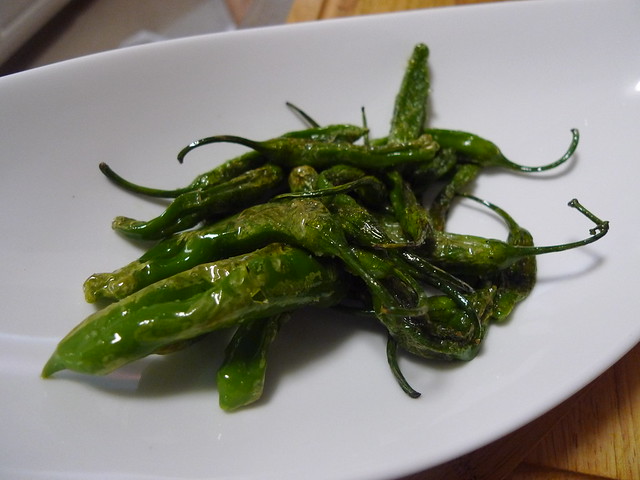
Blistered Shishito Peppers

So far I can only buy shishito peppers from two places here in New York City during the late summer months: Sunrise Mart off St. Mark’s Place and the TriBeCa Greenmarket a couple of blocks from work on Wednesdays. I don’t ever get tired of eating or serving them. They’re so easy to prepare and, without fail, guests can’t get enough of them.

Word is that the Japanese cultivated them because they can’t take the heat from the more popular peppers. I first had a taste of blistered peppers in Cal Pep when we were in Barcelona. They use pimento peppers over there which has the same subtle sweetness; the shishito are skinny while the pimentos are greener and a little bit more plump.

When blistering either, make sure you watch out for the splattering hot oil. Remove them to a mesh colander on a plate after blistering–using paper towel to drain the oil will just make them soggy.

Ingredients:
oil
2 handfuls of shishito peppers, stems intact, washed and dried thoroughly with paper towel
sea salt

1. Heat a large skillet. Add some oil and let it warm up until almost smoking. Add the shishito peppers and begin tossing around by swiveling the pan.
2. When most of the peppers are blistered on all sides, use a slotted spoon and remove them to a wire mesh colander on a plate to let the excess oil drip and immediately sprinkle with salt. Serve.

Related post/s:
Where to eat in Barcelona, Spain

Panini of Hot Salami, Brie and Cornichon

I wish I came up with this sandwich recipe because it’s truly the most complicated-tasting sandwich I’ve had in a very long time. I think a sandwich is never enough for a meal during the day, but this Salume-inspired panini put together all my favorite tastes and textures in my mouth in one seating. I remember eating this for the first time and wondering why I paid $10 for it, but also rolling my eyes back after the first bite. There’s that soft brie that’s even better when melted; the hot and spicy salami for that depth and chewiness and then the sourness and crunchiness of the cornichons all held up by sturdy whole wheat bread. It’s not exactly the $10 Tropea sandwich that I love ordering from Salume here in New York City, but I think it’s a pretty close adaptation considering I spent $20 to make four of them in one week for both the beach and for lunch.

I bought the hot salami from Di Palo’s–just ask for one of the hanging saawsages from their ceiling and have them slice it so you don’t have to worry about the thinness of each piece. The Vermont brie was from my Holton Farms CSA and the whole wheat panini bread was from Whole Foods. I highly recommend good quality cornichons here because you definitely don’t want to miss out on the crunch. Add a jig of Tabasco sauce for extra spice and you’re good to go to spend the last few weekends of the summer on the beach.

I used my trustworthy iron grill press here, but if you don’t have one, pressing on it using a heavy lid that’s smaller than the skillet will do. Otherwise, find a small, clean brick and wrap it with foil for a do-it-yourself sandwich press.

Ingredients:
a couple slices of Brie, rind removed
8 pieces of hot salami, thinly sliced
6 pieces of cornichons, halved
Tabasco sauce
1 whole wheat panini bread, halved
a small knob of butter

1. Assemble your sandwich. On one half of the panini, lay out the Brie evenly. Top with the salami and then the cornichons. If you want it extra spicy, add a few jigs of Tabasco sauce. Cover with the other half of the panini.
2. Melt half of the butter in a large skillet and heat the panini. Press with an iron grill press. After about two minutes, turn the sandwich gently with a spatula, making sure the cornichons do not spill out. Add the rest of the butter and distribute it around the sandwich while it melts. Press again for another minute and remove to a chopping block. Let it rest before slicing in two and serving.

Related post/s:
Speaking of complicated sandwiches, this let me express myself after getting laid off a second time

Braised Whole Chicken with Green Peppercorns

The Dr. tuned me into the new Cooking Channel when he came in from Boston to visit. I’ve stopped watching the Food Network a long time ago after I’ve noticed that most of their shows were targeting eaters that are not too adventurous. It seems that the Cooking Channel is their way to separate that content from the ones that involve personalities and cuisines of different origins. In a few hours alone, I saw segments shot in Vietnam, India and Italy which did not involve any screaming or bleached blonde hair.

My favorite so far is Luke Nguyen mainly because he’s traveling all over Vietnam with that ridiculously curious Vietnamese-Australian accent. He was in a green peppercorn farm that reminded me so much of the Philippines countryside. I actually remembered seeing the peppercorns the last time I was in Kalustyan’s but had no idea what to use them for, so after watching his show, I made a return trip to buy a packet.

The recipe also called for chicken. I had ordered a whole chicken from Holton Farms in Vermont who’s currently running an ingenious idea on how Community-Supported Agriculture could change the way we buy produce. My neighborhood in Harlem became one of their test spots after I convinced them to deliver in my neighborhood in exchange for getting them new customers who also live in my building. When I saw this recipe on TV, I thought it’d be a relief not to make another roasted chicken.

You can buy green peppercorns from Kalustyan’s, the heavenly spice store on Lexington Avenue in Curry Hill here in New York City. While there, pick up a sachet of annatto powder as well, but really, I didn’t think it added any thing special to the dish except for some more reddish-orange color. The original recipe called for oil, but the powder was less expensive so I opted for that instead. I also forgot to pick up tomatoes, so I ended up using half of the small can of tomato paste I had in my pantry.

I imagined this to be richer in taste, but it was subtle in flavor. Perhaps it was the coconut juice that made it a tad sweet and differentiated it from other tomato-based stews I’ve made before.

Ingredients:
green peppercorns
3 cloves of garlic, minced
salt
1 tbsp sugar
1 whole fresh chicken, washed, patted dry with a paper towel
oil
4 tbsps tomato paste
2 small carrots, chopped in bite-sized pieces
1 tsp annatto powder
4 shallots, sliced
3 cans of coconut juice
a splash of fish sauce

1. Lightly bruise 4 tbsps of peppercorns in a mortar and pestle. Remove and transfer to a small bowl. Add half of the minced garlic, a dash of salt and sugar and mix. Use this as a rub for the chicken and massage all over. Cover and marinate in the refrigerator for 1 hour.
2. In a large Dutch oven, heat some oil and sauté the remaining garlic and 2 tbsps peppercorns until fragrant. Set aside in the pot and add the whole chicken. Brown chicken on all sides for some nice color and then carefully remove to a plate.
3. In the same pot, add the tomato paste, carrots and annatto powder. Stir to combine and then add shallots, coconut juice and fish sauce.
4. Bring the mixture to a boil and skim off any impurities that rise to the top. Return the whole chicken and simmer, covered, for about 40 minutes. Turn the chicken after about 20 just to make sure the other side is also submerged into the coconut broth.

Related post/s:
Learn about the good things that Holton Farms is doing for our communities
OpenSky sells a nice 3.5 Le Creuset in flame