• Am I bummed that my apartment building won’t let me grill out on my terrace? Of course I am! Recipes like this make me wish I can just step out and put a nice piece of meat on the grill even if it’s just dinner for one. But alas, I don’t get everything I want, so I have to settle for a hot oven inside my home during the summer.

    Shank is the portion of meat beneath the knee. There’s a lot of movement in that part of an animal, so its meat is sinewy. Braising is the way to go to soften it, but I didn’t want the oven on too hot too long and decided to roast it instead. I cooked the shank 75 degrees lower than I normally would when roasting and I went past 45 minutes until the meat passed my medium-rare finger test. (Gently press the tip of your middle finger to the tip of your thumb. Feel the fleshy area between the thumb and the base of the palm. That’s how the meat should feel like when it’s medium rare.)

    Shave off the lamb meat from the bone and serve with mint sauce. Store the remaining meat in a container in the fridge–it will keep for a few days to a week. When ready to eat the leftovers, toss with salad greens, some grape tomatoes and drizzle with olive oil and season with salt and pepper.

    Ingredients:
    1 lamb shank
    sprigs of rosemary
    6 cloves of garlic, minced
    1 small knob of butter
    salt
    pepper
    oil

    1. Preheat your oven to 300º. In the meantime, use a small knife to create small slits around the lamb shank. Stuff the slits, or pockets, with small pieces of butter, rosemary and garlic. Using cooking twine, tie up the shank at 1-inch intervals to hold its shape while roasting.
    2. Brush the shank with olive oil and sprinkle with salt and pepper.
    3. Roast in the oven for about 1 hour. Remove to a chopping block and let rest for 20 minutes. Carve to serve.

    Related post/s:
    Braised lamb shank recipe
    This hank shank recipe with sausage is one of my favorites

  • After biking my third Century, I cleared my calendar the following week and stayed out of the gym and off my bike. I wanted a whole week where I can just veg and chill. I was on my way to the new extension of the High Line when Nate emailed me about a last-minute invitation to Sud de France’s Wine Lover’s Dinner at the James Beard House. How do you say no to that? I had 15 minutes to run to the west Village so I moved my sore legs as fast as I can and just recomposed myself as soon as I stepped in the townhouse.

    It was a warm summer night in New York City—one of those nights that make you fall in love with the city again even after 18 years of a steady love-hate relationship. A chilled glass of Antech Blanquette de Limoux Brut in my hand helped, of course. I sat in the garden and watched the other guests until we all had to move indoors and take our seats. I was seated under the glassed roof with eleven other people. I used to not do well eating alone, but I’ve since learned to enjoy the moment and languish on being on my own, especially if it means meeting new people with the same interest; in this case, a love for food and wine. The gamble is being seated with guests who have no qualms about picking up their ringing cell phones and actually carrying on with their one-sided conversations. One guest at our table had to finally ask the quatro to my right to remain quiet while someone was introducing the chefs to the rest of the house.

    Sud de France invited Chef Charles Fontès of Montpellier, France, to cook for the guests with the help of Daniel Boulud’s Feast & Fetes Catering chef, Cédric Tovar. (Some of the best wedding h’ordeuvres I’ve had were from them, and boy, I’ve been to a lot of weddings.) The chefs met for the first time the day before and they found out they actually grew up in the same neighborhood! Funny that; this city always brings people together–the second reason why I can’t stay away from this place. Everyone seemed like they were in a good mood; the townhouse was abuzz and it even got too loud that I struggled to listen to the wine descriptions. There was a separate table in the entry hall plus a few more upstairs that were not viewable from where I sat next to the kitchen. They were awkwardly set, but how else do you accommodate all the paying guests in a townhouse-cum-restaurant? I was a bit taken aback that the servers stacked up plates every time they removed them from our table. I expect that from a Chinese restaurant, and perhaps from a smaller establishment, but not from the James Beard House.

    An oyster appetizer in seawater gelée was fun to eat and looked so pretty on the plate with a small piece of zucchini stuffed with braised lamb, mint and almonds. The two small items were completed by a shot of tomato-basil velouté with small chunks of roasted eggplant–“eggplant royale” on the menu, natch. The zucchini ravioli for the second course fared much better for me, served with asparagus and beautiful morels in, gasp, tarragon-oil foam! Just when I thought I’ve seen the end of foams on dinner plates! A very memorable 2010 Domaine La Bastide Viognier perfectly complemented the asparagus. If I took home anything from the night’s event, it’s the fact that Viognier is now my favorite warm weather white wine.

    A seared scallop was the third course with a slice of avocado in grapefruit vinaigrette. I felt like the dressing didn’t match the soft avocado. The glass of 2008 Toques et Clochers Haute Vallée Limoux Blanc familiarly tasted like a California Chardonnay which was later confirmed because the grapes grow in a similar terroir as the Napa Valley. The striped bass, an already mild fish, could have used a heavier salt hand, though the bouillabaisse jus reminded me of those meals I’ve had by the Mediterranean. (Too fishy, the lady to my left said, as she pushed her plate away from her.) The duo of braised beef cheek–described as brisket by the same lady–and roasted tenderloin was delicious with the glass of the 2008 Château D’Aupilhac Montpeyroux and all its black cherry-ness. A nice panisse was warm and crisp and complemented the different textures of the dish. A bowl of (sautéed) cherries–ha!–with verbana ice cream and a delicate pistachio-orange tuile ended the evening’s event.

    Chef Charles Fontès, as you can imagine, cooks in Montpellier using the freshest ingredients from the farms surrounding the La Reserve Rimbaud restaurant. Unfortunately, being far away from his original setting didn’t translate quite well, so I was glad the wines paired with each dish more than made up for the food’s shortcomings. It was a wine lover’s dinner after all, not a food lover’s dinner.

    Related post/s:
    Check out the Sud de France’s Web site for the delicious wines I tasted

  • The last time I was in the Philippines was in 2008 for my brother’s wedding. I had been traveling to learn how to surf in the southern part of the country before the festivities and then had to travel up north to fulfill familial obligations right after. On our way to my father’s hometown of Ilocos Sur, my parents and I stopped at the Santa Cruz wet market to buy ingredients for that night’s dinner and provisions for the next few days. All the produce were incredibly fresh and I realized how much I missed the Filipino fruits and vegetables I don’t get to buy in New York City. I watched my dad as he negotiated and haggled with the sellers in his native dialect while I took photographs of the market’s different colors. I had to catch my breath when I saw how fresh the yellowtail fish were. Each fish cost roughly US$3 and my father had to hold me back from squealing in excitement so as not to get a higher price quote from the market ladies. They always say that you have to check for clear eyes when you buy fish to see how fresh they are. Can these be any more fresh?

    When we arrived at my father’s family’s house, I had to follow the fresh fish to the kitchen to make sure that no one tries to cook them. Filipinos love their deep-fried anything, and not even fish with super clear eyes will stop them from cooking them. One of my cousins’ wife was in charge of the kitchen and I made her swear not to cook the fish and to fillet all of them right away to make kilawin, or Filipino ceviche.

    My dad’s famous ceviche recipe requires a very pungent vinegar locally made in his hometown. I wanted to recreate it here in New York even without that very important ingredient. There is a white coconut vinegar available in Chinatown, but for my version, I used fresh lime juice and cured the fish for 15 minutes while I prepped the other ingredients.

    I was trying to avoid turning on the stove or the oven during the heatwave and this dish came to mind after I harvested the second batch of greens from my garden. You can skip the greens here, but crunchy and chilled Persian cucumbers are a must. Sweet watermelons are aplenty in Harlem right now–I bought mine from the back of a truck parked on 147th Street.

    It goes without saying that you absolutely need fresh fish here, so make sure you buy sushi-grade quality from a reputable fish monger. I used striped bass because that’s what looked the most fresh, but a thicker cut of halibut for double the price would have been more heavenly.

    Ingredients:
    fillet from 1 striped bass, patted dry with paper towels, cut in cubes
    juice from 2 limes
    1 small jalapeño pepper, thinly sliced
    1 small red onion, thinly sliced
    salt
    pepper
    watermelon, chopped into cubes
    cherry tomatoes, halved
    2 Persian cucumbers, chopped into cubes
    a handful of salad greens
    a handful of cilantro, finely chopped
    oil

    1. In a glass bowl, cure the fish fillet. Mix the fish cubes with the lime juice, jalapeño and onion with some salt and pepper. Cure for 15 minutes in the fridge. Stir every 5 minutes to make sure the fish is well-covered.
    2. While curing, combine the watermelon, tomatoes, cucumbers, salad greens and cilantro in a salad bowl. Toss with oil and season with salt and pepper.
    3. The fish is cured if they look white and “cooked”. Divide fish among shallow serving bowls and toss gently with the vegetables. Drizzle with some of the fish-lime juice dressing.

    Related post/s:
    Philippines photos on Flickr
    Summer salads like this make me think of Montauk
    And places like Roatan in Honduras

  • What did people ever do before the freezer? It was time to clean the fridge over the weekend and I was surprised to see a package of frozen Swai fish fillets. I called my dad and he told me he brought them one time I invited them over for dinner in the hopes that I would cook them, but I already had a meal ready so he just stored them in my freezer. I thawed them and left the apartment to run errands. When I came home famished, I dried the fish with paper towels and marinated them until I could no longer stand my rumbling stomach. While the rice was cooking, I prepped the rest of the ingredients. Garlic paste will work best here, but you can just mince a whole head of garlic as substitute. (There’s no reason for less garlic, is there?) Make sure you fry all the spices in very hot oil for the best flavor. If it can be helped, don’t use dried curry leaves. The fresh ones fry so awesomely.

    Ingredients:
    2 fillets of Swai, or any white fish, patted dry with paper towel
    2 tbsps turmeric
    2 tbsps red chili powder
    salt
    oil
    1 red onion, thinly sliced
    8 cloves of garlic, minced
    10 fresh curry leaves
    1 lime, juice and zest

    1. Marinate the fish for several minutes. Sprinkle turmeric, red chili powder and salt on both sides of the fillets. Set aside until ready to cook.
    2. Heat oil in a large skillet. When oil starts to smoke, sauté the onions and cook until light brown. Add garlic and cook until golden. Add the curry leaves to crisp.
    3. Move the spices to the side of the skillet and add a little bit more of oil until hot. Fry the fish for 4 minutes on one side. Feel free to move the spices on top of the fish if you need more room. Gently flip the fish using a spatula and fry the other side for another 4. Squeeze lemon juice and sprinkle with zest before serving.

    Related post/s:
    I buy my fresh curry leaves from Kalustyan’s
    My friend Jim loves some Swai

  • I was coming off eating a lot of burgers the few days before my flight to Boulder when Jax Fish House was added by Michelle to my list of places to eat because I had expressed interest in eating more seafood. Seafood! In Colorado! A land surrounded not by water but by the snow-capped Rockies, the Plateau and the Great Plains! I saw four deer on the side of a downtown street!

    Soft-shell crabs season had begun–one of my favorite food-eating times in New York City–and specials the last few days have involved them in sandwiches and salads. I had soft-shell crab sandwich the day before my flight, but I still had room for a few more. If I was going to miss the rest of it in the city, I was going to get my fill in Boulder.

    I was warned of the wait at Jax–that it would be longer than usual because of the upcoming long weekend–but we decided to try scoring bar seats anyway. The restaurant was definitely crowded for 6pm and the maitre d’ told us the wait would be for half an hour. But not even 10 minutes into our first drinks that we were called to follow her to our table! We were almost unprepared to eat as we were still enjoying our first drinks after my four-hour bumpy flight.

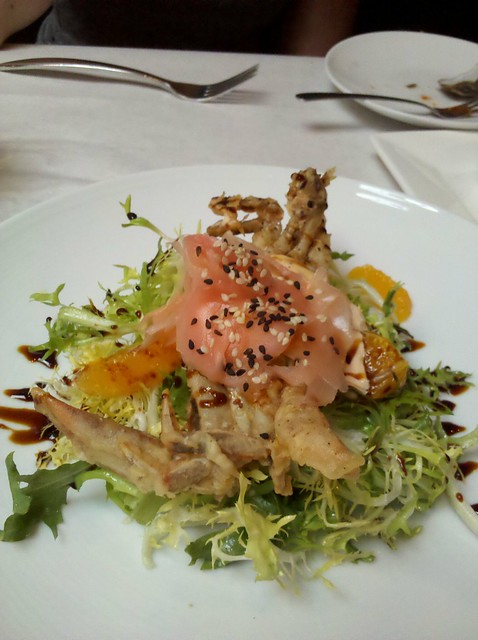
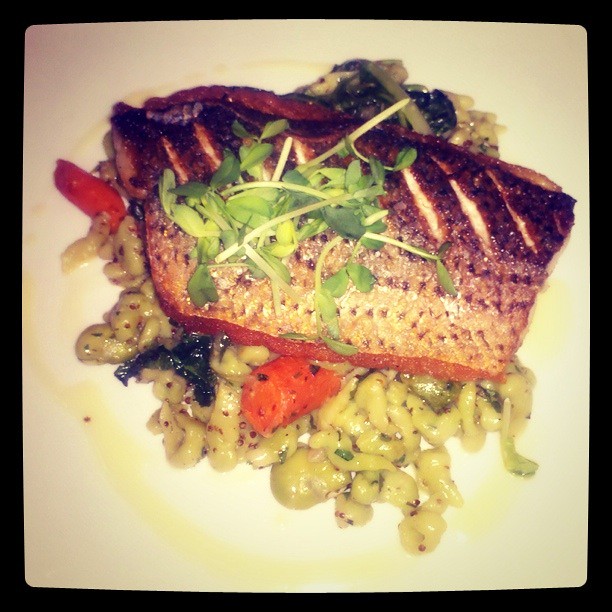
    We started off with half a dozen gigantic oysters before their special of, sure enough, soft-shell crab salad with frisée in wasabi aioli. We also split the main of crispy skinned striped bass on top of a beautiful chive spaetzle with roasted carrots and fava beans. Everything on their menu evoked spring vegetables and I fell in love with all the choices of greens. My least favorite dish though was the spearfish sashimi with noodles. I don’t remember the beet-red sauce that accompanied it (could it have been beets?) but the noodles didn’t do anything for me. They took away from the buttery texture of the sashimi. I could have simply eaten the fish unadorned. There wasn’t any room for dessert but we couldn’t resist the key lime tart. I don’t even remember if it was a good key lime tart, only it was what I needed at the time. (I know I use that line every time I order food with my eyes instead of my stomach.)

    We sat under the sunroof so we were surprised to notice that the space had gotten dark. We realized that we had been eating for three hours! For two walk-ins, we never felt rushed. Our server left us to catch up with barely any interruptions and our bill for two didn’t break the bank. As a New Yorker, I will never stop feeling amazed at how much less other people have to pay for good food. Boulder’s one of those places: fresh produce, good cooking, affordable prices. I was in Colorado with an already satisfied stomach enjoying the crisp summer night without the humidity and it had only been five hours. I could already tell my weekend was going to turn out really well.

    There are two Jax restaurants in Colorado. This Boulder one is at 928 Pearl Street.

    Related post/s:
    Boulder, Colorado Instagram photos on Flickr

  • I had no idea I missed Chinatown as much as I did last Friday when I made a trip during a break from the office. I stopped by my favorite meat market on Mulberry and saw how beautiful all the pork belly were and took home 8 pounds’ worth.

    I woke up Saturday morning feeling refreshed so I was quite disappointed that it was cloudy outside. I set up in the kitchen and started to boil the pork belly, still imagining different recipes in my head. I left my apartment for some fresh air to make up my mind. On my way home late in the afternoon, there was a perfect chill in the air and I immediately craved the pork belly waiting at home braised, just like they do in those quiet Japanese restaurants. All I had to do was pick up a bottle of sake and an envelope of konbu , or dried kelp.

    I cooked some sticky rice and washed off the dirt from my remaining ramps stash. In a heated skillet, I added some olive oil and waited for it to smoke a bit. I flash-fried the ramps and drizzled in some of the buta no kakuni liquid to tame the strong onion flavor. When it dried up, I quickly picked them up with tongs and put them on top of the warm rice. A large chunk of pork belly accompanied them plus more of the soy-flavored liquid.

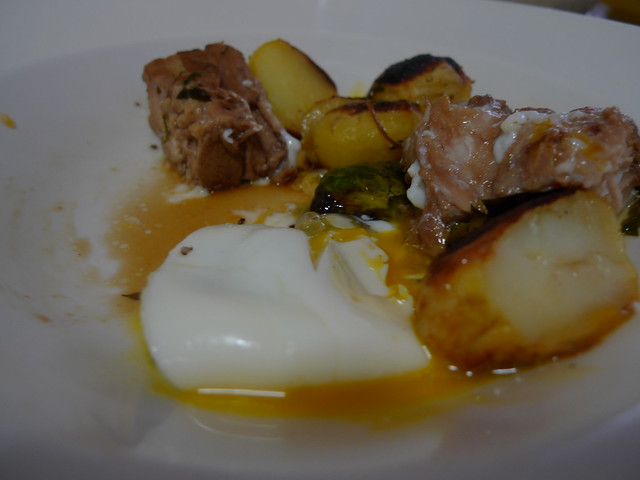
    For the second seating of Not Just Eggs the next day, I roasted some Brussels sprouts and Peewee potatoes and used them as a bed for the pork. They held up while the pork beautifully fell apart and the poached egg yolks oozed their way down the sides. I heard a lot of mmms while the six guests were eating and that made me a very happy host.

    For dinner, I strained the first batch of pork belly cooking liquid to make my broth and served the belly with noodles, plus steamed bok choy and, yes, another poached egg. It’s the pork belly that kept on giving!

    Any way you serve your buta no kakuni, don’t be shy about pouring in the thickened soy-flavored cooking liquid as sauce.

    Ingredients:
    4 large pork belly, chopped in large squares, washed thoroughly
    2 cups of sake
    3 sheets of konbu
    3 knobs of ginger, peeled
    1/3 cup of raw cane sugar
    1/2 cup of soy sauce

    1. In a large Dutch oven, submerge pork belly in enough water and bring to a boil with 1/2 cup of the sake. Skim off impurities that float to the top.
    2. Lower heat and simmer for an hour, covered. Turn off the heat and let cool, uncovered.
    3. Transfer the pork belly to a colander and rinse under warm running water. (Save pork belly water in another container for future soups.) Return and submerge the pork belly in the pot again with enough water and let boil–this time with the konbu, ginger, sugar and the rest of the sake. Gently stir to distribute the sugar. Lower the heat and simmer for another hour, covered.
    4. Add the soy sauce and continue to simmer for another hour. The soy-flavored liquid should reduce and thicken a bit and the pork should fall off when gently prodded by chopsticks.

    Related post/s:
    A similar Chinese version of braised pork belly uses rice wine instead of sake

  • I love where I live in Harlem, but the neighborhood has been a bit slow in opening up restaurants I’d like to frequent. Sometimes, after I bike around Central Park, I wish that I can just chain my bike somewhere and eat a satisfying brunch without the food being soggy eggs and weak coffee. Instead, I bike all the way home and make myself a quick bite to eat and think, “Well, that wasn’t so difficult.”

    My mother always told me, “If you want it done right, do it yourself.” I’ve created an eating club before called Supper with Strangers, so the idea of inviting people to my home for a civilized and good brunch came easily. Serving brunch to a group of people is easier in theory because there are less courses to prep for and I don’t have to expect my guests to linger like they would if it’s at night. The challenge was presenting more than just eggs to eat, and thus, Not Just Eggs was born. I put up the announcement on my Facebook and Twitter pages and received very enthusiastic responses that I sold out a total of 24 seats for a total of three Sundays in May.

    I was actually nervous for the first Not Just Eggs seating. I spent the week before testing a couple of recipes that would taste good with a poached egg on top. I wanted to create a dish that celebrated the spirit of brunch: a substantial meal with a breakfast feel. I had two vegetarian guests and I didn’t want to buy two sets of groceries, so I had to cook a dish that would work for everyone with just the additional meat for the pork lovers as the slight difference.

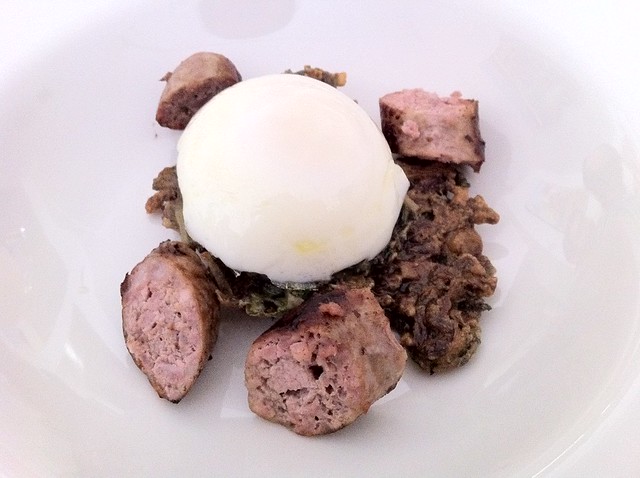
    Since the carrots need to be grated for this recipe, I know you’d be tempted to grate the potatoes as well. Spend extra time to chop them like matchsticks so that they do not get soggy. And it’s okay to use one of those silicone poachers so your eggs come out perfectly. They’re especially handy if you’re poaching eight all at once. The ingredients below made enough for all eight guests with each person getting two fritters. Add pan-fried sausage for the other guests.

    Ingredients:
    3 carrots, grated
    2 potatoes, chopped like matchsticks
    scallions, finely sliced
    a handful of parsley, finely chopped
    3 tbsps flour
    salt
    pepper
    6 eggs
    vinegar
    oil

    1. Mix the carrot, potato, scallion and parsley in a bowl. Add the flour and season well. Stir the eggs into the vegetable mixture to combine.
    2. Heat some oil in a sauté pan. Add a large spoonful of the mixture to the oil, lightly flatten with a heat-resistant spatula, and fry each side until golden brown. Remove with a slotted spoon and drain on a cooling rack.
    3. Meanwhile, bring a pot of water to a boil and soft-poach the eggs. Add a tbsp of vinegar. Crack the egg in a small bowl or a ramekin. Gently pour in the egg–don’t be afraid to get that ramekin wet too–and cook for 3 to 4 minutes or until the yolk is half-set. Scoop the poached egg out with a slotted spoon and place on top of two fritters to serve.

    Related post/s:
    Roasted beets with poached egg
    In D.C., I had poached egg on top of frisée

  • Our last full day in Stockholm, Francine and I hit the hotel breakfast buffet to power up with more herring, more fresh fruits and more charcuterie before we walked around the hip Södermalm neighborhood. We scoured so many stores that we forgot to eat lunch. Towards mid-afternoon, we walked by Louie Louie and decided to join the pretty people inside–I was already convinced by the pretty typeface they used on their sign. (We later realized that it was on our list of places to eat that we’d left back in our hotel room.) While Francine saved a couch and coffee table for us, I managed to talk to the guy at the counter and asked him to order two things he would like for us to try. He chose a warm open-faced roast beef sandwich and a blueberry pie. How do you feel about vanilla sauce? he asked. I flirted back that if he liked it, I would like it. It was an eye-rolling experience. The pie and the vanilla sauce, of course, not the guy, though he was very easy on the eyes. By the end of our day, I ended with vintage dish towels, a clutch and a necklace while Francine fell in love with another hat. Both of us had several items of clothing on our tallies.

    We put our feet up back in Gamla Stan at Wirströms Pub and drank a couple of pints to while away the rest of our afternoon. We were pretty desperate to eat reindeer during dinner time. The one place I was dying to go to was closed for the day (also used a good-looking typeface in their logo) and the one recommended by the concierge didn’t serve it. (Thirty-one countries and not once did concierge ever give me a good restaurant recommendation.) We remembered seeing reindeer on the menu when we walked by Glenfiddich Warehouse back in Gamla Stan the day before, so I called to confirm.

    We expected a dark and cavernous space full of old barrels and the menu to have some heavy stews. It had been drizzling all day and we were quite ready for a satisfying meal. To our surprise, the kitchen whipped up some beautifully-presented dishes that you would see at a modern restaurant. Ordering veal carpaccio for an appetizer before the reindeer fillet main course sounded a little much at first, but they were perfect split in two.

    For a nightcap, we stopped by Akkurat for some scotch before we decided to end the night with a second one in the lobby of our hotel. We counted down the minutes until Francine’s birthday and then toasted turning a year older before we called it a night.

    It was a little sad back in our room, packing up and saying goodbye to Stockholm. Though we felt like we did a lot in the short time we had, we agreed we could stay for another day, but alas, real life was waiting for us back in New York City.

    Louie Louie is at Bondegatan 13 in the Södermalm neighborhood of Stockholm. Glenfiddich Warehouse is at Västerlånggatan 68 in Gamla Stan.

    Related post/s:
    Stockholm, Sweden photos on Flickr

  • Swedish efficiencies were immediately experienced upon our arrival six hours after taking off from JFK: no immigration forms, no lines at customs, a superfast Arlanda Express train to downtown, smooth check-in at the Nordic Light Hotel conveniently located right next to the train station, a much larger shared room than expected, a good breakfast of herring, paté, fresh fruits, cheeses and charcuterie at the lobby.

    Francine and I only had two full days to spend in Stockholm, Sweden and we were going to be as efficient as any Swede. We freshened up after breakfast and picked the nearest neighborhood to explore first. Filled up and energized to walk around Gamla Stan, or Old Town, we looked up old buildings, took photos of the water coming in from the Baltic Sea, crossed bridges and checked out several vintage and specialty stores. Francine scored a cute hat from the “antikt” store on Drakens, or Dragon’s Alley, and I poured over different fabrics with loud Swedish prints and contemplated buying a very pricey wooden sculpture of a mackerel. (For US$200, I changed my mind.)

    Kronor still intact in our wallets, we decided it was time to eat again after a couple of hours of walking. If you think Americans are gluttons of the world, you better check the Swedes’ all-time world record when it comes to eating candy. Every Friday, or fredagsmys–literally “cozy Friday”–the Swedes unwind and reward themselves with something sweet. The pastry shops and bakeries we walked past displayed wares that made my mouth ache. Café & Brödbod looked more chill inside and so we grabbed a table and bought the two prettiest things behind the glass. My pastry was filled with almond paste and sprinkled with cardamom seeds that made it oh-so-savory. Francine opted for the ultra-light choux with the perfectly sweet cream topping.

    We walked off the snacks and snuck into some more alleys to window-shop for souvenirs. I checked out a small gallery where people were drinking while hovering around some art. We went inside several gift shops to look for fridge magnets that also doubled as bottle openers to add to my collection. It took us a few more blocks before we decided that it was time for an afternoon drink. We ducked into Pubologi, a bar decorated after my own heart, and sat at one of the long tables for some hefty and not-so-hefty beers. They were closing to prepare for dinner service, but the bartender let us move to the bar by the front window so we could drink our second and third pints.

    After a quick nap back at our hotel room, we joined the tourists for more beers at Pelikan before we shared home-style Swedish cooking of meatballs (much better than what you can get at Ikea’s) with cream sauce and lingonberries and a roasted pork knuckle as big as our faces. A salad would have been nice, but naturally, there were no vegetables on the menu except for an artichoke pie. Pelikan’s cathedral-high ceilings reminded me of the old pubs in Prague and the group next to us singing beer songs reminded me of the camaraderie in Ireland. We spent our last few hours of our first day congratulating ourselves at how well we did even with jet lag and a six-hour time difference.

    We were falling in love with Sweden. We didn’t need to worry about the language whenever we had to inquire about something. Almost every person we assumed was local was mad beautiful with their height, skin tone and ridiculously blonde hair, and yet there were a lot of people who looked like us. (I later found out that by 1996, approximately 26% of Stockholm’s residents are of an immigrant or non-Swedish background.) Metro attendants were friendly and everything was convenient and easy to get to. The city may not be on an easy-to-understand grid, but it’s divided into smaller neighborhoods that are explorable by foot.

    I could create a long list of the things I love about European countries someday, but for now, I was happy to experience that Stockholm had a lot of them in one place.

    Pubologi is at Stora Nygatan 20 in the Gamla Stan neighborhood. Pelikan is at Blekingegatan 40 off the Skanstull metro stop.

    Related post/s:
    Stockholm, Sweden photos on Flickr
    I highly recommend the Nordic Light Hotel for your weekend getaway
    I am so jealous that we don’t have the equivalent of Arlanda Express in New York City

  • Shauna introduced me to this Paula Deen recipe last year. I had invited her to come down for dinner and she brought a ceramic pot filled with batter and peaches. Because I’m not a baker, I always welcome guests bearing desserts. It was delicious with vanilla ice cream as soon as it came out of the oven, but the bread was even better the next day. It had sucked all the peach juice and made it less sweet. I was even skipping the fruit and just going for the starch.

    When it was my turn to make dessert, I asked Shauna for the link to the original recipe and was completely turned off at how much sugar and butter was used. No wonder it had to be baked in a deep pot. I made my version in a shallow pie pan, cut the ingredients in half and–gasp–cut the sugar altogether. I added a tad of sweetness by drizzling in some of the peach syrup from the can just before serving. It might not satisfy your sweet tooth, but it probably won’t make you sick of it either. (If you must, use 1/4 cup of sugar and that should be enough.)

    Ingredients:
    1 cup of flour
    1 1/2 tsps of baking powder
    1/2 tsp of salt
    1 cup of milk
    a small knob of butter, melted in the microwave
    canola oil baking spray
    1 small can of sliced peaches in heavy syrup
    cinnamon powder

    1. Preheat oven to 350º. In a large mixing bowl, combine flour, baking powder, salt and milk using a spatula. Add the butter and mix well.
    2. Coat pie pan with a spray or two of canola oil. Pour in batter. Top with slices of peaches and spoon in some of the heavy syrup. Sprinkle with cinnamon powder.
    3. Bake in the oven for 35 minutes or until the edges are browned. Serve warm with vanilla bean ice cream.

    Related post/s:
    This recipe from 2008 looks more like a peach crumble

  • 21-17 49th Avenue off 21st Street, Long Island City, Queens
    718/425.6917
    $330 for five, with drinks, without tip
    ♥ ♥ ♥

    It’s rare that I eat out these days mostly because there’s something in my life now called “mortgage”, but when I do go, I make sure that I’m with a good group of people who appreciate food as much as I do. I was at the Breslin a few months ago with more or less the same group of people and we talked about what and where we were going to eat next while we were eating. We jokingly called ourselves the EatingAnimal Club because we realized how much we liked our red meat and pork. I wanted the rest of them to love sashimi and offal as much as I do, so the premise of eating nose-to-tail came up as one of the unofficial foundations of the club. (The “club” in the name made it sound so pretentious and exclusive–two adjectives we all aspire to be.)

    M. Wells was the club’s third meeting. I was glad that everyone was willing to take the 7 train to Long Island City, Queens on a weeknight. When we were planning it, all we could find online was their brunch menu, but it didn’t take a lot of convincing to tell them to get adventurous for dinner–Québécois adventurous.

    We all looked at the small dishes on the menu but I was pretty much handed the baton to order for the table. They were out of the “porterhouse pork” and the headcheese sandwich by the time we sat down at 8pm, so we picked eleven other dishes while skipping out on the three salads and a blini. Here’s the line-up of what went in our tummies:

    Oyster in sabayon – We all met up at Grand Central Oyster Bar beforehand, so I wasn’t a big fan of this. It was also coffee sabayon! I love coffee-flavored anything, but I prefer my oysters unadulterated.
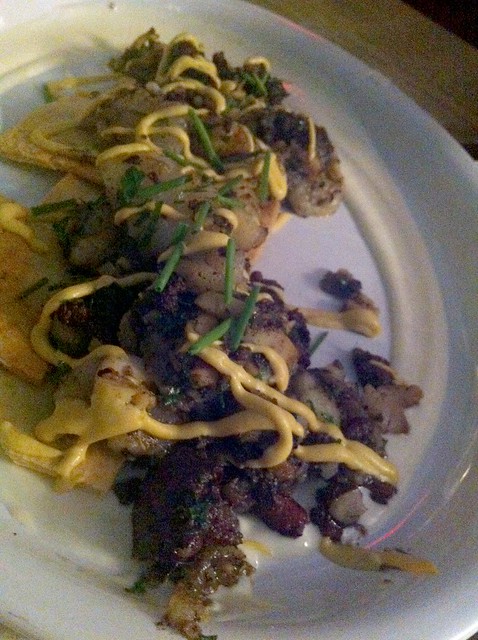
    Whelks and blood sausage – I love me some snails and blood sausage, but I never thought I can eat them together. That said, this was one of the strongest dishes on the menu for me. Both ingredients were doused in dill-garlic butter while the soda crackers kept the strong flavors at bay.

    They didn’t have sweetbreads on the menu but the veal brains made up for that. It was soft and smooth like homemade ricotta, rich like creamy butter.

    Escargots and bone marrow – Another combination that perhaps only Canadians with French thinking would come up with. The textures were odd: chewy escargots with slushy marrow fat but I couldn’t stop scooping them up. I would have loved it even more topped with finely chopped parsley and red onion.

    Beef tartare – Tartare is tartare and I wasn’t a fan of how saucy their version was. Like my oysters, I prefer my raw meat clean and immaculate. The poached egg was a nice touch, though–much heftier than a quail egg.

    The snow crab salad with celeriac was also delicious and, if I remember correctly, went faster than any other dish on our table. The shaved Brussel sprouts was also a nice break from all the fatty dishes. It was served with dry venison jerky instead of perhaps bacon bits.

    My favorite dish of the night was the tripe. It was called tripe “pasta” on the menu because I think they looked like cavatellis, but instead of a sauce, they were tossed with crushed smoked herring. The saltiness of the fish was oddly perfect with the blandness of the tripe. I would have this for breakfast, lunch and dinner.

    The Canuck breakfast reminded me not of Canada but of my breakfasts in Ireland sans the grilled tomato. I ate fried eggs, ham (bacon to us Americans) and blood sausage everyday for a week before I hiked or biked and the dish brought so many memories of that trip.

    The tuna was pretty amazing with capers and egg yolk sauce, but I barely remember the butter chicken that my eating mates loved.
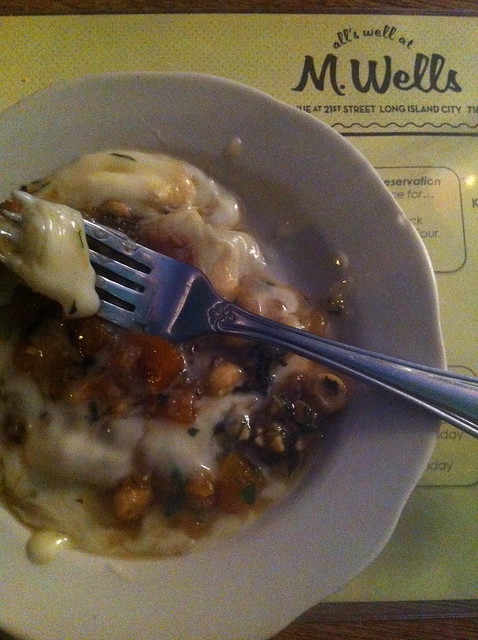
    If those weren’t enough, somehow a cheese plate made it onto our table. (Good upsell from the staff there!) We were expecting small wedges of cheese but it came as a sticky mess of Winnimere, hazelnuts and candied fruit in maple syrup. I think if I wasn’t full, I would have appreciated the earthiness and saltiness of the dish. It certainly falls under the “weird” category for me and I didn’t need a platter for four of it.

    We were pretty bummed when we found out that they had ran out of the banana cream pie, so we opted for the cheesecake, and man, what a cheesecake! Were those Ladyfingers in there? The cake wasn’t ridiculously sweet and we practically fought over it. The solution: take a slice to go!

    Put the EatingClub in one room with food and drinks and we get pretty boisterous. The three ladies who shared our long wooden table weren’t too pleased with our behavior, but our servers seemed to like us, offering us a complementary bottle of bubbly for keeping us waiting in between courses and shots of some type of anise-flavored digestifs. We had to cancel a couple of dessert items after the gigantic cheese course and we felt bad that we requested to remove $17 worth of extra charges from our first bill, but we were also good diners and left them a hefty tip for putting up with us. I hope the staff had a good time with us as much as we had eating at their diner-cum-restaurant. We walked out of there, happy and drunk well past midnight, and into the cold Queens night.

    Related post/s:
    The Spotted Pig back in 2005

  • It’s spring. No, it’s not; it’s still winter. It’s warm and I’m wearing a light jacket. Oh, it’s going to be cold this week, let me unpack my winter coat again.

    Mother Nature has been playing with us here in New York City. One day, it’s warm enough to walk around without a jacket, the next day my neck is so cold because I didn’t carry my scarf with me. The good thing about this beef stew is that for warmer weather, you can lighten it up by skipping the potatoes and adding more broth so it’s more liquid than sauce-y. If it’s cold outside and you want something heartier, serve this with potatoes, pasta, bread or rice and you got yourself a heavy meal.

    I prefer the lighter version served with a few jigs of Tabasco sauce for a little kick. In either version, you mix all the ingredients together and simmer. You don’t even need your silly crockpot to replicate them.

    Ingredients:
    oil
    1 pound of stewing beef, cubed
    4 cloves of garlic, minced
    1 white onion, chopped
    3 sprigs of thyme
    1 large carrot, chopped
    1 large can of whole tomatoes
    vegetable broth
    salt, pepper
    1 can of corn kernels, drained
    a handful of parsley, roughly chopped

    1. In a large heated Dutch oven, add some oil. When hot enough, brown beef cubes by cooking and stirring occasionally until most of it has changed color.
    2. Add garlic, onions and thyme and sauté with the beef. Add carrots, plus the whole tomatoes with its juice and enough vegetable broth for most of the beef to be submerged. Season with salt and pepper. Cook in low fire for 30 minutes.
    3. When beef cubes are tender enough that the meat gives with a soft prod of a fork, add corn kernels and parsley. Cook for another 10 minutes just to make sure corn is well-combined with the rest of the stew. Season with salt and pepper to taste.

    Related post/s:
    Skirt steak salad with endives recipe