From Josep M Blanc to Colomina, the fog was thick and the rain steady. A young German couple we met at Blanc were going the same way. The girl was wearing a bright yellow covering on her backpack and we followed it to make sure we were going the right way. When we arrived in Colomina, we ended up eating dinner with them. They told us that they kept looking back during the hike to look for us. They were looking for us to make sure they were going the right way!
Video diary, day 4: Rain and wind to Colomina
Video diary, day 4: Arriving at Colomina
The refuge at Colomina was held down by giant steel cables. I couldn’t sleep that night, not just because it was cold in the bedroom, but because the wind was howling so fiercely I was afraid the roof was going to come off.
We had to start over from Espot and waited for a 4×4 to fill up with other tourists until we reached Amitges, the stop we missed the previous night. As soon as we received our fourth stamp there, we hiked down as quickly as we could to Mallafre to get our fifth stamp. Because we were trying to recover from our mistake, going through the mountains and making it to Josep M Blanc the same night was next to impossible. A park ranger in Espot advised us to take the forest route because he was expecting another downpour in the afternoon.
Video diary, day 3: Recovering from a mistake and on to Josep M Blanc
Video diary, day 3: Arriving at Josep M Blanc
We might have taken a shortcut, but to us, the hike from Mallafre to Blanc still took four and a half hours. It would have taken eight if we went through the mountains. We were just glad to be back on schedule.
After hiking in the rain to Colomers, the sun was out in full force our second day. We felt well-rested even though we slept packed like sardines on bunk beds. The hike was exhausting because there were plenty of rocks we had to cross, but we made it to Saboredo without any problems.
Video diary, day 2: Waking up in Colomers
Trouble began after Saboredo: we took a different path and walked for hours following yellow marks on the trail. (Later, we learned that the yellow marks were for the entire national park, and not for the trail we were supposed to follow.) When we finally reached a small town, we knew we were in the wrong place because we have gotten used to hiking without seeing anyone, or anything, except for rocks, trees and lakes. When it started drizzling, I knocked on the first house we saw to ask for help. With the Dr.’s little command of Spanish, he told the guy our story. Where are you guys from?, he asked us in English. We were surprised he spoke English in these parts. When we told him that we were from New York, he smiled and told us he was raised in Long Island.
Video diary, day 2: Passing through Refugi de Saboredo
I am still flabbergasted when I recall this story. We had no clue where we were, and someone, someone up there, was watching us to help us get back on track. It turned out that we hiked up north to the ski town of Salardu, far, far away from our stop of the night at Amitges. He called the refuge and told them we weren’t going to make it–a search party is dispatched if someone with a reservation via the Carros de Foc office in Vielha doesn’t show up in any of the refuges. He bought us beers at the local pub while we waited for a cab that took us to the nearest town of Espot.
Video diary, day 2: Getting lost on the way to Amitges, ending up at Espot
It was disheartening to get lost on our second day, and the Dr. completely gave up when we talked about our options during dinner. We were a day late and we knew it was going to be more difficult to finish the trek in less than seven days. It was only in the morning that he expressed continuing on after talking to the park rangers who directed us to take a 4×4 to Amitges, get our stamp and rush to Mallafre, and then hike through the forest to Josep M Blanc, where they were expecting us for our third night.
We started our hike from the town of Vielha where we took a cab to the beginning of the path to Restanca. I cried the first hour as soon as I realized I signed up for a hike that would last six more days. We had on our 30-pound backpacks. It was so difficult, but the view from Restanca was absolutely amazing. On our way to Colomers, where we were to sleep the first night, Mother Nature brought hail, and then a downpour. When we arrived at the refuge, we were so glad to change into dry clothes and eat dinner with several other hikers.
Video diary, Day 1: An Introduction to Carros de Foc
Video diary, Day 1: Hail from Restanca to Colomers
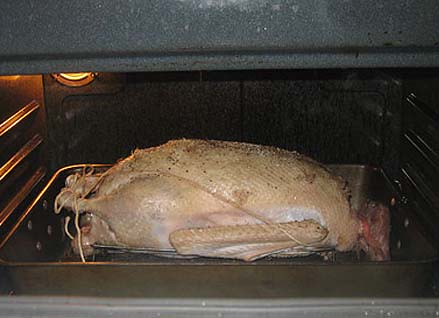
Because the suckling pig feast was a success, I put my name down for the Christmas goose. Cameron named her Shazia, after another NY1 reporter who does the Zagat reviews on TV. It wasn’t difficult to carry her home like Rog; I just put her in my tote bag, dragged it to work and made the trip uptown. I picked up Shazia last week after Mike from Tamarack Hollow Farm hand-plucked the feathers for about two hours. I thought you could just submerge any bird in hot water and the feathers will easily come off like for chickens, but I learned that because geese are water fowls, they have oily feathers. Soaking them in water would only repel their natural oil–you really have to hand-pluck them.
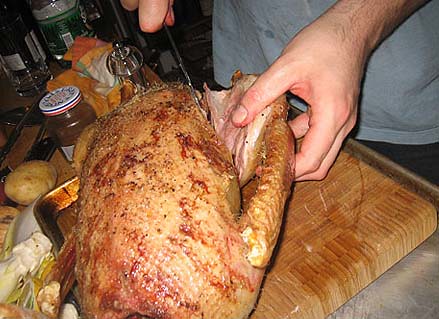
We didn’t do anything special for Shazia. We only let her thaw in the fridge for a couple of days and just went to Chef Weld’s Brooklyn apartment for our holiday dinner. I saw him tie it up and rub it with some spices and next thing I know, it was in the oven. I saw him remove the goose fat and later used some of it for gravy with the liver. It was a huge bird, about 11 pounds, and I was a bit curious at how long it was, instead of, say, round like a turkey.
We spent a couple of hours hanging out and eating sausages, prosciutto and cheese while the bird stayed in the oven. There was sparkling wine and a few bottles of red. I was so glad to finally open a bottle I’ve been saving–a 2004 Châteauneuf du Pape. Sharing it with good company and good food made it even tastier.
Christmas goose to me is very Charles Dickens. In Manila, we always had ham for noche buena or crispy pata (pig’s thigh) with the other traditional Filipino dishes, but I suppose the Victorian way was to always included game meats because they were expensive back in the days. My goose cost a lot of money but I bet we had a better time than the Cratchits.
132 Crosby Street between Houston and Prince Streets
212/965.1777
$7 for rice with two choices, with chai, without tip
♥ ♥
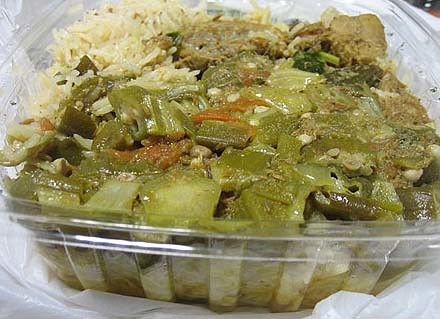
This hole-in-the-wall is only one of the stops a New York City cab driver makes during his daily route. For $7, the guy behind the Lahore counter will give you rice with your two choices of curry. When I have a craving, I order the lamb or the goat with the alo saag, a spinach and potato mush spiced with fragrant cardamom, cinnamon and fennel. Or else I go for the chicken with the okra stew or the chickpea dal and pay extra for a small container of yogurt.
They also sell sandwiches which are easier to eat especially if you’re on the go, as well as samosas and traditional Pakistani pastries. There are a couple of stools if you prefer to stay in and eat but don’t say I didn’t warn you when your clothes end up smelling like the aromatic kitchen. Whatever I order, I don’t skip on the hot chai to push down all the heavy goodness I call lunch.
139 Duane Street between Church and West Broadway
212/571.8880
$80 each for ten, with a lot of drinks, with tip
♥ ♥ ♥
Updated, December 2008: The Dr. and I returned for Christmas dinner and it was still the same hearty and filling food for half the New York City price.
The restaurant is meant to be casual, where guests can just sit, talk, eat and drink wine. We did exactly just that while the faint music played in the background mixed with a good buzz of conversation and laughter. I wasn’t able to take good photos because I was inebriated (and because I also need a new camera) but that just gives me another reason to make a return trip and enjoy the food again. For now though, happy birthday, me.
I stopped by the Dr.’s apartment the other night looking for something to eat and discovered a big pot of chicken stew on the stove. For the past few years, I’ve seen him cook big pots of anything-stew because of his schedule. He’ll have time to pick up groceries but not enough to cook, so they end up sitting in the fridge. The next time he gets a break, he throws them in a pot before they spoil, cook and eat it as a stew for a couple of days–it’s the recipe that keeps on giving. He didn’t have cooked rice so he quickly boiled some water and cooked pasta to match. I ate two bowls’ worth and basically finished what was supposed to be his packed lunch the next day.
Over the weekend, I found some leftover herbs in the fridge from my last trip to the grocery store so I thought I’d make my own. I picked up a couple of boxes of golden raisins to make the stew sweet and used up the chicken legs and breasts I’ve been meaning to cook since last week. Campagne means “countryside” in French and I use it for this chicken stew recipe because it is so simple to make, yet rustic and hearty to eat. It’s so easy “your country-ass can make it,” as Anthony Bourdain would say. Serve it with the leftover white wine you used to cook and pour over rice, pasta or bread. Save some to share with your own Dr.
Ingredients:
6 chicken pieces, excess fat and skin removed
6 slices of bacon, cut in small pieces
2 cups dry white wine
1 large plum tomato, chopped
1 bunch of baby carrots, peeled and cut in small pieces
1 red bell pepper, julienned
1 yellow bell pepper, julienned
1 orange bell pepper, julienned
2 small boxes of golden raisins
1 red onion, sliced thinly
2 garlic cloves, minced
thyme sprigs
rosemary sprigs
red pepper flakes
salt
21 Saint Marks Place between 2nd and 3rd Avenues
212/529.4805
$25 each for three, with three beers, with tip
♥ ♥ ♥
The Chipotle opened along St. Marks opened first and then the vending-machine store BAM! made headlines. When I saw the Grand Sichuan open, I only thought, Great, I don’t have to go to Chelsea for Sichuan Chinese food. The neighborhood is truly changing and now tattoo and piercing parlors co-exist with restaurants catering to both college students and punk kids. I wasn’t about to pass by the area without trying some spicy Chinese food. Because I am used to the Grand Sichuan menu, I also ordered the same dishes from the St. Marks branch.
The St. Marks is sparkling new and it’s definitely less of a zoo than the Chelsea branch so if you’re craving Chinese food and don’t want to keep walking downtown, Grand Sichuan is the way to go.
Dashi is fundamental to Japanese cooking. Kelp and bonito are boiled down to make the dashi broth that’s most popularly known as the base for miso soup. With soy sauce, or soyu, and rice wine vinegar, or mirin, you can make the simplest yet most satisfying Japanese soup perfect for a last course after a heavy meal.
Ingredients:
green-tea noodles, half of the 7-ounce packet
1 quart vegetable stock
2 tsps dashi granules
1 tbsp rice wine vinegar
1 tbsp soy sauce
firm tofu, drained, sliced into squares
1 small sheet of dried seaweed, torn
2 tbsps sesame seeds, toasted
1. Cook the noodles in a large saucepan of boiling water for 5 minutes. Drain and rinse in cold water.
2. Combine the dashi granules with the stock in another large pot. Stir over medium heat until the granules are dissolved. Bring to a boil and stir in mirin and soy sauce.
3. Divide the noodles and tofu cubes in serving bowls. Ladle hot soup and garnish with nori and sesame seeds.
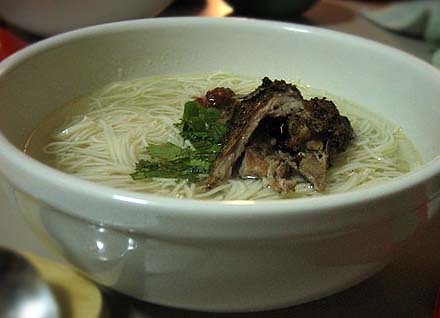
The Chinese use five-spice powder to create a blend of different flavors: sweet, sour, bitter, pungent and salty. You can easily buy them from any grocery store with a well-stocked spice aisle but I prefer to make my own. With one star anise, I used the heart of my palm to measure the other four ingredients and grind them using a mortar and pestle. If you have a Filipino dad, he should be able to grind them for you. You can make a salad from your leftovers by adding some sugar snap peas and chopped red bell peppers. Just whisk together some fish sauce and lime juice in a small bowl and pour over the noodles for dressing.
Ingredients:
2 duck legs, excess fat trimmed but skin left on
2 small bundles of somen noodles
4 cups chicken broth
1 star anise
scallions, finely chopped
cilantro, finely chopped
peanut oil
1 tbsp red chili sauce
For the five-spice powder:
1 star anise
1/2-inch cinnamon stick
fennel seeds
whole cloves
black peppercorns
1. Preheat the oven to 400º. In the meantime, lightly coat the duck legs with the five-spice powder and set aside. Heat some oil in a frying pan and brown the duck legs, skin-side down first, about 5 minutes each side. Transfer to a baking dish and cook for about 25 minutes. Remove from the oven and let them rest on the chopping board.
2. In a small pot, boil some water and cook the somen noodles for 2 minutes. Drain and rinse with cold water while separating noodles with a fork to avoid sticking.
3. In another small pot, let the chicken broth boil with the other star anise. Then simmer for a few minutes with the scallions and cilantro.
4. To serve, divide noodles and ladle broth in bowls and top with sliced duck meat.