• Corner of Wooster and Prince
    no phone number
    about $12 for two, without drinks, without tip
    ♥

    Updated, 2006: They do have a phone number! 917/674.1869 and of course, “Cal” is from California

    I assume Calexico is currently enjoying their Vendy Award status as a finalist because I had to try twice before I finally got the chance to buy lunch from their spot on Wooster and Prince. When we finally found the cart, we ordered their tacos for $3 each: the much-loved carne asada, the pork and the pollo asado. For an extra $2, you can get two tacos of your choice with rice and beans.

    They’re set up in front of the Camper store. Expect a wait during lunch time but they move quickly and take your order right when you walk up and stand in line. They called our names with our tacos in less than ten minutes.
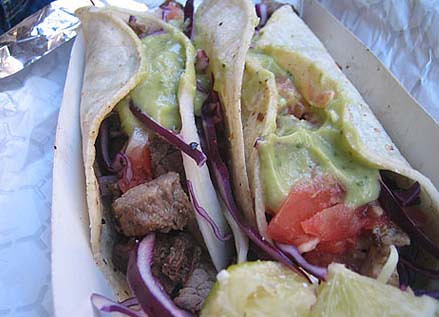
    I think I’m just being a snob because I’ve eaten so many tacos this year alone, but Calexico definitely does not sell the best one in the city. The carne asada is pretty good and the pork is okay, but I’ve definitely had better. The guacamole was runny so it made us wonder if it is homemade or from a jar. I’m not quite sure if it’s a Tex-Mex thing to only have one tortilla instead of two but it was very messy to eat my tacos. We ended up sitting on the stoop a block away and our tacos fell apart at every bite. It’s $2 cheaper than La Esquina but if I have to pick between the two, my vote goes to the one with a phone number.

    Related post/s:
    Vendy Awards
    La Esquina has chairs
    Searching for a Good Taco Food Project

  • I schlepped in the pouring rain to stop by the farmers market and order my turkey for Thanksgiving. After I put my name down for an 11-pound bird, I noticed the Blue Moon Fish tent. There were a few people standing in front waiting to be helped so I squeezed my way in to see what the commotion was all about. They were giving away fish heads and bones for stock. I waited for my turn and got my own but I also ended up buying a $6 whole sea bass. Blue Moon hails from Mattituck, New York and they specialize in wild-caught fish. But I didn’t even stay long enough to ask what kind of sea bass it was. The Dr. said it would be a black sea bass because that’s the type most often caught in the east coast.

    I could only think of roasting it so I also bought a couple of fennel bulbs and bunches of herbs before I walked to the subway to go straight to work. I was juggling to hold my umbrella, my purse and the goods in my half-wet tote bag. At dinner time, I opened a bottle of Chardonnay from Lamoreaux and roasted the fish I stuffed with lemon, onions garlic and rosemary. While it was cooking, I made a bowl of salad. The Dr. stopped by after a long day in the hospital. He confirmed it was indeed a black sea bass and also gave me a nod for a wonderful rainy night meal.

    Ingredients:
    1 whole black sea bass, scaled and cleaned with head and tail intact
    1/2 red onion, sliced into thin rings
    1/2 lemon, cut into thin rounds
    a few sprigs of fresh rosemary
    2 cloves garlic, thinly sliced
    salt, pepper, olive oil

    For the fennel tomato salsa:
    1 fennel bulb, chopped
    3 medium tomatoes, diced and seeded
    1 red bell pepper, julienned
    1 yellow bell pepper, julienned
    1 red onion, roughly chopped
    a handful basil leaves, torn
    a handful mint leaves, torn
    red wine vinegar
    salt, pepper, olive oil

    1. Prepare the salsa. In a small heated skillet, let the fennel sweat to soften them. Toss for a couple of minutes and let cool. Combine all of the ingredients in a large bowl and toss to mix well. Let sit at room temperature for 30 minutes before serving.
    2. Preheat oven to 400º. Rinse the fish under cold running water to make sure the cavity is clean of any entrails and pat dry with a paper towel. Stuff the cavity with the onion rings, lemon rounds, garlic and some of the rosemary sprigs. Put some in the head as well. Make small slits on the body to insert more garlic.
    3. Place the fish on a bed of rosemary branches set in a large roasting pan. Rub the fish with the olive oil and sprinkle with salt and pepper. Roast the fish until completely cooked through, about 40 minutes. Transfer the fish to a large platter and serve with the salsa.

    Related post/s:
    Fresh fish from Blue Moon

  • 64 Charles Street on West 4th
    646/486.2185
    about $200 for four, with two bottles of wine, without tip
    ♥ ♥ ♥

    For a restaurant that wasn’t selected by me–I met friends from out of town there–I was really surprised at how good our meals were at Mary’s Fish Camp. I’ve been to Pearl Oyster Bar before and although pretty good, I remember not being too happy with my sandy razor clams. (The owner of Mary’s was a partner at Pearl’s before she left to open her own.) I was running late so it took a while for us to be seated because a party has to be complete before they let you in. (It makes sense unless, of course, you’re the one your party is waiting for.) We were famished when our turn came, but oh, the surprises!

    The lobster pot pie was so delicate. Its puff pastry was so light with a ramekin filled with about two claws and some fortifying vegetable chunks. Grilled fish usually bores me but the whole branzino was stuffed with rosemary and other herbs for flavor. A squirt of lemon juice brought out its smokey flavor and we ravaged it until all we had were bones. You can usually find skate in New York City menus because it’s so cheap but at Mary’s Fish Camp, it’s breaded and crunchy on the outside. It’s much more exciting than Jean Claude’s French version in SoHo. The cockles were also good, served with beans and thyme. We also ordered half a dozen of the oysters and although they were smaller than expected, I couldn’t really complain. I love oysters so all you have to do is serve them fresh and we’ll get along. The roasted beets with fennel and aged goat cheese salad was excellent. We left this for last as a palate cleanser and it was a nice break before dessert. We couldn’t help but order the banana pudding with vanilla wafers. I don’t think I’ve tasted a better banana pudding than theirs–balanced, not too sweet. A bottle of the white Burgundy and a bottle of Reisling completed our meal and we walked away from the West Village satisfied.

    Mary’s Fish Camp is famous for their lobster roll so it was very pleasing to know that the other items on the menu stand out, too.

  • I lived in Washington Heights for more than ten years and I spent my formative high school years uptown, but like most New Yorkers, I never really made it past my comfort zone even though that already meant way above 14th Street for me. “Hiking” down from 207th to 97th Street was a new experience for both Cameron and me. After a big lunch at home, we took the A train to the last stop in Manhattan and walked towards Dyckman Park where it looked more like New England than New York City.

    It was an absolutely glorious day with the sun up and shining. The trees still had their leaves on and the light breeze was enough to cool us down. Through the park, we made it along the Hudson River where there was a walking path right next to the Amtrak rail. A short fence kept us away from it, but it was still exhilarating whenever a train would zoom by. For the next hour or so, we kept walking until we reached a dead end. We had no choice but to cut through thorny bushes and walk on the rocks right next to the river. We probably did something illegal, but the old mattresses we saw tucked under the rocks led us to think other people have gone that way, too.

    Twenty-eight blocks later and still no dead bodies to be found, we saw our reward: the 75-year old George Washington Bridge. At the bottom of the bridge, a more legitimate-looking pathway emerged from Fort Tryon Park. We walked towards the picnic area where we saw our second reward: the little red lighthouse, the only one in Manhattan.

    It was pretty cool to see it even though I haven’t read the Hildegard H. Swift book because I’ve had a fascination with lighthouses ever since the Dr. and I drove all over the coast of Maine to visit each one marked on our map. The little red lighthouse under the great gray bridge was actually used by mariners passing through the Hudson until it was deactivated in 1947. They were going to dismantle and auction it off, but a lot of people who loved the book convinced the powers that be to keep it as a reminder of an area once called Jeffrey’s Hook. In the book, the little red lighthouse is happy and content until a bridge is built over it. But in the end, the lighthouse learns that it still has an important job to do and that there is still a place in the world for an old lighthouse.

    We continued walking until the sun started to set, past the huge sanitation building and the Fairway on 135th Street. Even New Jersey looked pretty harmless from our side of the river. It got dark right away and we made it to 97th Street just in time for red wine, sausages and cheeses at the Vintage Wine Bar on 93rd Street.

    Related post/s:
    Sitting at the Vintage Wine Bar after our first urban hike

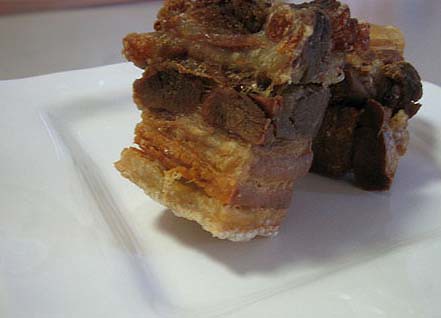
  • My brother loves to cook. In fact, together with a friend, he cooks for small private events in Manila. He’d like for his business to be a bigger catering service in the future but I think he likes the fact that he’s paying attention to every detail in smaller portions than, say, a batch for more than a hundred guests. Of course, he has my mother’s full support. She hires him to cater her parties whenever she is in Manila entertaining. Lechon kawali, or deep-fried pork belly, is one of the best Filipino staples. We like our pork and we like it even better deep-fried in hot, hot oil. The last time my brother visited New York, he made this and I swooned (and then I think I got a heart attack because of clogged arteries from all the fat) so I just had to call him to ask for the recipe when I had the craving.

    Letting the pork belly air dry after boiling and freezing it before frying are important. After boiling it until it was soft, I left the house at lunch and did not return until 10pm. I put them in the freezer and did not fry them until the next day. So it takes some time but I can guarantee you that all the trouble is worth it.

    Ingredients:
    pork belly
    salt, pepper, oil

    1. Sprinkle the pork belly with salt and pepper and let it sit in the fridge for a few hours up to a day then boil in water until soft using a big pot with a heavy lid on low to medium fire. This should take about two hours.
    2. Transfer to a colander in a large bowl to drain excess water and let it sit in room temperature to air dry.
    3. When the pork belly is dry, cut it in four large chunks. Set them on a plate, separated, and store in freezer until the next day.
    4. When ready to cook, heat a lot of oil in a heavy-duty pot, low to medium fire. In the meantime, take the pork belly out of the freezer. You will fry them frozen. There should be enough oil to deep-fry the pork belly chunks. Dip one chunk in the oil using a pair of tongs to test if the oil is hot enough. You’ll just know. Set them gently in the oil and fry until golden brown, uncovered. Serve while hot and crunchy with crushed garlic in soy sauce and vinegar on the side.

    Related post/s:
    Buy affordable pork belly from Chinatown
    Or else get grass-fed pork from the farmers’ market

  • Our best dining experience in Barcelona? Hands-down, it was at Cal Pep. I read about Chef Pep and how he still cooks at the bar and entertains guests with his cigarette-smoke voice as if he’s known them for years, but no one seemed to know where Plaza de les Olles was until a local overheard us ask a boqueria waiter for directions. The waiter didn’t know either so the local took a napkin and sketched out a street map for us. He was curious as to how we heard about Cal Pep because he told us it’s one of Barcelona’s foodie secrets. (Maybe that’s why no one wanted to tell us where it was!) This got us even more excited and a 40-minute waiting time spent standing behind the bar stools (with champagne, natch) didn’t seem to be an inconvenience.

    When we were finally seated, we noticed that the printed placemats matched the art hanging on the walls. They are sketches from different artists and they randomly give a different one to each customer. The more you make a mess, the more you get it replaced. So we sat at the bar elbow-to-elbow with everyone else–there is a dining room in the back but the action happens at the counter–and let one of the bartenders serve whatever he wanted us to eat (omakase, Catalan style!) while we started with the traditional toast rubbed with grilled tomato and garlic. The next three hours were pretty much heavenly. Everything was made with passion and you could watch the chefs toss, sauté, grill and fry different ingredients with gusto.

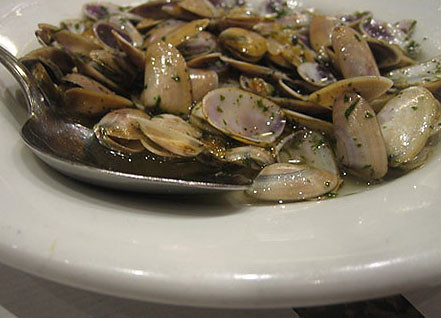
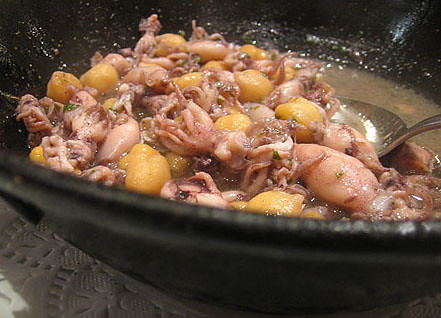
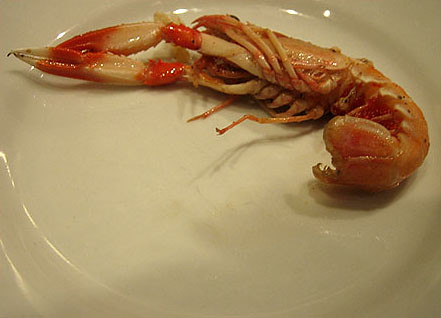
    Almejas, or clams, were quickly fried in olive oil and parsley. They were so fresh, you really didn’t need much with them. The purple taint inside was so nice to look at, too. The chipirones, or baby squid, were the size of my thumb and cooked with garbanzos. This dish changed my distaste for chickpeas. The langoustines came next and we spent so much time peeling, eating the meat and sucking the juice out of their heads. They were a lot of work but every minute was worth it because the Dr. was so pleased. A German father and son next to us saw how well we ate, the father put some of his roasted pimento peppers on our plates to try. We ended up swapping stories throughout our meal.

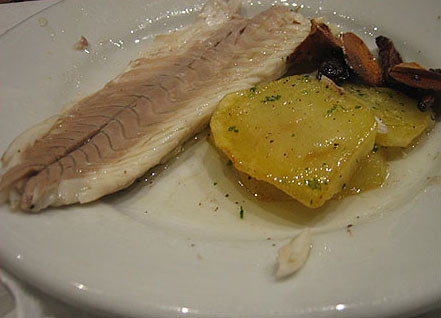
    We could have ended our night there but we really wanted to taste the way Cal Pep cooks fish. It was almost 1am and they’ve ran out of monkfish so they served us seabass instead. The bartender showed us a fresh piece of fish and asked for our approval before cooking it. Before serving it to us, he filleted it for us.

    And it was at Cal Pep where we ended our vacation in Barcelona. We were full, drunk and happy as we stumbled back to our room in Hostal Goya room. After seven days of rigorous hiking, Barcelona meant to be our reward. It was just that.

    Related post/s:
    Where to eat in Barcelona: Tapelia + Xador
    Where to eat in Barcelona: Boqueria

  • During our hike in the Pyrenees, we met a French family who has lived in Barcelona for the last ten years. They recommended Tapelia for their more-adventurous tapas and paellas. We tried the pig’s ears which were crunchy and addictively chewy. We had wine with it but it would have been more perfect with a nice pint of beer. The octopus with mushrooms and potatoes was tender and delicious. The squid was as good, if not better. And I could have eaten the anchovies with aubergines the entire night.

    We went on a Saturday night at 10:30pm which is prime dinner time in Barcelona, but Tapelia was still under-staffed. It took a while to get the menu, have our orders taken and get our final check, but it also made for a quiet first night in Barcelona.

    We also couldn’t skip the paellas while in Spain. There were several fast-food type of places serving them around the city but we ended up at Xador in the El Born neighborhood. While also hiking the Pyrenees, we met a young German couple we ended up following during one of the routes to avoid getting lost. Funnily enough, we crossed paths again on the bus back to Barcelona so we got together one night to hang out and have dinner. Between the four of us, we ordered the langoustine and the squid-ink paella. They were just okay because to me, paella is like risotto–it’s harder and harder to find people who can make it from scratch without it being soupy and mushy.

    Related post/s:
    Where to eat in Barcelona: Santa Caterina Market + Costa Gallega
    Where to eat in Barcelona: Boqueria

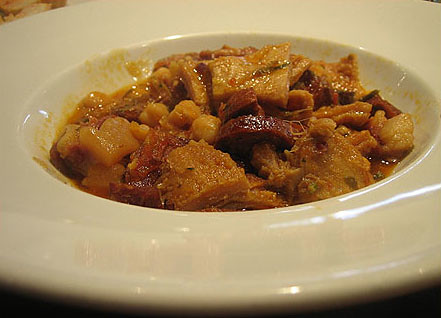
  • The Santa Caterina Market is the new boqueria. There’s more space in between the stalls. It’s more airy and better lit. The stores take credit cards and can deliver your orders. There’s even wireless Internet connection. Of course, it’s known for its Enric Miralles and Benedetta Tagliabue (EMBT)-designed flying carpet roof than anything else, but its location is so central it’s hard not to do your shopping in there, too. One day before we started our walk, we had breakfast at one of the food stalls and ordered the stewed tripe. Someday, I’ll be making tripe like this, too.

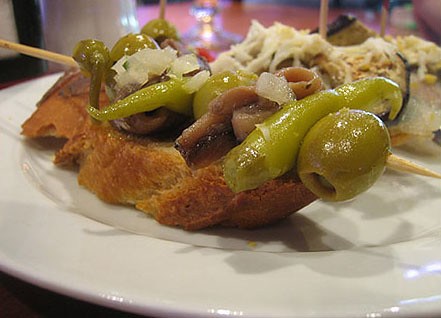
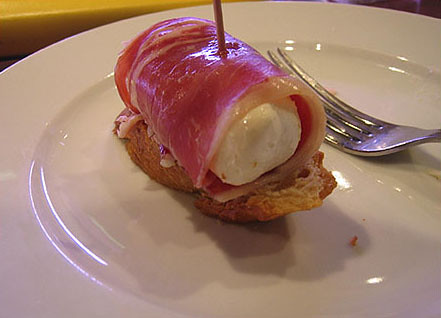
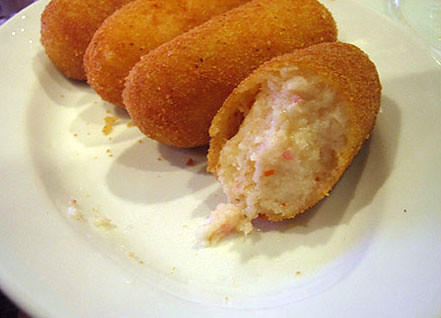
    We didn’t always go to the boqueria for lunch. After a long day of sight-seeing, we stopped by Costa Gallega on Passeig de Gràcia. They have several branches in the city and is definitely a tourist magnet, but we had some nice tapas there which kept us going until dinnertime. Under the hanging hams, we sat at the bar and pointed to several things in front of us: anchovies with peppers and olives, ham-wrapped mozzarella balls and croquettas, a truly European treat.

    Related post/s:
    Where to eat in Barcelona: Boqueria
    Where to eat in Barcelona: Cal Pep

  • More tapas places are opening up in New York City, but Barcelona just has the culture down. Where else but in Spain can you eat a decent bowl of stewed tripe for breakfast? Where else will you be spared a quizzical look when you order razor clams for a snack? And toasted bread rubbed with a grilled tomato and garlic? Thank goodness for those Galicians. Red wine with every meal whether it’s 9am or 4pm? Bless their hearts.

    At the buzzing boqueria, or the central market, produce sellers co-exist with hungry shoppers and camera-happy tourists. Walk around and you can buy the freshest fruits and vegetables. Fish, clams and lobsters are around the corner. The store across the way has all kinds of meat and dried sausages. Stand behind those eating to make sure you get the next empty seat because we ate some of our best meals there.

    When we first arrived in Barcelona, we had a few hours to kill before we had to catch the 6-hour bus ride to Vielha, the nearest town to where we were supposed to begin our hike up the Pyrenees. Our first meal of the day was at El Quim.

    Everything they have to offer was written on the chalkboards. Specials are updated daily and we learned to ask for the price before ordering because a plate of mushrooms drizzled with balsamic vinegar cost us €16. We later saw the fresh mushrooms being sold in one of the vegetable stalls and they were really going for at least €8 for half a pound. The sausage was fried and when I took a bite, its crunchy skin snapped and I was rewarded with that kind of heavenly taste only sausages and bacon can give a human being.

    We returned to the boqueria two more times. While still in New York City, we ended up talking to a bartender who is also an expat. He recommended Pinotxo, or Pinocchio, so we couldn’t fly back without trying. It’s always packed because it’s the first eatery you will see when you walk in the market and for several other reasons: white anchovies in good olive oil sprinkled with paprika, stewed garbanzos in fatty goodness, beef with white beans and flan for dessert. The service is brisk but they’re so used to tourists that they’re very accommodating towards those who have no qualms about eating whatever they have to offer and to those who make a face when they suggest something.

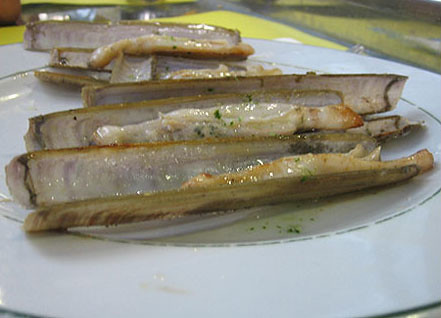
    At Kiosk Universal, we were finally able to get our fill of razor clams. I’ve never been a big fan because no matter how much you clean the diggers, they will always be sandy. They were still good, though, and any excuse to have more good olive oil and bread is acceptable to me.

    Related post/s:
    Where to eat in Barcelona: Cal Pep
    Where to eat in Barcelona: Santa Caterina Market + Costa Gallega

  • 52 Irving Place corner of 17th Street
    212/253.2773
    $120 for two, with two drinks, with tip
    ♥ ♥

    Mario Batali took a lit bit of convincing to let Chef Andy Nusser open up a Spanish tapas bar under his name, but as told in Heat, a tasting knocked their socks off. Two years after they first opened, the place is still packed and the wait to sit at the bar is still long. We went out one cold night after I wrote about Barcelona with plans on eating at Bar Jamon but I’ve been there so many times that I just wanted to see how its sister restaurant compared. Without reservations, the wait for the bar was an hour. We put our names down anyway and waited in the pub down the street. One Guiness later, the maitre d’ called to seat us. We put our coats back on and ran back to the restaurant where he gave us two choices: a table that we will need to give up after an hour and a half for another couple who actually had reservations, or at the bar where we can watch the chefs cook. Which do you think we chose?

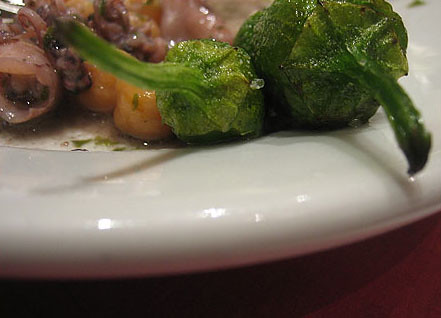
    We split four plates and a dessert with our small carafes of red wine. We saw that the Cal Pep of Barcelona had its influence here with their deep-fried green peppers and chipirones, or baby squid, with garbanzos, or chick peas. The giant duck egg is also a mainstay but we skipped those dishes because we wanted to try something with Casa Mono’s own signature on it.

    The cockles, or small clams, were cooked with sloppy scrambled eggs topped with scallions. It was a good combination but we could barely taste the clams. The sweetbreads were toasty on the outside and soft in the inside and the roasted fennel was a nice touch. I would like to think I’m difficult to impress and only good chefs would think of bringing two things like them together.
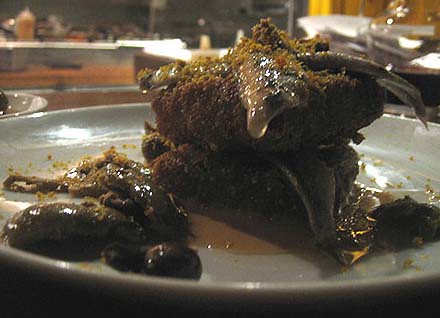
    Speaking of another great combination, the pig trotters were made into breaded square patties sandwiched with white anchovies. The vinegary taste of the small fish provided a great balance to the overwhelmingly gelatinous and sticky quality of the pig’s feet. It’s definitely not for everybody but I loved it. (And if your dining companion ends up liking it, too, I suggest that you keep him.)

    I had to admit that I only ordered the cock’s combs because I was tickled to say it. (What, the cockles weren’t enough?) Because they were cooked in a porcini reduction, they tasted like mushrooms even though they had the consistency of soft tofu. They looked like black slugs on our plates but the earthy taste was very addicting. Two scoops of plum ice cream with candied orange rinds and crunchy orange-flavored nuts were the perfect ending to these flavorful, sometimes oversalted, dishes.

    Go to Bar Jamon if you want to have simpler tapas like cured meats, but Casa Mono is worth a try if you want to experience the Batali influence in Catalan cooking.

    Related post/s:
    Buy Heat from Amazon.com
    Bar Jamon is right next door
    Tapas in Chelsea

  • 106 Kenmare Street between Lafayette and Cleveland Place
    646/613.7100
    about $18 for one, with one drink, without tip

    I celebrated my 2005 birthday in the basement of La Esquina. My guests and I had to walk through the door marked with an Employees Only sticker, down the stairs and past the kitchen to get to the dungeon-like setting of the restaurant. I had to reserve a table for thirteen pretty quickly with my credit card because the word had just gotten out about this “secret place.” I ended up throwing my party a day after Vogue Magazine did theirs.

    Nowadays, I usually end up in their corner spot, called The Corner, for a quick taco or grilled corn on the cob. Whether it’s hot out or not, The Corner always has pretty people standing outside. But the cafe around the block is a much better place for a sit-down meal. The nopales, or cactus, salad is refreshing with tomato salsa and parmesan shavings. I also like their fish tacos. A chunk of grilled fish comes in a skewer on a bed of lettuce, tomato, onions and radishes with green salsa wrapped in warm tortilla.

    My only gripe is that their tacos cost $8 for two. I’d eat more often here if I didn’t have to contribute to their rent, but alas, feeling like you’re a part of the cool crowd of New York City comes at a high price. For a more down-to-earth Mexican experience, check out my Searching for a Good Taco food project, but if you want to be seen and heard, La Esquina is still one of those places.

    Related post/s:
    Searching for a Good Taco Food Project
    Standing room only at Calexico

  • Right outside our Chinatown office, a line forms late in the afternoon in front of a Chinese man’s supermarket cart loaded with a huge pail of black liquid. I took a peek once and realized that hard-boiled eggs were floating in it. I’ve heard of tea eggs before but I’ve never had them, so the last time I walked by the cart, I bought six tea eggs for a dollar.

    My Chinese friend Shao told me she grew up eating them whenever her parents would make them at home. I’ve read that they are traditionally a Chinese New Year snack, but nowadays people line up for them whenever they feel like eating eggs.

    Back at home, I took the eggs out of the plastic bag, put them in a bowl and disposed the liquid. I noticed that the shells were a little bit cracked. When I took the shells off, the cracked shell made a pretty pattern on the egg. I did some research and found out that the marinade has soy sauce, star anise and cinnamon sticks together with the brewed black tea. The hard-boiled eggs are tapped gently in order for the shells to crack a little bit and then simmered in the marinade for an hour or two so that the black color stains the shell and the cooked egg inside, leaving that ornate pattern.

    Eating hard-boiled eggs past noon might be weird to some people, but I had one while I was making dinner and I thought it was a lovely treat to keep the hunger pangs from gnawing.